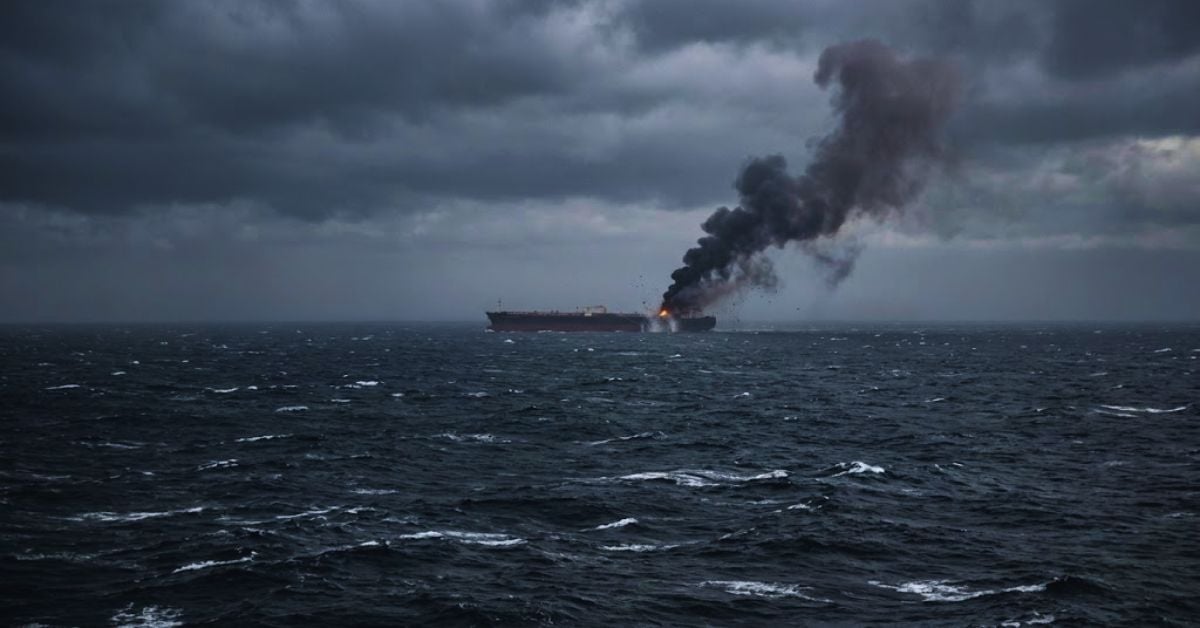
The latest attack on the M/T AL Dasma in the Strait of Hormuz is not an isolated incident, but a clear signal that the rules-based order governing international waterways is fraying under geopolitical pressure. For the 21 Indian seafarers evacuated from the burning tanker, the immediate danger has passed, but the deeper threat to global maritime stability remains unresolved. This is a practical problem for the entire ocean intelligence community: when commercial shipping becomes a target, the data we rely on for climate monitoring, trade flow analysis, and environmental risk assessment becomes compromised by disruption and rerouting.
The attack, occurring just 11 nautical miles west of Bukha, follows a troubling pattern that our publication has documented closely. Just weeks earlier, the MT On Peace, MT Petro Dolphin, and MT Valthera were all targeted in the same corridor, as reported in our coverage of the Diplomatic Talks Test Conditions for Reopening the Strait of Hormuz. More recently, the crude oil tanker MT ST3 was hit on October 16, also carrying Indian crew. The sequence is no longer a series of anomalies; it is a measurable escalation. When the Indian Ministry of External Affairs condemns these attacks and calls for de-escalation to uphold freedom of navigation, it is not merely a diplomatic posture but a recognition that the integrated data ecosystem of global shipping, from AIS tracking to port logistics, is under direct pressure.
Iran's stern warning to shipping operators against using unauthorised routes or accepting US assistance, coupled with the continued US blockade on Iranian ports, creates a dangerous dual-command situation for any vessel transiting the Strait. The AL Dasma, now stationary and requiring inspection before it can be seaworthy, represents a tangible cost: a ship out of service, cargo delayed, and crew displaced. The two million barrels of crude oil released as a supertanker struck a naval mine in Hormuz earlier this year demonstrated the environmental and economic consequences of a single maritime incident. While the AL Dasma's fire was contained, the risk of a similar spill remains a real, empirical concern that demands calibrated monitoring.
What this means for our readers, researchers, policymakers, and seafarers alike, is that the Strait of Hormuz has become a live laboratory for testing the limits of maritime security protocols. The open question is not whether another attack will occur, but whether the international community will treat this as a systemic failure requiring integrated, peer-reviewed solutions for vessel protection and crew safety. The specific detail to watch is whether the AL Dasma's inspection reveals structural damage that forces a prolonged docking, further constraining tanker availability in a region already under strain. That outcome will provide a quantifiable data point on how geopolitical friction translates into operational risk for every vessel that crosses these waters.