climate change
climate change at World Data Ocean is a file of 105 stories. The newest of them: “The ICJ anchors ocean law into the climate governance framework”, “Aligning Blue Finance Governance for China-ASEAN Ocean Climate Action”, and “Calibrating port resilience against measurable cyclone-driven economic loss”. The ICJ has anchored ocean law directly into the climate governance framework, treating the law of the sea as part of the most relevant applicable law in its advisory opinion on climate change. Blue finance must be understood as a governance mechanism, not merely a funding stream. A Global Hub for Ocean Intelligence 4 World Data Ocean is a centralized digital platform where researchers, scientists, and ocean enthusiasts converge to… The list below is every climate change story on World Data Ocean, newest first.

The ICJ anchors ocean law into the climate governance framework
The ICJ has anchored ocean law directly into the climate governance framework, treating the law of the sea as part of the most relevant applicable law in its advisory opinion on climate change. This strengthens international climate law coherence and may spur substantive action. Yet the opinion's insufficient justification for selecting UNCLOS, contested systemic integration, and evolutionary interpretation risk blurring state responsibility. SIDS and judicial bodies must now reconsider the future integration of these regimes.
Aligning Blue Finance Governance for China-ASEAN Ocean Climate Action
Blue finance must be understood as a governance mechanism, not merely a funding stream. This study builds a multi-agent framework to address the primary constraint on China-ASEAN cooperation: the lack of operational coordination among taxonomies, data systems, and verification protocols. Capital is not the bottleneck. Governance is. For deeper context on measurable ocean intelligence, see our related coverage on calibrating port resilience against cyclone-driven economic loss.
Calibrating port resilience against measurable cyclone-driven economic loss
Shanghai Port emerges as the most vulnerable among five key Chinese ports when resilience is calibrated against measurable cyclone-driven economic loss. This is no surprise for a mega-hub whose efficiency and network importance may mask fragility. The study's integrated index, built from expert surveys, AHP, and TOPSIS, reveals that high importance does not guarantee lower losses. Cargo-handling fees bear the heaviest seasonal damage. Better berth planning and staff training offer clear, empirical paths to protection. Understanding drives protection.
Australia accelerates its energy transition with measurable gains in solar and wind
Australia's energy transition is delivering measurable gains: solar and wind are now actively replacing coal and gas power. This is not a distant promise but a validated, real-time shift. Empirical data confirms the momentum is real. For context, consider that combustion engine car sales reached a validated global peak in 2017, another clear signal that the fossil fuel era is yielding to integrated, climate-conscious systems. Understanding drives protection.

Redwoods' photosynthesis slows under heat, imperiling a key carbon sink
Under heat-wave conditions, coast redwoods slow their photosynthesis, a measurable response that puts one of Earth's most efficient carbon sinks at risk. This is empirical evidence that even iconic, resilient ecosystems face limits. Validated longitudinal data is essential here, not alarm. For a broader view of cumulative climate pressures, see our coverage of coastal benthic ecosystems. Understanding these integrated signals drives protection.
Coastal benthic ecosystems reveal the cumulative toll of climate and human pressures
Coastal benthic ecosystems are telling us something urgent. Rising temperatures, acidification, and deoxygenation now converge with eutrophication, pollution, and bottom trawling, reshaping biodiversity from shallow coasts to continental margins. These compounded stressors simplify assemblages, alter trophic pathways, and push ecosystems toward critical thresholds. Yet recent advances, environmental DNA metabarcoding, automated imaging, multi-stressor experiments, are sharpening our ability to detect and understand these changes at scale.
Tracking the nations with the largest share of historical CO₂ emissions
A small number of nations account for the vast majority of historical CO₂ emissions. The United States leads, followed by the broader European Union and China, yet cumulative responsibility looks very different from annual rankings. This distinction matters for climate equity. Understanding these validated, empirical differences in contribution is essential for calibrating global action. For a complementary perspective on how economic pressures reshape regions, see our related piece on uneven house price surges across EU member states.
Simulate coral bleaching in real time with a free NOAA-powered 3D reef
A single summer heatwave can transform a vibrant reef into a graveyard. One builder, moved by witnessing bleached coral on the Great Barrier Reef in 2019, created a free 3D simulation where you set the temperature and watch each coral species bleach, recover, or die according to its own validated heat tolerance. This is empirical, interactive ocean intelligence. For another look at citizen science in action, see our piece on a browser game that turns seahorse identification into a research tool.

Measured sea level rise validated across decades of ocean data
Measured sea level rise, validated across decades of ocean data, tells a clear story. Seasonal estimates from Church and White (2011) align with the University of Hawaii's Fast Delivery data, both showing change in millimeters against the 1993-2008 average. This is empirical, peer-reviewed evidence of a measurable climate signal. For deeper context, our coverage of 2025 Temperature Anomalies reveals how these climate indicators connect. Understanding drives protection.
Acidification Alters Phytoplankton Chemistry, Shifting Ocean Carbon Cycles
Rising ocean acidity is quietly rewriting the rules of phytoplankton chemistry, with measurable shifts in cellular composition that ripple through global carbon cycles. This isn't a distant forecast, it is empirical change, now documented in peer-reviewed findings. Understanding these biological recalibrations is essential for calibrating climate models. For a deeper look at how Earth's systems respond to change, see our coverage of "A vanished billion-year cliff may explain a gap in Earth's geologic record."

Seismic data reveals warming oceans are intensifying global wave energy
Seismic data is giving us a measurable, real-time look at how warming oceans are intensifying global wave energy. Richard Aster, a geophysics professor at Colorado State University, presents empirical evidence that connects rising ocean temperatures directly to increasing wave power. This is not speculation; it is a validated, peer-reviewed finding that underscores the urgency of ocean stewardship. For deeper context, readers may explore "A Shared Data Ecosystem to Deepen Global Ocean Understanding."
Projected Climate Shifts Intensify Upwelling Along Southeast China Coast
Coastal upwelling along the southeastern coast of China is projected to intensify markedly under a high-emissions scenario, with vertical velocity increasing 0.755 meters per day each century and upwelling area expanding by over 1.8 million square kilometers. Enhanced Ekman transport drives most of this shift, while marine heatwave metrics appear moderated near the coast, an effect worth rigorous attribution. For context on how ocean warming plays out elsewhere, see our coverage of "Honduran Reefs Show Context-Dependent Shifts During Fourth Global Bleaching Event."
Honduran Reefs Show Context-Dependent Shifts During Fourth Global Bleaching Event
Sixty percent of live coral cover gone in three years, with fleshy macroalgae up by 58 percent: Tela Bay and Roatán are not quietly fading. They are reorganizing in real time under the Fourth Global Bleaching Event, and the data is unambiguous. What stands out is the heterogeneity. Some sites kept their corals and their diversity, suggesting resistance is not random but local. This is not a uniform collapse. It is a calibrated warning.
A decade of empirical data illuminates the ocean's hidden reef ecosystems
A decade of empirical data now reveals the hidden architecture of our ocean's reef ecosystems, measured, validated, and mapped in real-time. These are not speculative models; they are calibrated observations from orbit to ocean floor. Understanding drives protection. For deeper context on the systemic challenges facing marine environments, see our related coverage on validated data gaps in Europe's marine policy demanding integrated solutions. The science is clear; the call to act is measurable.
Validated data gaps in Europe's marine policy demand integrated solutions
Europe's marine policies set ambitious goals but fell short, the 2020 target for Good Environmental Status was missed, revealing critical gaps in monitoring, data comparability, and climate integration. This review confirms that isolated measures cannot reverse the triple crisis of biodiversity loss, climate change, and pollution. Integrated, adaptive frameworks, supported by long-term data and stakeholder engagement, offer the only viable path forward. For deeper insights into related challenges, readers can explore our study on validating DNA metabarcoding for fragile Arctic gelatinous zooplankton.
Validating DNA metabarcoding for fragile Arctic gelatinous zooplankton
Two universal primer pairs, one targeting 18S rRNA, one mitochondrial COI, reveal complementary strengths and clear limitations for detecting fragile Arctic gelatinous zooplankton. The COI primers delivered high species-level resolution but missed key hydrozoans and ctenophores; 18S captured broader diversity but lacked taxonomic precision. These findings underscore the urgent need to expand public reference databases and explore new genetic markers. Understanding drives protection, and for these elusive organisms facing climate-driven shifts, validated tools are non-negotiable.

2024 Follows 2023, a Second Record Year of Rising Climate Indicators
2024 has followed 2023 as a second consecutive record-breaking year for climate indicators, a pattern that demands our attention. The data is measurable and validated, confirming the oceans are sending us early warnings that are growing more urgent. Our related coverage on the accelerating ocean signals is a natural next step. This is not an anomaly; it is a trend that empirically links warming seas to rising atmospheric CO₂. Scientific clarity, not alarm, will guide the response.
Front lines recede as ocean warming reshapes chlorophyll trends
Front lines of ocean productivity are shifting, and not toward recovery. A new study in *Nature* reveals that as the ocean warms, chlorophyll trends are being reshaped, with frontal boundaries receding in response. This is measurable, empirical evidence that climate indicators are rewriting marine ecology in real time. Understanding these patterns drives better protection. For deeper context on how we track these planetary signals, see our coverage of atmospheric CO₂ reaching record highs in 2024, validated by global data from the WMO.

Atmospheric CO₂ reaches record highs in 2024, validated by global data
Atmospheric CO₂ reached record highs in 2024, validated by global data from the World Meteorological Organization. This is not an anomaly, it is a calibrated signal of accelerating change. Each measurable increase reinforces what the geological archive already tells us: the planet responds to pressure. Understanding drives protection. For deeper context on Earth's thresholds, see our coverage of "Five mass extinctions recorded in Earth's geological archive." The data is clear. The question is what we do with it.
ECCO‑Darwin model delivers first multi‑decadal global ocean CO₂ flux estimates
For the first time, a single model has delivered multi‑decadal global ocean CO₂ flux estimates. The ECCO‑Darwin data‑assimilative system integrates ocean physics with biogeochemistry, producing validated, peer‑observed records of surface ocean pCO2 from seasons to decades. This is measurable progress toward understanding the ocean's role as a carbon sink. Read how AI models and integrated data track shoreline debris at scale for another view of how integrated data ecosystems sharpen our planetary picture.
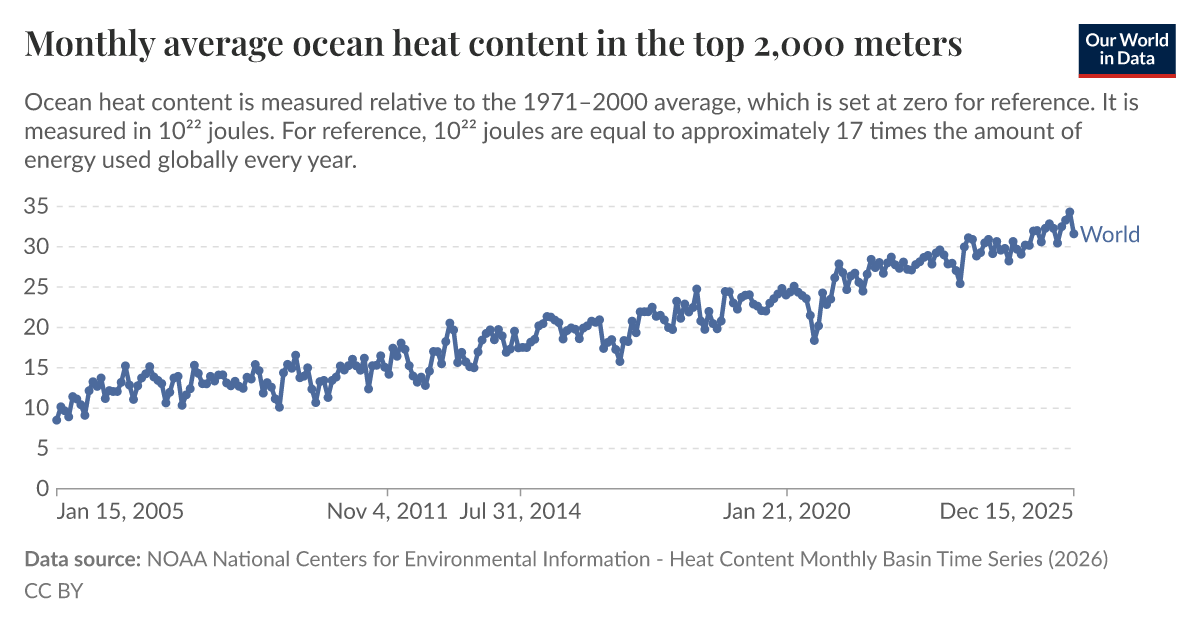
Measuring the Ocean's Warming Pulse at 2,000 Meters
Two thousand meters down, the ocean is warming measurably and without pause. Monthly average heat content in the top 2,000 meters provides one of the most empirically grounded climate indicators available, validated, peer-reviewed, and increasingly urgent. This isn't a distant signal; it is a calibrated pulse we can track in real time. Understanding drives protection. For deeper context on how global experts are building the data framework to monitor these changes, see "Global experts unite to steer Ocean Decade's data and knowledge framework."
Measuring the longevity of a booming ocean economy through integrated climate indicators
The ocean economy is booming, but its longevity depends on what we can measure. UN Trade and Development now asks a critical question: how long can this growth last? The answer lies in integrated climate indicators, validated, empirical data that tracks real-time ocean health. Understanding drives protection. For deeper context, see how the cruise fleet expands its role as a calibrated platform for ocean intelligence. Growth without data is just speculation.
Calibrating ocean intelligence to navigate a warming world
Calibrating ocean intelligence requires more than collecting data, it demands integration. Our warming world is outpacing fragmented observation systems. Validated, real-time measurements from orbit to ocean floor must become an integrated data ecosystem, not isolated snapshots. This is measurable, empirical work. Understanding drives protection. For deeper coverage, explore our related piece, "From orbit to ocean floor: integrated data reshapes our view of the sea," which examines how this unified approach is transforming marine science.
Ocean intelligence measures our progress toward sustainable marine stewardship
Ocean intelligence measures our progress toward sustainable marine stewardship, translating vast datasets into actionable insights for conserving marine resources. This is not abstract science, it is a calibrated, real-time account of human impact on the sea. Understanding drives protection. To see how integrated data reshapes our view from orbit to ocean floor, read "From orbit to ocean floor: integrated data reshapes our view of the sea." The work is empirical, collaborative, and urgent.