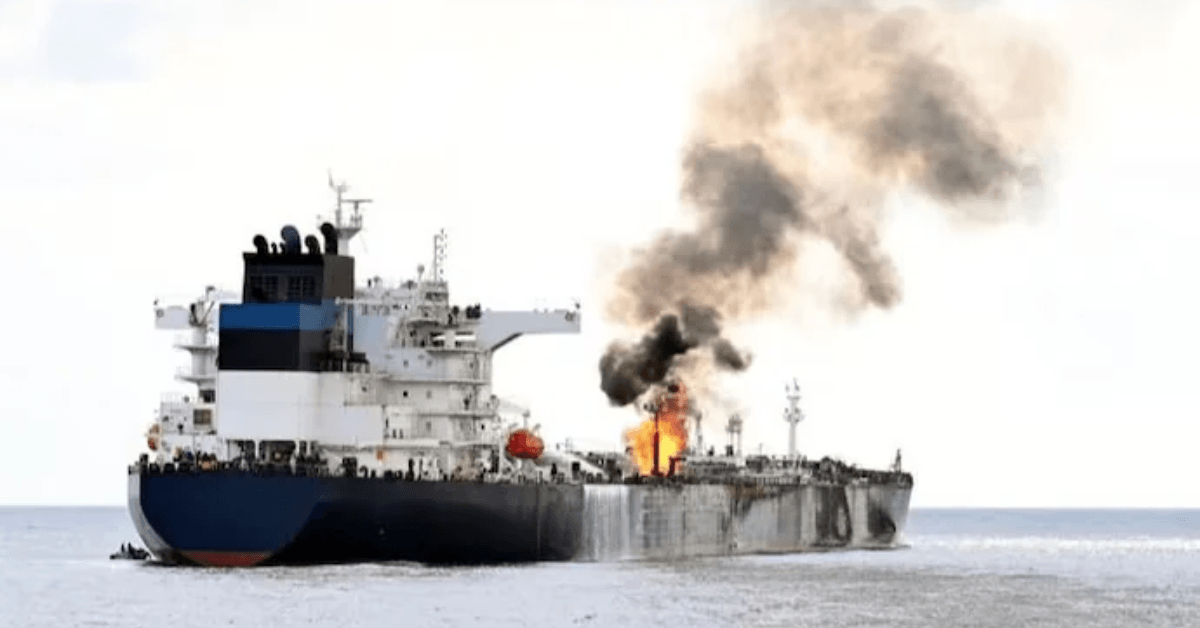
The Strait of Hormuz has become a proving ground for a dangerous new form of maritime coercion, and the international community is failing to respond with the empirical rigor the situation demands. Iran's latest claim, that a naval mine ignited a tanker in the eastern strait on November 14, follows a pattern of unverified assertions that treat commercial shipping as both a weapon and a propaganda tool. For our readers, who depend on validated, real-time ocean intelligence to navigate risk and policy, this is not a geopolitical sideshow; it is a systemic breakdown in the data ecosystem that governs safe passage.
Consider the sequence of claims. On November 1, the IRGC announced that two crude tankers were burning after mine strikes. On November 7, the UKMTO logged a tanker fire off Khasab, with crew evacuated and no cause given. On November 10, a projectile struck the VLCC MT Fujairah Energy in the Persian Gulf, injuring four crew members, an event our own reporting documented as Projectile Strike on VLCC in Persian Gulf Injures Four Crew Members. And now, the IRGC claims another vessel is disabled, its crew unnamed, its cargo unknown. Each incident carries a consistent narrative: ships turned off tracking systems, entered prohibited zones, and faced "the fate of tankers involved in illegal activities." Yet independent verification remains absent. When the UKMTO reported a separate projectile strike on the same November day, it did not confirm the IRGC's version of events. The gap between assertion and evidence is widening, and that gap is where maritime safety erodes.
This matters in practical terms because the Strait of Hormuz is not a theoretical space. It is a calibrated chokepoint through which roughly one-fifth of the world's oil passes. When a state actor lays mines and claims the right to destroy vessels that do not contact its traffic control center, it is not merely making a military statement, it is rewriting the rules of navigation without peer review or multilateral consent. Our earlier piece on Enforcing maritime safety in the Strait of Hormuz saves lives and ensures data integrity underscored that the IMO has urged states to enforce safety rules precisely because unverified claims undermine the trust that keeps shipping lanes open. The IRGC's pattern of announcements, mid-October, November 1, November 7, now November 14, suggests a deliberate strategy to normalize the idea that any vessel can be destroyed without independent confirmation. That normalization is the real threat. It makes every tanker captain's decision to transit the strait a gamble not on navigation, but on the credibility of an unverified report.
The open question is whether the maritime community will demand a higher standard of proof. We have the tools: satellite imagery, AIS data, thermal detection from orbit to ocean floor. What we lack is the collective will to treat each claim as a hypothesis requiring validation before it shapes insurance rates, naval deployments, or diplomatic responses. The next time the IRGC announces a tanker in flames, the world should ask for the vessel's name, its flag, its cargo manifest, and the coordinates of the mine strike, and refuse to act until those data are produced. Until then, the Strait of Hormuz will remain a place where the loudest claim, not the most accurate one, dictates the fate of the ships that cross it.