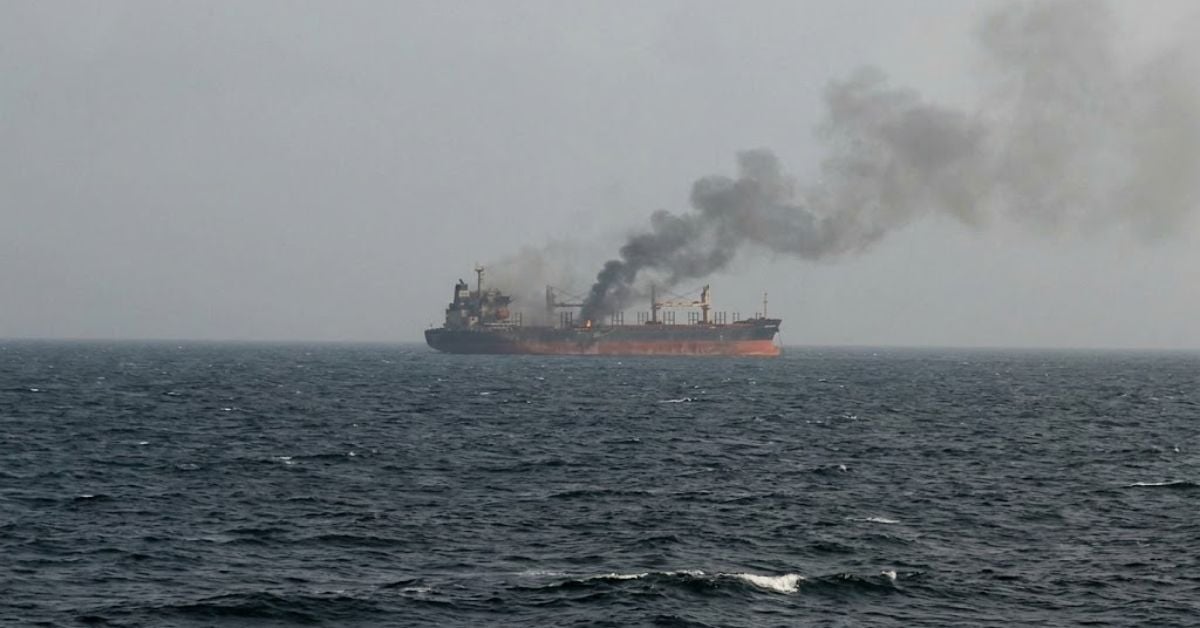
The Strait of Hormuz is not merely a geopolitical flashpoint; it is a calibrated indicator of global energy security and maritime order, and the latest reports of a commercial vessel ablaze near Khasab demand a response rooted in empirical clarity, not alarm. Our position is straightforward: without validated, peer-reviewed data on the cause of the fire, the crew's condition, or any environmental pollution, details UKMTO could not immediately confirm, the incident remains an open question that risks being weaponized in an already volatile information ecosystem. This is precisely the kind of scenario where ocean intelligence, integrated from real-time vessel tracking and satellite surveillance, becomes indispensable for distinguishing between accidental maritime hazard and deliberate escalation.
The context is sobering. Iran's Islamic Revolutionary Guard Corps claims three tankers exploded after striking sea mines, while separately, a vessel was seen burning off Oman. We cannot assume these are the same events without empirical confirmation, yet the pattern is measurable: crude flows through the Strait have already declined, and ship attacks are at their highest level since February, according to the Washington Institute for Near East Policy. This is not a moment for corporate marketing hype or alarmist messaging, it is a moment for longitudinal, peer-reviewed analysis of maritime security data. Our related reporting on Unexplained drone claim in Strait of Hormuz lacks empirical validation underscores the danger of unverified claims in this theatre, where even a downed MQ-1 Predator drone, acknowledged by Iranian media but unconfirmed by Washington, can shift perceptions of risk without a single piece of calibrated evidence. Meanwhile, the human cost is already documented in our piece on 22 Indian Lives Lost as West Asia Conflict Claims Seafarers and Civilians, a stark reminder that these are not abstract strategic maneuvers but events with measurable casualties among those who crew the global supply chain.
For our readers, researchers, policymakers, and engaged citizens, the practical takeaway is that the Strait of Hormuz has become an integrated data ecosystem of contested narratives, where every fire, every mine claim, and every drone intercept must be subjected to the same rigorous standards we apply to climate indicators. The U.S. Navy is ramping up security efforts, and a third aircraft carrier strike group is preparing for a potentially long deployment, but military presence alone cannot substitute for transparent, real-time data sharing. Iran's imposition of fees and its warning against the southern route represent a fundamental challenge to the principle of freedom of navigation, a principle that has underpinned global trade for decades. The specific consequence to watch is whether the international community, through bodies like the International Maritime Organization, can establish a verified reporting mechanism for incidents in the Strait before the accumulation of unvalidated claims erodes the trust required for safe transit. Without that, the fire off Khasab will be just one more data point in a fog of war, rather than a clear signal we can act upon.