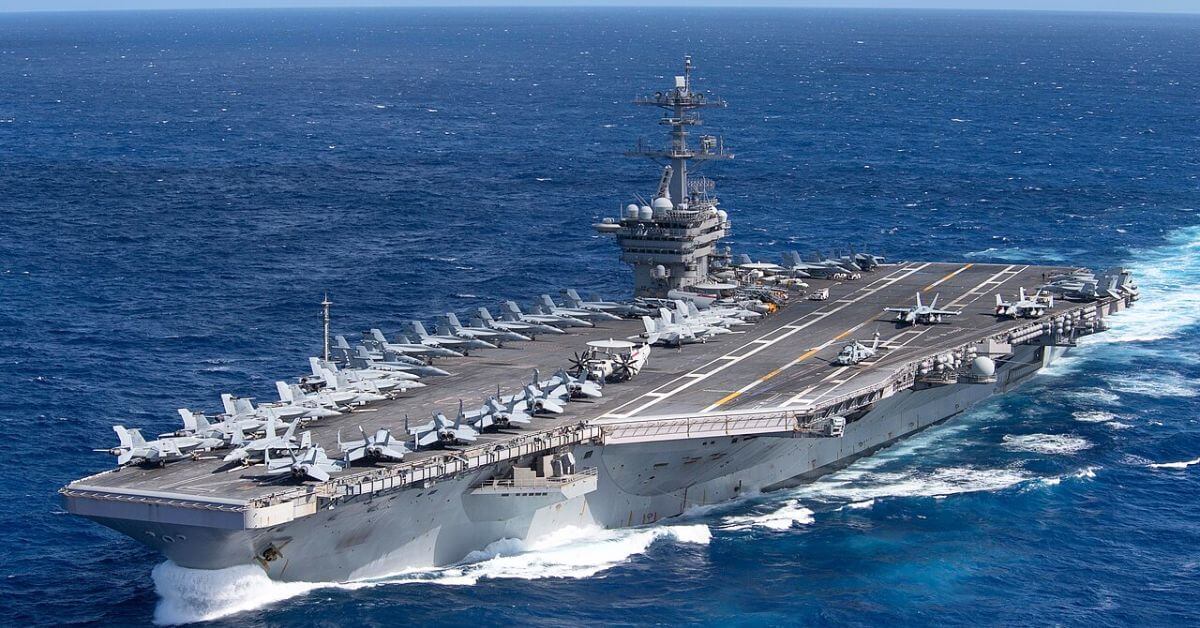
The United States has just extended a naval commitment that shows no sign of easing, and the practical question for anyone tracking maritime security is how long the global shipping network can absorb this level of strain. The USS Theodore Roosevelt carrier strike group departed San Diego on Sunday, followed a day later by the USS Makin Island amphibious readiness group, marking the eighth consecutive month of extended Middle East operations. This is not a routine rotation; it is a signal that the region's chokepoints remain under acute pressure, and that the Navy is willing to sustain a tempo that historically has been unsustainable without long-term consequences for readiness and deployment cycles.
The timing of these deployments is instructive when read alongside recent events in the same waters. Just last week, Projectiles Strike Two Tankers Near Strait of Hormuz, UKMTO Reports and Projectiles strike crude and LNG tankers in the Strait of Hormuz, both incidents that underscore the persistent threat to commercial vessels transiting one of the world's most critical maritime corridors. The Navy's decision to surge additional carrier and amphibious capability into this theater suggests that planners see the threat as enduring, not episodic. For the shipping industry, this means that the calculus for transiting the Strait of Hormuz has shifted from a temporary risk to a permanent operational cost, insurance premiums, crew willingness, and rerouting decisions are no longer based on short-term flare-ups. Meanwhile, Chartering tankers through Hormuz to secure India's oil supply chains reveals that major importers are already adapting by restructuring their logistics, using chartered vessels rather than their own fleets to spread risk. The Navy's extended presence validates that adaptation as necessary rather than precautionary.
Our view is that these deployments are a measured, empirical response to a validated threat environment. The data from the past eight months, repeated projectile attacks, extended carrier rotations, and the restructuring of commercial shipping contracts, points to a reality where the Strait of Hormuz is no longer a temporary flashpoint but a semi-permanent zone of conflict. The Navy is calibrating its force posture accordingly, and the private sector is doing the same. The open question is whether the industrial base can sustain this pace. Carrier deployments of this length typically require months of maintenance and training before redeployment, and the Navy has been running these cycles back-to-back. The specific consequence to watch is how quickly the next carrier strike group, likely the USS Carl Vinson or USS Nimitz, can be readied to relieve the Roosevelt. If the gap between relief and arrival widens, it will tell us more about operational limits than any Pentagon briefing can.