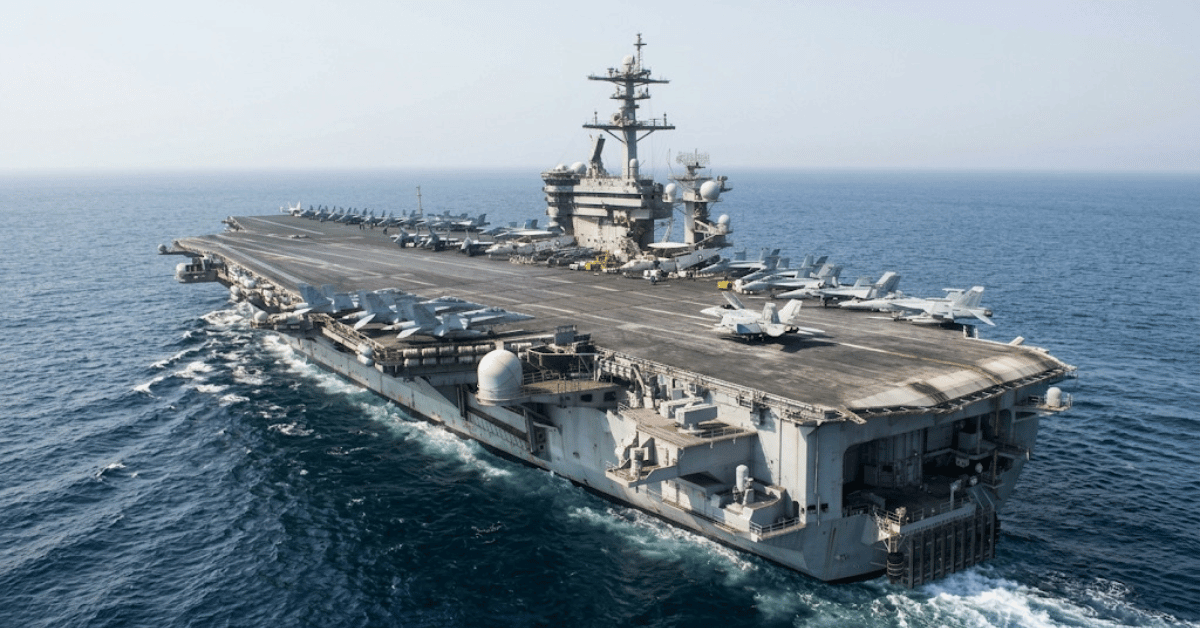
Three carrier strike groups in Middle Eastern waters is not a show of force; it is a signal that the maritime order we have relied on for decades is fracturing in real time. For our readers, researchers, analysts, and decision-makers who track ocean intelligence, this concentration of naval power demands a recalibration of how we measure risk in the world's most critical chokepoint. The Strait of Hormuz, through which roughly 20 percent of the global oil supply once flowed, now sees less than a third of its pre-war traffic, and the US Navy has reported that 150 merchant ships have been redirected and five disabled since the blockade began in June. This is not an isolated military operation; it is a live, empirical dataset of how conflict reshapes ocean transit, and it connects directly to the threats issued against Navy officers in related coverage, as well as the loss of a supertanker carrying two million barrels of oil after a mine strike in the same waters. The data points are accumulating faster than policy can adapt.
What does three carriers mean in practical terms? It means the US has pulled significant naval capacity from the Indo-Pacific to sustain this posture, a trade-off that ships like the 600-ton unmanned warship now being tested by HD Hyundai may eventually help mitigate, but that today leaves a gap in another ocean basin. The USS Theodore Roosevelt arrived alongside the USS Makin Island amphibious ready group, which includes some 2,000 Marines, yet those landing ships and Marines have not reached the region. That detail matters: the capability is staged, not deployed, suggesting a posture calibrated for deterrence rather than immediate escalation. Meanwhile, Iran's state television warned that mines make the US-supported route through the strait dangerous, and a projectile struck a tanker attempting transit, igniting an engine room fire. These are not abstract threats; they are measurable disruptions to the integrated data ecosystem that shipping companies, insurers, and climate researchers rely on for stability.
The stalemate is not static. Negotiations remain stalled on two incompatible demands: Iran wants the naval blockade lifted; the US insists Iran's nuclear program must be part of any deal. President Trump has described the war as effectively over in military terms, but he also cautioned that American forces are "locked and loaded" and has not ruled out resuming fighting. This creates a paradoxical operational reality: three carrier strike groups are present to enforce a blockade that is itself the central obstacle to a diplomatic resolution. For those of us who track ocean intelligence, the key metric to watch is not the number of hulls in the water but the volume of traffic through the strait. Independent assessments already show throughput at less than a third of pre-war levels. If that number drops further, or if the mine threat forces the Navy to divert the remaining traffic, the economic and environmental consequences will become a climate indicator in their own right, measurable in disrupted supply chains and potential spills.
The specific detail to watch is the timing of USS George Washington's departure. USS Theodore Roosevelt is expected to relieve it, but no timeline has been set. Until that handoff occurs, the US maintains a three-carrier posture that is unsustainable in the Indo-Pacific and untested in its current form in the Middle East. Whether this force level becomes the new normal or a temporary peak will tell us more about the trajectory of this conflict than any statement from either side.