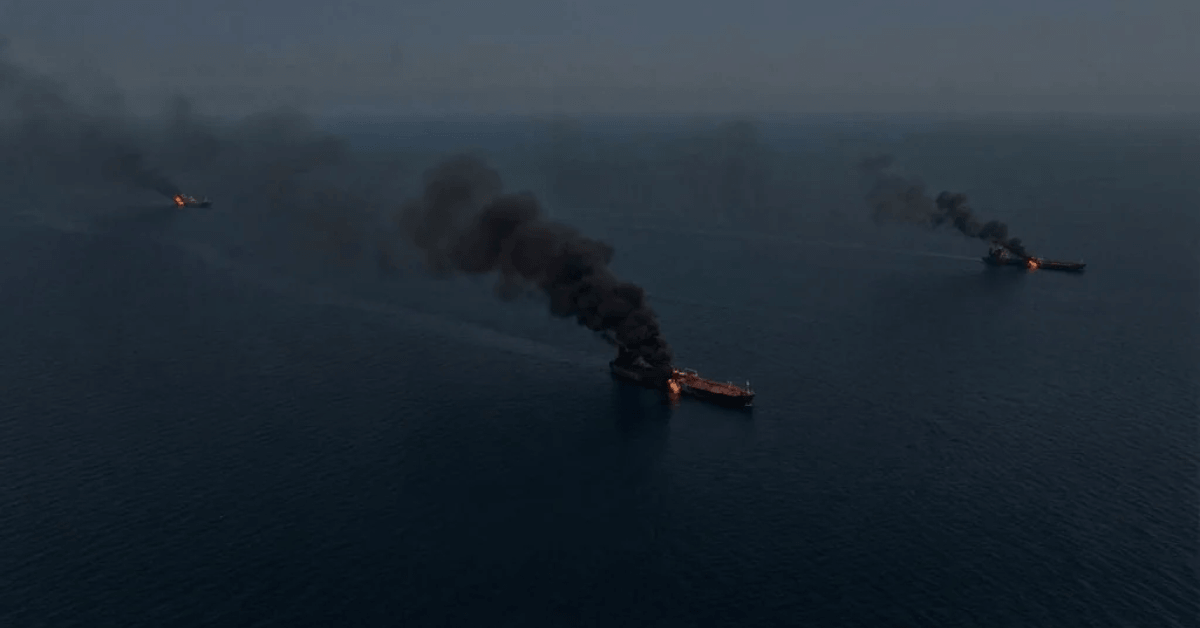
The Strait of Hormuz is no longer just a chokepoint for oil, it is a chokepoint for truth. When Iran's IRGC navy claims five tankers struck its mines in two days, while UKMTO logs projectile hits near Oman's Khasab, we are witnessing more than a military escalation. We are witnessing a deliberate assault on the very data streams that underpin global ocean intelligence. For our readers, researchers, policymakers, and maritime analysts, the immediate practical question is not who hit what, but how we can trust any navigational or environmental reading from a waterway where the baseline facts are contested by design.
Consider the pattern. Iran says three tankers under US escort hit mines; UKMTO describes separate projectile strikes on vessels north and east of Khasab. No names, no crew counts, no independent verification. This is not a gap in reporting, it is a feature of modern hybrid warfare where each side weaponizes uncertainty. Our earlier coverage of the Egyptian Crew Maneuver and Armed Guard Fire Repel Three Speedboat Attacks showed how asymmetric threats in the Red Sea force commercial crews to become real-time decision-makers under fire. The Strait of Hormuz incidents escalate that dynamic: now the threat is not a visible speedboat but an invisible mine or projectile, and the response includes contradictory state narratives that muddy any after-action analysis. For ocean intelligence platforms that rely on calibrated, peer-reviewed shipping data, these contradictions are poison. A mine strike and a projectile hit produce different acoustic signatures, different debris fields, different oil-spill trajectories. If we cannot trust the incident classification, we cannot trust the environmental models that depend on it.
The stakes go beyond maritime security. The Black Sea grain corridor loses 63% of shipments amid 300 vessel attacks demonstrated how sustained disruption to a single shipping lane cascades into measurable global food insecurity. The Strait of Hormuz carries roughly one-fifth of the world's oil. A prolonged conflict there, or even a sustained information war that degrades shipping confidence, will ripple through climate indicators, fuel prices, and marine ecosystem monitoring. Our piece on Law of the Sea as a shield for the Gulf's fragile marine life highlighted how the region's coral reefs and seagrass beds depend on stable regulatory frameworks. Those frameworks are now under direct pressure from unverified claims that shift liability and confuse jurisdiction.
What we need is an independent, real-time verification protocol for incidents in contested waters. The current system, relying on state media and UKMTO bulletins that sometimes contradict each other, is not calibrated for the speed of disinformation. Our take is clear: ocean intelligence requires empirical, validated incident data, not competing press releases. The detail to watch is whether any neutral party, an international maritime organization, a university consortium, or a satellite-based analytics firm, can establish a longitudinal record of these events that is accepted by all sides. Until that happens, every mine strike, every projectile hit, and every silenced transponder is a data point we cannot afford to lose, but also cannot fully trust.