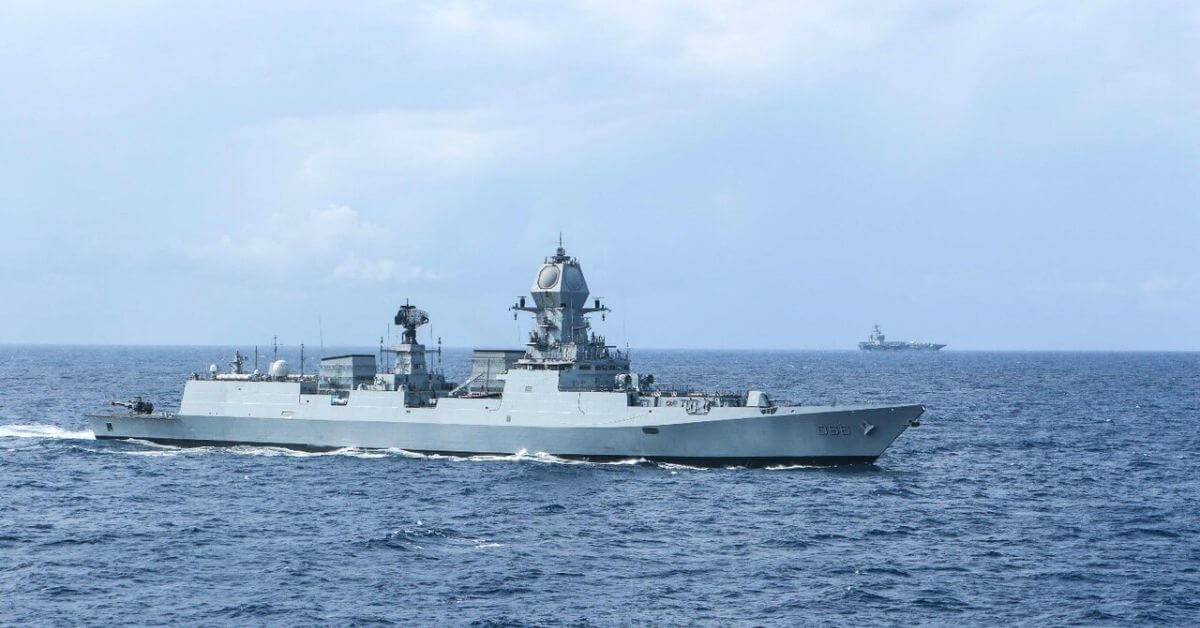
The Indian Navy plans to have around 230 ships by 2040-2045 as it prepares for a more contested maritime environment, Chief of the Naval Staff Admiral Krishna Swaminathan said on Thursday, September 24.
Speaking at News18’s DEFCON 2026, Swaminathan said the Navy had already built more than 100 ships in India and had been working towards self-reliance for many years.
Swaminathan said the sea is important to India’s economy and security. More than 90% of the country’s trade by volume and around 99% of its internet connectivity pass through the sea.
He said the maritime environment, especially in the Indian Ocean region, is becoming more competitive.
Competition for seabed resources, geopolitical tensions and the growing use of cheaper weapons are changing the threats faced at sea. Low-cost drones, sea drones and missiles are also changing naval operations, he said.
Swaminathan said the Navy’s pace of adding an indigenous warship or submarine roughly every 40 days should not be taken to mean that it is adding a large warship every 40 days.
The Navy needs different types of ships for different jobs, he said.
But the Navy also needs training ships, close-coast ships, coastal patrol ships, coastal security ships, survey ships and multipurpose ships.
Swaminathan said the current pace of shipbuilding was not the work of the present generation alone. It was the result of work done by naval officers over many years.
Building a warship takes a long time and involves complex design work, he added. This means the Navy has to start planning many years before a ship is needed.
The Navy has to consider what a ship will be used for, how long it will take to build and what technology may be available in the future.
A warship can also go through several design changes before construction is completed.
The Navy’s planning looks about 25 years ahead and considers future friends and adversaries, new technologies and changing threats.
Swaminathan said the Navy wants to keep building new capabilities so that future officers have the ships and systems they need, even if those capabilities enter service 10, 15 or 20 years after the officers who started the work have left.
He added that the Navy is deploying more widely as India’s interests and presence around the world grow. He also said the open nature of the sea was facing new challenges.
Swaminathan said freedom of navigation was facing challenges and geography was increasingly being used as a tool.
Countries can also be affected by conflicts that happen far away because the global economy is closely connected.
He said India cannot always take access to critical equipment, spare parts, components and technology for granted because supply chains can be vulnerable.
Technology is also becoming part of geopolitical competition.
The Navy has set up initiatives including the Naval Indigenisation and Innovation Organisation and the Technology Development Acceleration Cell.
It is also working with MSMEs and startups and has formed two special task forces to work on emerging technologies.
The Navy has also organised the Swavalamban seminar to promote indigenous capabilities.
Swaminathan added that the Navy was working on modular structures and ways to bring new technologies into service faster. He also said defence companies should be treated as collaborators rather than simply customers or suppliers.
References: news18, moneycontrol