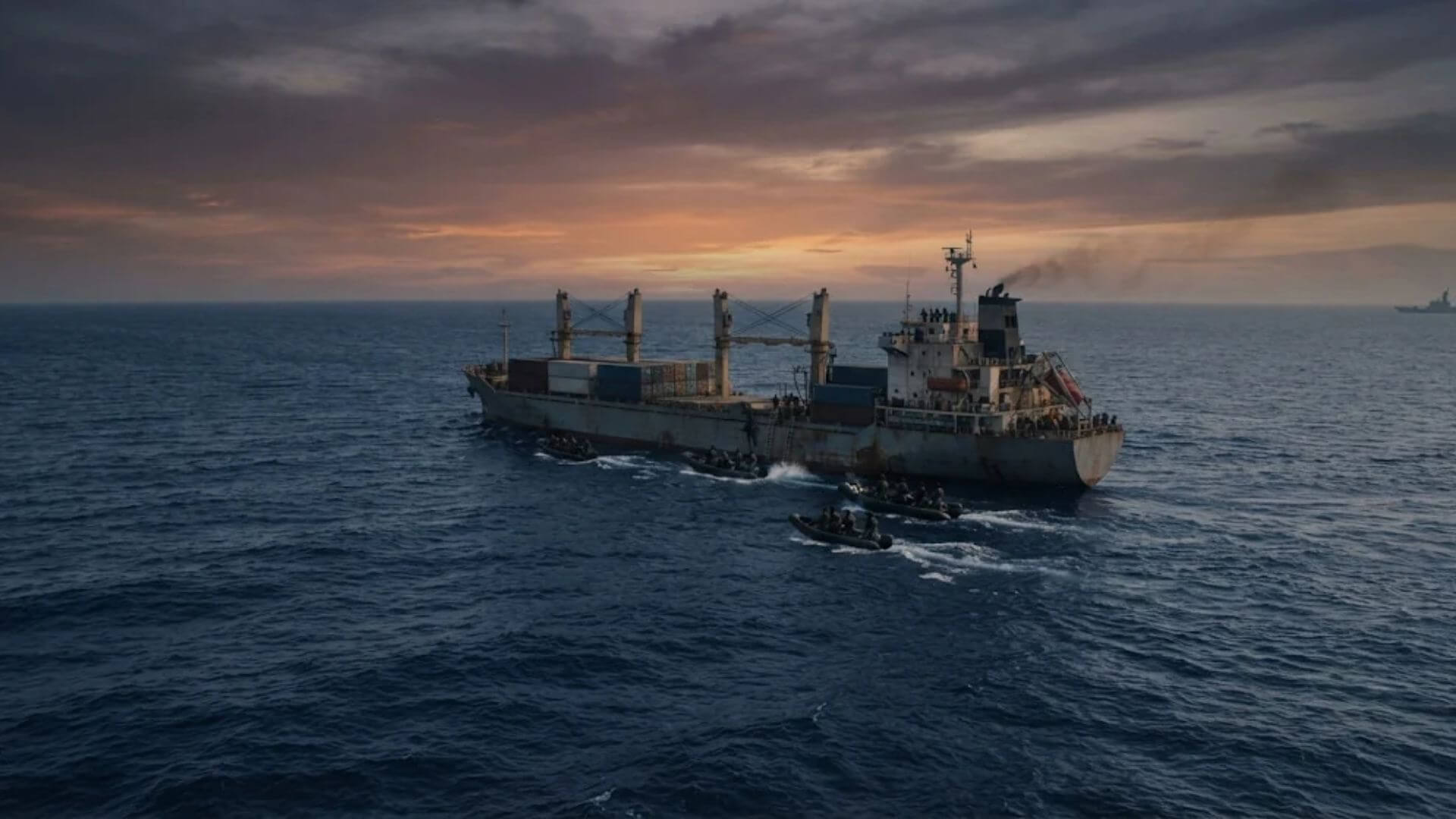
A warning shot deterred an armed skiff from boarding a cargo vessel off Yemen this week, and while the incident ended without casualties, it is a symptom of a maritime security gap that demands calibrated, empirical attention. The UK Maritime Trade Operations reported that the skiff, carrying weapons and ladders, approached a cargo ship roughly 50 nautical miles southwest of Mukalla; the vessel's armed security team fired a single warning shot, and the skiff turned back toward its mothership. No injuries, no damage, and no disclosed identities, but this is the third such encounter in the region within a month. These are not random anomalies. They are data points in a measurable pattern.
On October 17, a separate skiff fired two shots at an LNG tanker southeast of Mukalla; guards responded with warning shots and the skiff altered course. On November 16, a tanker east of Socotra reported a possible mothership and a skiff with four armed individuals and a ladder approaching. Compare these to the Missile Strike Ignites Engine-Room Blaze in Hormuz, Crew of 25 Evacuates Safely and the Rescue in the Black Sea: Drone Strike Capsizes Cargo Vessel Off Bulgaria that occurred within the same 48-hour window. The waters off Yemen, the Strait of Hormuz, and the Black Sea are not isolated theaters, they are nodes in an integrated data ecosystem of maritime risk. The common thread is not the weapon type but the method: coordinated small-craft approaches using motherships, often at night, with ladders and small arms. This is a tactical playbook, and it is being validated by repetition.
For our readers, whether researchers, policymakers, or seafarers, the practical takeaway is that reactive security measures, while effective in the moment, are not a longitudinal solution. A warning shot works today, but it does not address the mothership's origin, the skiff's logistics, or the intelligence gap that allowed the approach in the first place. What is needed is a calibrated, real-time monitoring framework that integrates satellite surveillance, vessel-tracking data, and port-state reporting to predict and preempt these patterns. The Crew rescued after cargo vessel grounds off the Wexford coast reminds us that maritime emergencies often stem from systemic failures in navigation and oversight, not just hostile acts. The same principle applies here: we must treat each skiff approach not as a one-off event but as a climate indicator of deteriorating maritime governance in a corridor that carries a significant share of global trade.
The question that lingers is not whether the skiff will try again, but whether the international community will treat these repeated incidents as the empirical signal they are. Authorities are investigating, and vessels have been urged to exercise caution. That is a short-term instruction. The long-term consequence is that without integrated data-sharing and coordinated response protocols, the warning shot will remain the first and last line of defense, and that is not a sustainable strategy for ocean intelligence.