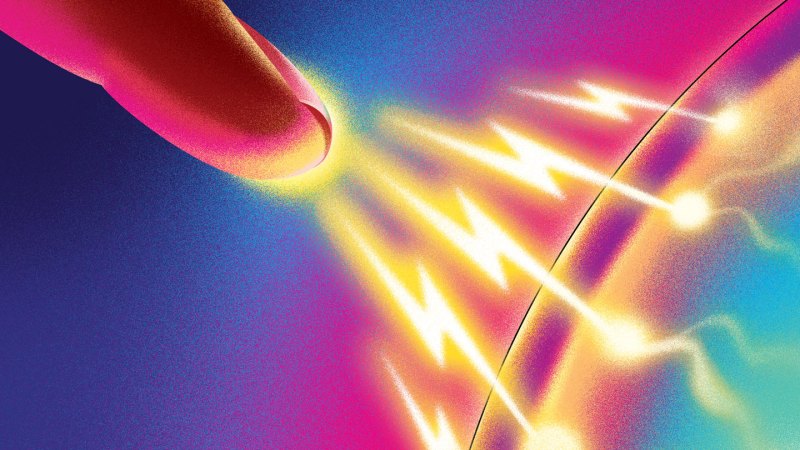
The static electricity that crackles from a doorknob after you shuffle across a carpet is one of the most universal, and yet most poorly understood, phenomena in physics. For all our technological sophistication, the scientific community remains largely clueless about its fundamental origins. A quirky group of researchers is now trying to change that, and their work deserves more than a passing glance from anyone who has ever wondered why the universe works the way it does. This is not a trivial parlor trick; it is a foundational gap in our empirical understanding, one that touches on material science, atmospheric chemistry, and even the mechanics of dust on planetary surfaces. When we consider how much of our modern world depends on calibrated, measurable interactions at the atomic level, the fact that we cannot fully explain a basic spark is a humbling reminder of how much ocean intelligence we still lack on land.
The pursuit of this mystery is not isolated in its ambition. It sits alongside other recent investigations into the hidden mechanics of our world, such as the discovery that Magma and microbial activity may rewrite a 2-billion-year-old carbon signal, which challenges our assumptions about deep-time climate indicators. Similarly, the researchers probing static electricity are not just looking for a single answer; they are questioning the very frameworks we use to describe contact, friction, and charge transfer. This is the kind of foundational science that often gets overshadowed by flashier, applied research, but it is precisely this type of inquiry that leads to breakthroughs in energy storage, printing, and even pharmaceutical manufacturing. For our readers, the practical takeaway is clear: when we ignore the gaps in our basic knowledge, we risk building entire industries on assumptions that may be flawed.
What makes this research particularly compelling is the character of the scientists involved. They are described as quirky, which suggests a willingness to think beyond the rigid confines of institutional orthodoxy. That matters because the problem of static electricity has stumped some of the greatest minds in history, and it will not be solved by incremental, safe thinking. We would tell a reader who asks about this that the value here is not just in the eventual answer, but in the process of questioning itself. In a scientific culture that often prioritizes measurable outputs and publishable results, there is profound merit in chasing a question that has no immediate commercial application. It is a reminder that our understanding of the natural world is incomplete, and that intellectual courage is as important as empirical rigor. This is a lesson that transcends the lab, applying to how we approach complex systems in climate science and oceanography as well.
The connection to broader Earth science is not a stretch. Consider the evidence suggesting that Cascadia and San Andreas: Evidence Suggests Sequential Earthquake Risk and the accidental discovery of an Ancient Impact Crater, 390 Million Years Old, Identified in Quebec. These stories share a common thread: nature's most profound secrets often hide in plain sight, waiting for a curious mind to notice. The static electricity researchers are doing exactly that, and the specific detail to watch is whether they can move beyond descriptive models to a predictive, empirical theory. If they succeed, the implications will ripple far beyond the humble balloon stuck to a sweater. That is the concrete point we are watching for: not just an explanation, but a validated, peer-reviewed framework that could one day make our current ignorance a historical footnote.