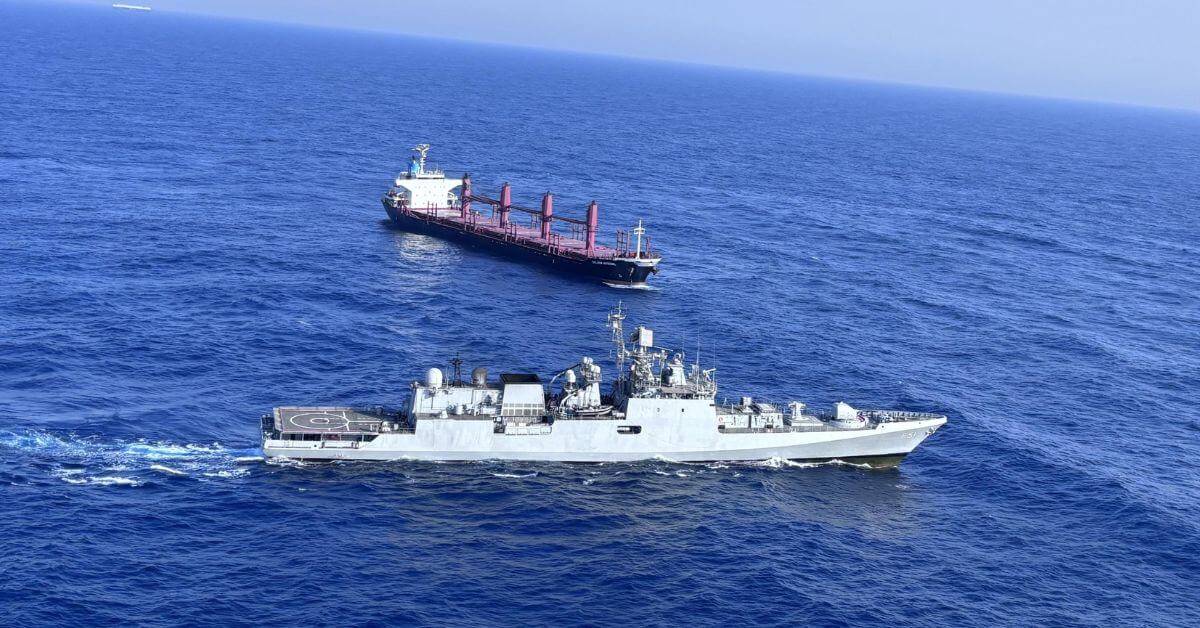
The Indian Navy's recent escort of two merchant vessels through the Bab-el-Mandeb Strait is not a headline-grabbing spectacle, nor should it be. It is a quiet, calibrated assertion of a principle that often goes unspoken until it is threatened: the sea is not a vacuum, and the movement of essential cargo is the circulatory system of global economies. This operation is a validation of what we have long tracked in these pages, the shift toward integrated maritime security as a practical, daily necessity rather than an abstract geopolitical talking point. The same logic that drives ship-to-ship transfers to max out in the Gulf of Oman, as we reported on the Gulf of Oman STS Transfers Max Out Amid Rising Saudi Oil Exports, applies here: when chokepoints tighten, the response cannot be reactive. It must be woven into the operational fabric of the region.
For our readers, the takeaway here is not about naval bravado. It is about the measurable cost of disruption and the value of presence. When a hijacked tanker is intercepted off Puntland, as detailed in Puntland Forces Intercept Hijacked, US-Sanctioned Oil Tanker After 48 Hours, we see the consequence of a security gap. The Indian Navy's escort mission is the counterpoint to that: a deliberate, empirical demonstration that safe passage is not a given, but a product of sustained attention. We would tell any reader asking about this that the practical implication is straightforward. Your supply chain, your fuel prices, and your import costs are directly tied to whether a destroyer is on station in the Bab-el-Mandeb. This is not sentiment; it is logistics.
The deeper point, and the one we find most compelling, is the integration of these efforts. The Navy's operation is not an isolated event but part of a larger data ecosystem of maritime domain awareness. As we noted in Integrated Subsea Infrastructure Shifts to Enhance Indian Ocean Connectivity, the Indian Ocean is becoming a more connected, monitored space, with cables and shipping lanes forming a single, fragile network. The escort is a physical manifestation of that network's protection. It is one thing to have real-time data on a threat; it is another to have the calibrated force to respond. The Navy's action proves that the latter is still the most reliable form of ocean intelligence.
Our honest take is this: do not mistake the calm for the absence of pressure. The Bab-el-Mandeb operation is a benchmark for how medium-tier naval powers should behave, with purpose, without fanfare, and with a clear-eyed focus on the cargo. We would tell a reader that the detail to watch is not the next deployment, but the frequency. If escort missions become routine, we are building a new standard for maritime security. If they remain exceptional, we are only patching holes. The question is not whether the Navy can secure a strait; it is whether the rest of the world understands that this is the price of doing business. The sea is not asking for permission. It is asking for attention.