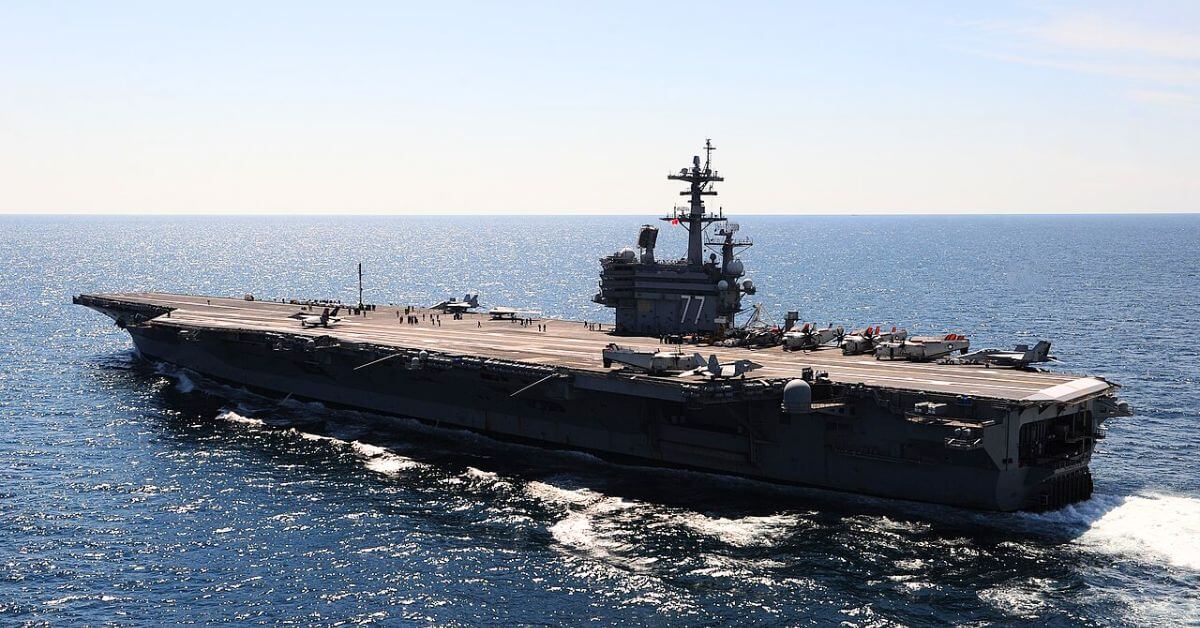
A US Navy carrier does not pull into Phuket for rest and recreation without strategic rationale. The arrival of the USS George H.W. Bush with 4,800 personnel after six months supporting operations in the Middle East is an implicit signal of force posture recalibration, not merely a morale stop. For analysts tracking maritime security patterns, this visit, the first port call since the carrier left Norfolk in March, affirms an operational rhythm where extended at-sea deployments demand corresponding diplomatic staging. The Bush's arrival follows the USS Abraham Lincoln's visit to Laem Chabang last month and coincides with the departure of two other carriers from the region, leaving the USS George Washington as the sole flattop in the Middle East. This redistribution matters because the Strait of Hormuz remains an active theater: 2 million barrels of crude move beyond the Strait of Hormuz in a calibrated shift and laser deterrence deploys in the strait as naval defense enters a new measured era. The Bush's departure from that area without a public announcement from CENTCOM or 5th Fleet suggests a deliberate opacity around operational timelines, something readers tracking naval presence should note.
Our view: the Bush's stop in Thailand is a practical case study in the human and material cost of sustaining a contested maritime blockade. The crew supported Operation Epic Fury and the naval blockade in the Central Command area of responsibility. Iranian missiles and drones targeted US bases and at least one carrier in the Arabian Sea; nine Marines and 29 sailors were wounded in September. Meanwhile, the USS Lincoln spent months without a port call, and eight of its service members attempted suicide. These are not abstractions. The Bush's sailors now have limited shore time, October 4 to 9, anchored offshore with access via Phuket Deep Sea Port, plus a scheduled soccer match and cultural activities. The local mayor estimated each Lincoln sailor spent up to 3,000 baht ($89) per day during that visit. The economic injection is real for Phuket, but the underlying deployment tempo carries measurable stress indicators that are empirical and longitudinal.
Thailand is the United States' only treaty ally on mainland Southeast Asia. Hosting two carrier visits within weeks reinforces that relationship, but it also places the Royal Thai government in a calibrated position, balancing its traditional alliance with growing regional power dynamics. The Nimitz-class carrier and its strike group, now including destroyers USS Mason, USS Ross, and USS Donald Cook, represent integrated naval capability that does not simply vanish between deployments. The Bush left the Middle East after further Iran-US exchanges, and its next operational window is unclear. One specific detail to watch: the USS Theodore Roosevelt is heading toward the region but is not expected to arrive for days, and the Makin Island Amphibious Ready Group just left San Diego. The resulting gap in carrier presence east of Suez is the sort of measured force distribution that informs both adversary planning and allied reassurance. The Bush's crew may be resting in Thailand, but the ocean intelligence this deployment generated, on blockade sustainability, crew welfare thresholds, and port diplomacy, will be validated in how the next rotation is designed.