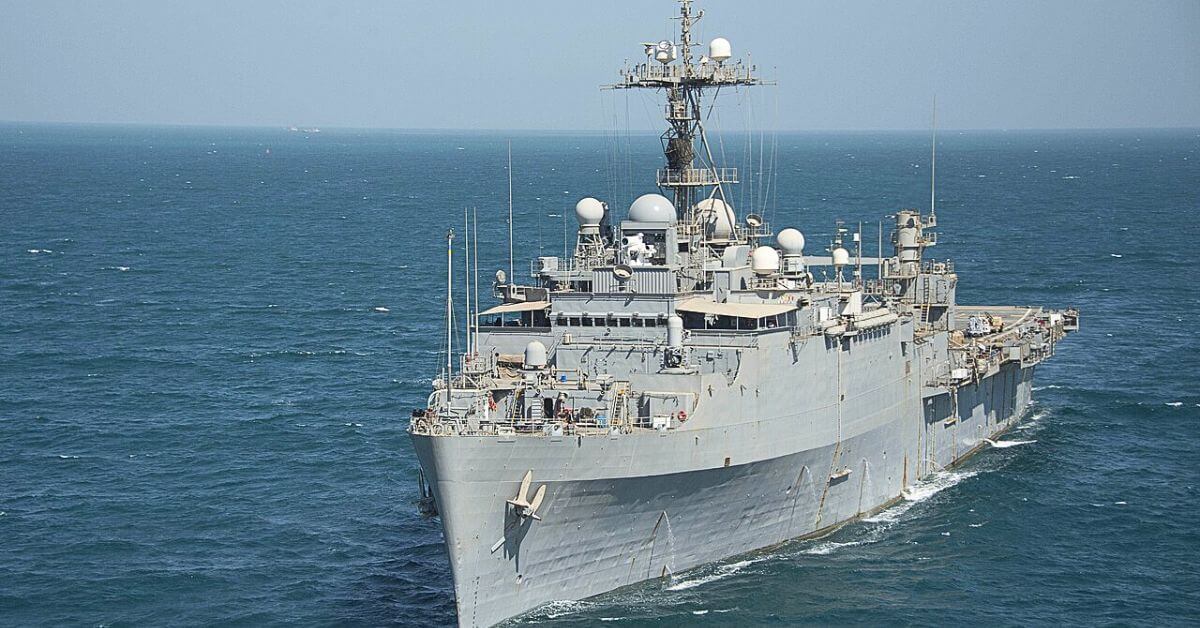
The deployment of high-energy laser weapons on US warships in the Strait of Hormuz marks a genuinely measured step forward in naval defense, not a revolution but a calibrated advance born of five decades of research. This is not about flashy new hardware; it is about operational economics and sustained engagement capability that directly affects how navies will protect critical maritime chokepoints. For our readers tracking the intersection of technology and ocean security, the practical takeaway is clear: the cost-per-shot advantage of directed energy is already reshaping tactical calculations in active conflict zones, and the implications for naval force structure will ripple outward for years.
The numbers tell the story. A single laser engagement costs roughly $13 in electricity, compared to anti-aircraft missiles that can run from thousands to millions of dollars per shot. That is not a marginal efficiency, it is a structural shift in how navies will allocate resources, especially in high-traffic areas like the Strait of Hormuz, where recent Projectiles Strike Two Tankers Near Strait of Hormuz, UKMTO Reports underscore the persistent threat to commercial shipping. The HELIOS system, mounted on large warships and operated with modified Xbox-style controllers, can keep engaging targets as long as the ship has power, effectively decoupling defensive capacity from magazine depth. This matters because the US Navy has already extended its Middle East operations to an eighth month, and a weapon that does not run out of ammunition changes the logistics of prolonged deployments.
The technology has real limits, and acknowledging them is part of the scientific integrity this publication values. The laser requires several seconds of focused dwell time on a single point of a drone, demanding steady tracking against maneuvering targets. It is invisible to the naked eye, operating in the infrared spectrum, and its power draw from generators or battery packs means it competes with other shipboard systems. Yet these constraints are being addressed through iterative testing, as seen in earlier trials aboard the USS George H.W. Bush and now in active operations. The use of gaming controllers is not a gimmick; it is a practical response to training timelines, reducing the learning curve for sailors already familiar with the control layout. Secretary of War Pete Hegseth demonstrated this himself, shooting down a drone after a short session at White Sands Missile Range.
What remains to be seen is how this technology scales and integrates with broader fleet operations. The US Army has awarded a roughly $500 million contract for war-ready laser systems, and the Royal Navy is installing similar capabilities on its destroyers. Ukraine is testing AI-guided lasers against Shahed drones. The Strait of Hormuz deployment is one of the first operational uses of an anti-drone laser in an active conflict area, but it will not be the last. The specific detail to watch is whether the controllers used on these warships are standard commercial units or specially hardened military versions, a small technical point that speaks to the balance between rapid adoption and reliability under combat conditions. The ocean is a harsh environment, and every component must be validated for sustained operation at sea.