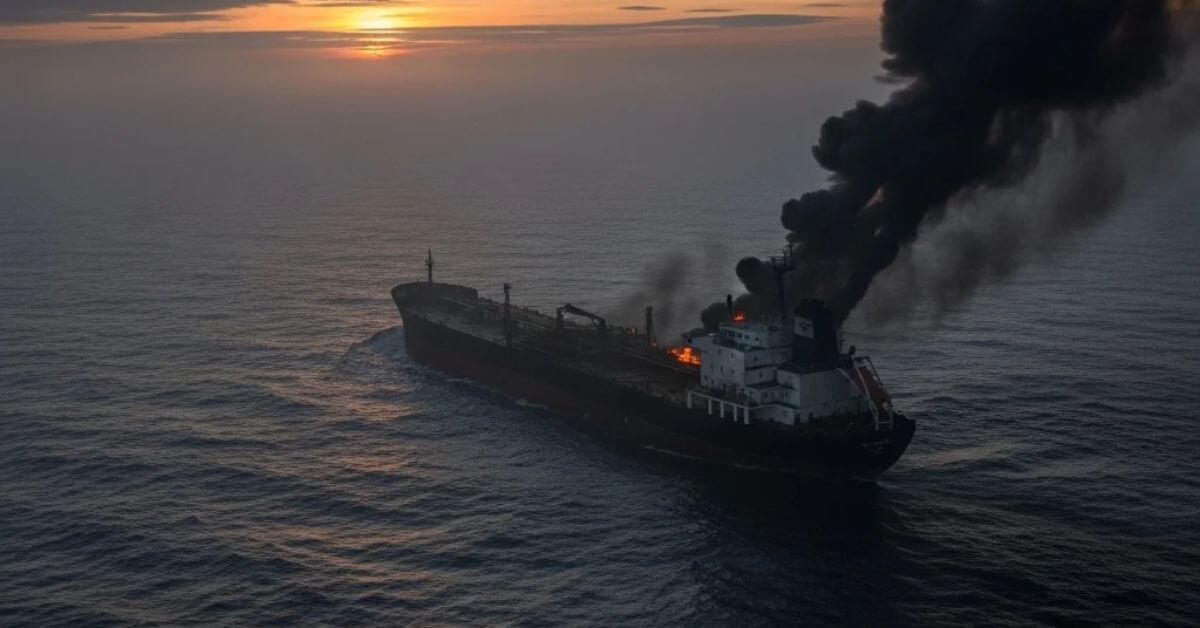
The Strait of Hormuz has become the most expensive stretch of water on Earth, and the price tag tells a story the world cannot afford to ignore. Acting US Navy Secretary Hung Cao's claim that insuring a single commercial crossing now costs $64 million, up from $54,000 before the war, is not just a number; it is a calibrated signal of how deeply conflict has fractured global maritime stability. We do not need to wait for independent verification of that exact figure to recognize what it represents: the cost of moving the world's energy supply has been weaponized, and the consequences ripple far beyond the insurance desks of London and Dubai.
This shift in risk pricing is a measurable, real-time indicator of a broken integrated data ecosystem in the strait. Before the US and Israel launched strikes on Iran on February 28, the waterway carried roughly one-fifth of the world's oil supply. Now, with Iran restricting passage and the UKMTO recording 308 vessel crossings in the week ending November 11-65 percent below pre-war levels, the empirical evidence of disruption is undeniable. The maritime intelligence analyst who cautioned that Cao gave no context is correct: war-risk premiums vary by vessel type and hull value. An industry report from July put those premiums at 7.5 to 10 percent of hull value, compared with 1 to 3 percent earlier, and cover for a 270,000-tonne crude tanker could cost around $21 million. A Dubai state oil executive estimated $10 million to $20 million per cargo in September. Even at the lower end, these are not abstract costs; they are passed directly through supply chains. This reality sits alongside our recent reporting on how the US Navy's posture in the region has already reduced to two vessels, as detailed in Carrier Presence Shifts as Middle East Naval Posture Reduces to Two Vessels, and how Global Shipbuilding Strategy Must Include Foreign Investment for Frigate Fleet reflects a broader recalibration of naval capacity. These are not separate stories; they are linked data points in a single, deteriorating picture.
What this means for our readers, researchers, policymakers, and maritime professionals, is that we are past the point of treating the strait's closure as a temporary disruption. The insurance spike is not a market anomaly; it is a structural recalibration of risk that will persist as long as the blockade and retaliatory attacks continue. The UKMTO reported two attacks on tankers on November 16 alone, including one near Oman that left a vessel disabled with a fire in its engine room. Every crossing now carries a measurable probability of loss that insurers are pricing accordingly. For nations dependent on strait transit, and that includes most of the global economy, the question is no longer when the waterway will reopen, but how to build resilience in its absence.
The specific takeaway is this: a $64 million insurance cost per transit is not sustainable for commercial shipping, and the market will adapt by rerouting, reducing volume, or renegotiating risk-sharing with state actors. We should watch for how flag states and charterers begin to write these costs into long-term contracts, because that is where the real economic shift will calcify. The Strait of Hormuz was always a chokepoint; it has now become a ledger of conflict's true expense. Understanding that ledger is the first step toward protecting what remains of freedom of navigation.