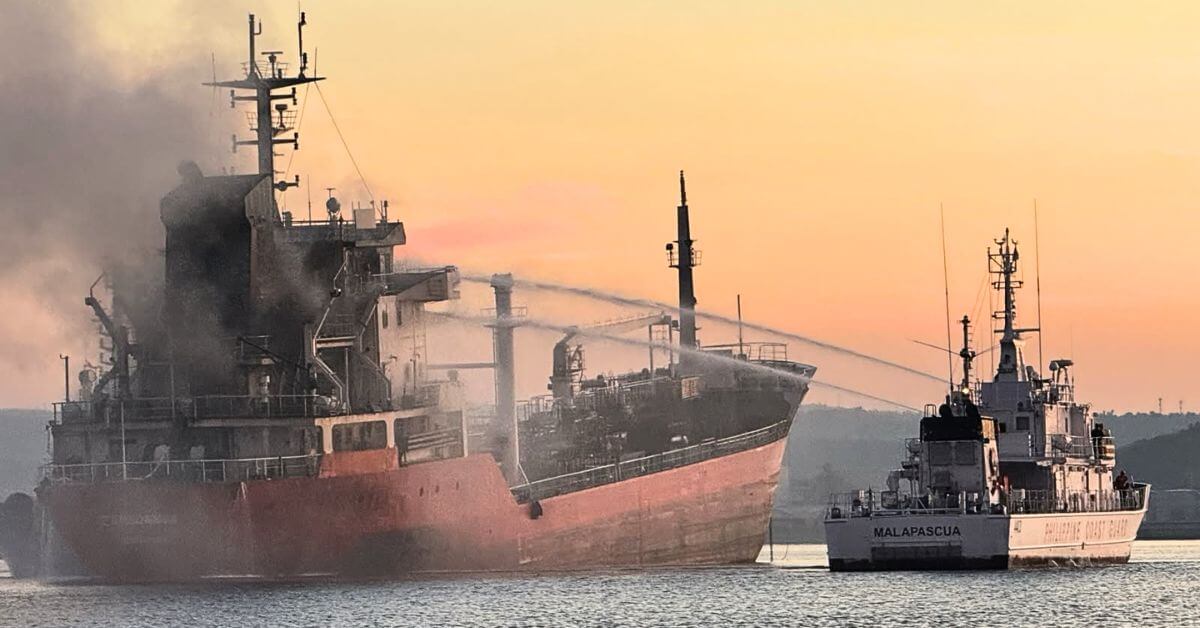
Two injured crew members in an engine-room fire aboard the tanker *Gindara* at Baladi Distillery Inc. Port in Calaca City is a reminder that maritime safety remains a chain of small, quotidian decisions, not just headline-grabbing regulations. This incident, while contained, cuts against the comfortable assumption that commercial shipping's risk profile is dominated by geopolitical strikes or catastrophic structural failures. The more mundane truth is that an engine room, packed with fuel lines, hot surfaces, and electrical systems, is a controlled hazard that demands constant, calibrated vigilance. The fire at Calaca is not an outlier; it sits on a spectrum of ignition threats that includes the recent Projectile Strike at Yanbu Port Disrupts Tanker Operations, where external violence caused a fire, and the Tragic incident off Manori highlights risks of unregulated vessel access, where a grounded tanker became a target for theft. Each event has a different trigger, but they all converge on the same operational truth: fire does not discriminate between intent and accident.
For our readers, the practical lesson is not to wait for the investigation report to tell you what you already know. The engine room is where maintenance schedules are tested daily, where a skipped inspection or a temporary bypass of a safety interlock can become the root cause of a casualty. We should treat this incident as a live data point, not a static news item. The crew members' injuries are the measurable outcome, but the precursor conditions are what demand scrutiny. Was the fire suppression system tested within its validated window? Were the engine-room watch protocols followed to the letter? These are the empirical questions that will determine whether this was an isolated failure or a systemic gap. The industry has a tendency to focus on cyber threats and autonomous vessels, but the engine room remains the most unforgiving environment on board, and it will not be automated into safety.
This is also a moment to connect the dots with the broader energy transition. The MSC World Atlantic floated: LNG marine fuel enters a validated phase signals a shift toward alternative fuels, but LNG brings its own fire and explosion hazards, particularly in confined spaces. If a conventional tanker's engine room can produce a fire with legacy fuel, what happens when the fuel itself becomes cryogenic or pressurized? The industry is not just changing its power source; it is changing the risk landscape, and the training and detection systems must be updated in parallel. The Calaca incident is a baseline, a reminder that before we celebrate new propulsion technologies, we must master the fundamentals of fire prevention in the spaces we already have.
The specific detail to watch is the investigation's finding on the fire's origin and the condition of the fixed fire-extinguishing system. If the system discharged correctly and contained the fire, that is a validation of existing protocols. If it failed, then the question becomes one of maintenance integrity and crew familiarity. This is not a theoretical exercise. The next engine-room fire could happen on a vessel carrying a more volatile cargo, in a more constrained port, or during a more complex operation. The takeaway is direct: treat every fire, no matter how contained, as a failure of the layered defenses that should have prevented it. The crew members' injuries are the cost of that failure, and their recovery is the only acceptable outcome.