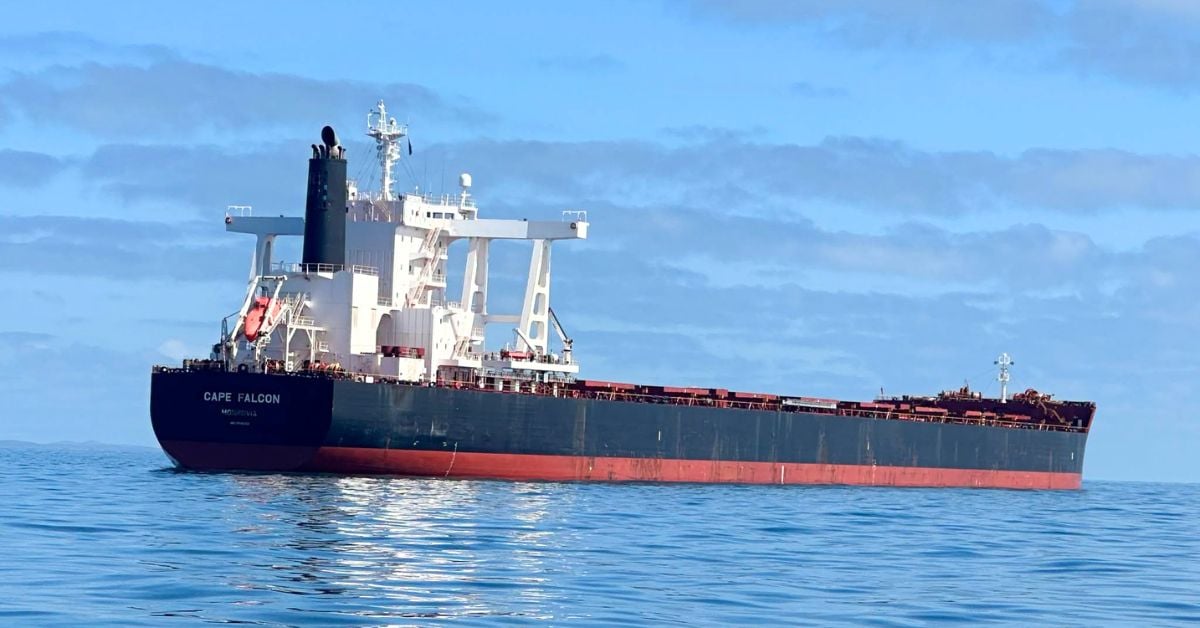
The Cape Falcon remains where it settled, and that is the story. Two attempts to refloat the Liberian-flagged bulk carrier near Gladstone have failed, leaving the vessel hard aground in a busy Queensland shipping lane. We are not alarmists, and we will not reach for hyperbole, but this is exactly the kind of incident where patience stops being a virtue and starts becoming a liability. Every hour the ship stays put, the risk profile shifts from theoretical to operational.
We have seen this script before. In our own reporting on the Bulk Carrier Freed After Prolonged Grounding Near Gladstone, Australia, a similar vessel spent six days stuck before being refloated. The difference here is that the Cape Falcon has already burned through its first two attempts, and the tide is not negotiable. Compare that with the Cargo Ship Fire Prompts Evacuation Near Mykonos; Incident Under Investigation, where the crew had to abandon ship entirely, and you see the pattern: maritime incidents do not follow a schedule, and every decision is a trade-off between speed and safety. The practical lesson for our readers, whether they operate tugs, manage logistics, or just track global supply chains, is that grounding events are not isolated mechanical failures. They are stress tests on the entire response ecosystem.
Our take is straightforward: the failure of two refloat attempts is not a bureaucratic hiccup, it is a signal. The next step is not necessarily a third try with more tugs. It may require lightering the cargo, bringing in salvage experts with different equipment, or accepting that the hull may need to be patched in place before the ship can be moved. That is expensive. That is time-consuming. And it is also the reality of operating large vessels in shallow, tidal waters. We would tell a reader who asked us directly: do not wait for the next update to ask whether the response plan is adequate. Ask what the contingency is for a hull breach while the ship is still aground, because that is the question that will determine whether this becomes a footnote or a case study.
The related Gate Delays Expose Critical Link in National Trade Flow article reminds us that the supply chain is only as strong as its most constrained point. A grounded bulk carrier off Gladstone is exactly that kind of chokepoint, not just for the port, but for the coal and gas terminals that depend on clear approaches. The specific detail to watch now is not the weather window, but the salvage assessment due in the coming days. If the surveyors recommend lightering, expect a multi-week operation. If they deem the hull sound and the tides favorable, a third attempt may come quickly. Either way, the Cape Falcon is no longer a shipping incident; it is a logistics bottleneck with a schedule. We will be watching the draft marks, and so should you.