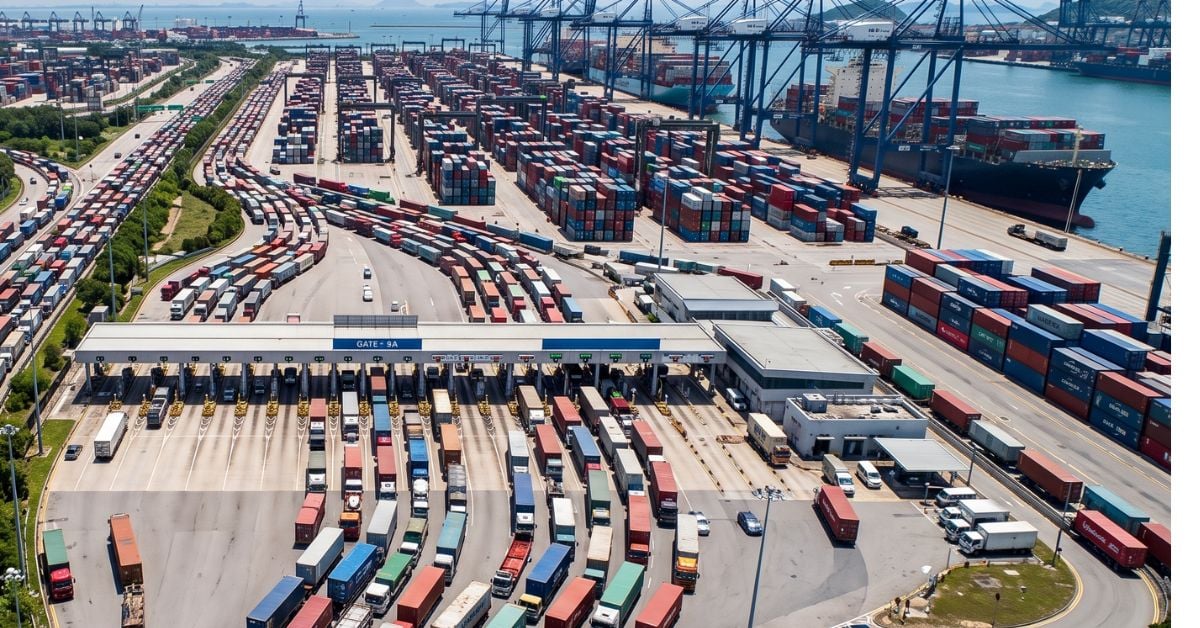
A container gate looks unremarkable. It is a lane, a barrier, a place to wait. But in September 2026, that unremarkable space became the bottleneck in a national equation. Gate delays frame the issue plainly: any disruption at this entry-exit point does not stay local. It moves directly into the export-import volume of the country. The gate is not a handoff point; it is a valve. When it sticks, the pressure drops across the entire network.
This is the kind of operational detail that rarely makes headlines, yet it is where the real intelligence of the ocean economy lives. The same logic applies to the Integrated Subsea Cables Enhance Data Transmission Across the Indian Ocean, which now carries 99 percent of the world's data beneath the sea. That cable is not a glamorous feat of engineering for its own sake; it is a calibrated response to a simple requirement: move information as reliably as we move containers. Gate delays and subsea data transmission are different problems, but they belong to the same integrated data ecosystem. One moves goods, the other moves knowledge, and both must be measured in real time if we are to act before small frictions become national losses.
Our honest take is that the industry has spent decades optimizing the open ocean while treating the gate as an afterthought. That is no longer defensible. When a gate stalls, it is not just a truck queue. It is a signal. It tells us that our port infrastructure is not yet an integrated system; it is still a collection of handoffs. Look at the Russia Calibrates Export Revenue for Northern Sea Route Icebreaker Fleet, where export revenue is being deliberately tied to the construction of new icebreakers. That is a national strategy built on a single route. Compare that to the fragile choreography at a container gate, where a single delay ripples outward without any comparable calibration. And consider the Ukraine Supports India's Initiative for Black Sea Shipping Routes: restoring safe navigation is a diplomatic and security effort, but it will mean nothing if the gates on the receiving end cannot process the increased flow. The entire chain is only as strong as its least calibrated point, and right now, that point is often the gate.
What would we tell a reader who asks about this? We would say this: do not confuse the simplicity of the gate with the simplicity of the problem. The gate is where the abstract concept of national trade flow becomes a physical reality. It is where policy, infrastructure, and human behavior collide. Our take is that the gate deserves the same level of empirical scrutiny we give to climate indicators or subsea cable performance. It needs sensors, data, and a feedback loop. The takeaway here is direct: if you cannot move a truck through a gate in minutes, you cannot claim to have an efficient national trade network. Watch how ports respond to this. The ones that treat the gate as a critical node, not a formality, will be the ones that keep their export-import volumes stable when the next disruption arrives. The question is not whether the gate matters. It is whether we will start measuring it like it does.