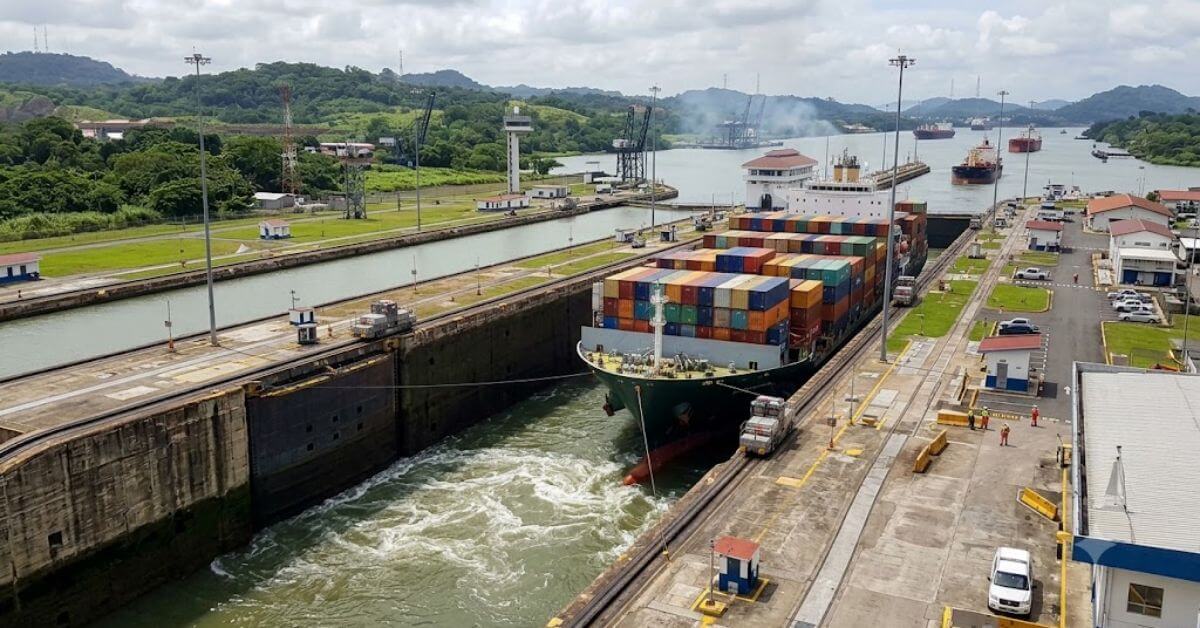
The Panama Canal's record of 521 million tonnes of cargo in fiscal 2026 is not a simple story of maritime efficiency; it is a stark, empirical signal of how global trade is bending under the pressure of geopolitical conflict and climate stress. The canal set its record precisely because the Strait of Hormuz disruption strands thousands of seafarers amid mounting maritime threats forced energy shipments to seek alternatives, while simultaneously a drought driven by El Niño constrained its own capacity. For our readers, researchers, policymakers, and maritime professionals, this convergence demands a recalibration of how we measure resilience. The canal did not thrive; it adapted under duress, and that adaptation reveals vulnerabilities that are measurable and, critically, addressable.
The immediate takeaway is that the Panama Canal Authority's ability to raise its daily transit limit from 36 to 41 ships to absorb diverted traffic from the Strait of Hormuz was a tactical success, but it came at a cost. The same authority had to cut that limit to 32 ships in early September because of low water levels in its artificial lakes, a direct result of reduced rainfall linked to El Niño. This is not a contradiction; it is a calibrated trade-off. The canal moved more cargo by prioritizing heavier, more valuable vessels, LNG shipments saw the biggest increase, while reducing the number of transits. For shipping companies, this means that route diversification is no longer just a cost calculation; it is a climate-risk calculation. The Projectile Strike on Tanker in Strait of Hormuz Endangers 21 Seafarers made the strait a chokepoint of active danger, but the canal's drought-induced limits show that even a functioning alternative can become a bottleneck when its freshwater supply is compromised. The integrated data ecosystem we rely on for ocean intelligence must now include freshwater availability as a core climate indicator for maritime logistics.
What this means in practical terms is that the 6.5% increase in cargo volume and 16.6% rise in revenue to $6.6 billion are not benchmarks of health but of strain. The canal carries about 5% of global maritime trade, and its record was set while operating below its standard daily transit capacity for the final four months of the fiscal year. Administrator Ilya Espino de Marotta noted that the effects of El Niño were felt in those final months, yet the canal still handled more cargo because shipping companies had nowhere else to go. This is the definition of a brittle system: it can flex under acute pressure, but only until the next variable, another drought, another conflict, pushes it past its limit. The canal's reliance on two artificial lakes for lock operations makes it directly sensitive to climate patterns, and with Ocean Heat Content Reaches Record High in Measured History, the conditions that drive El Niño events are becoming more intense and less predictable. The question we must ask is not whether the canal can break another record, but whether the global shipping network can sustain the level of adaptive pressure it is currently absorbing without a structural failure.
The specific detail to watch is the canal's daily transit limit. It was 36, then raised to 41, then cut to 32, then raised to 33. These are not administrative numbers; they are the real-time calibration of a system under stress. If the next fiscal year begins with another drought or another geopolitical closure, the margin for maneuver narrows further. The takeaway for our audience is direct: the Panama Canal's record is a warning, not a victory. It shows that trade can be rerouted, but it cannot be rerouted indefinitely without addressing the fundamental constraints of water availability and conflict risk.