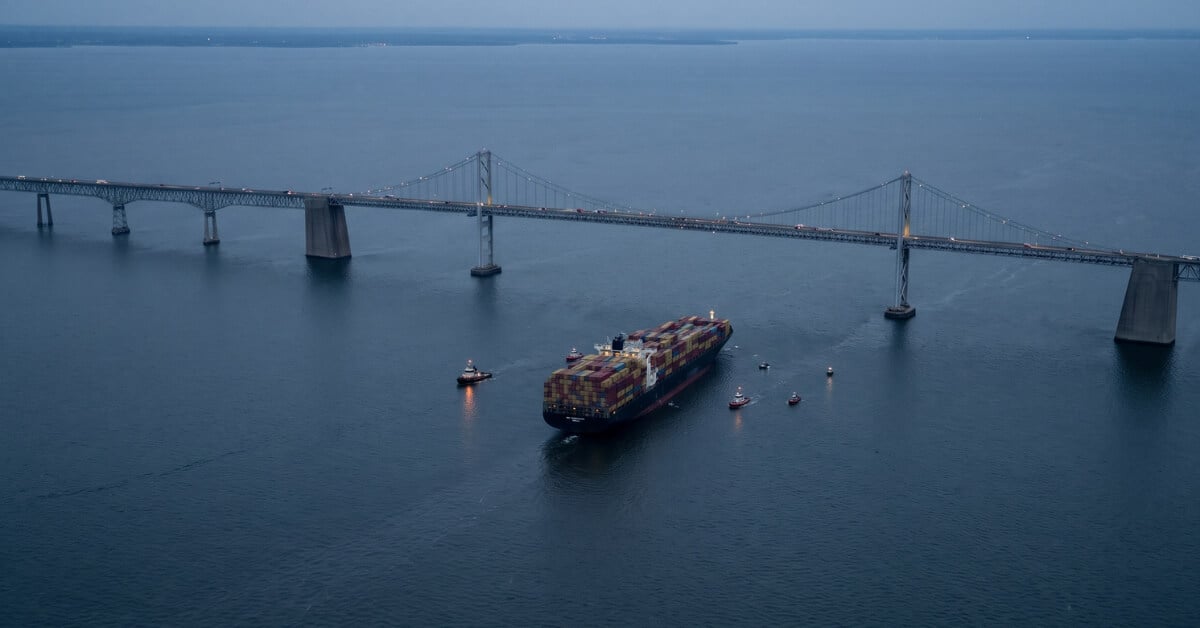
The eight-minute gap between a ship losing steering and the decision not to close the Chesapeake Bay Bridge is a near-miss that demands a systematic fix, not just a procedural review. When the container ship GSL Nicoletta lost steering three miles from the bridge at 12:30 am on November 20, the vessel's pilot acted correctly by requesting an immediate road closure. The Maryland Transportation Authority dispatcher gathered details, and a duty officer contacted the Coast Guard. But the Coast Guard advised that closure was unnecessary because the vessel had already anchored safely, a conclusion reached eight minutes after the initial request. Those eight minutes represent the exact window in which a drifting ship could have closed the distance to the bridge. The MDTA has received only two such closure requests in recent memory, the first in August 2024 leading to a 15-minute closure. This is not an acceptable baseline for safety protocol. As we have noted in our coverage of the Atlantic Asphalt remains under judicial arrest as liability cap seeks validation incident, the legal aftermath of a maritime collision can take years to resolve, but the physical consequences are instantaneous.
The context of this incident is impossible to separate from the March 2024 collapse of Baltimore's Francis Scott Key Bridge, when the container ship Dali lost power and struck a support pier, killing six construction workers. That disaster killed people, closed a major highway for months, and triggered a $175 million contract to build physical pier protection around the Bay Bridge, stone islands and concrete barriers expected to be completed by the end of 2029. But that construction is years away, and in the meantime, ships pass under the Chesapeake Bay Bridge more than 3,000 times annually. The GSL Nicoletta is operated by Maersk, is 984 feet long, and its steering failure occurred three miles from the bridge. The operator stated that the cause is still under review. The vessel was placed under a Captain of the Port order until a classification society surveyor approved repairs, after which it proceeded to its Baltimore berth. The MDTA's executive director said the authority will review the incident and improve emergency protocols if needed. That "if needed" qualifier is the detail to watch. The Dali collapse was a catastrophic failure of existing protocols. The GSL Nicoletta incident was a test of those same protocols, and the result was an eight-minute delay in a decision that could have blocked road traffic before the ship was safely anchored. Compare this to the operational discipline required in other maritime sectors: the Kota Odyssey bunkers certified bio-methane, cutting Qingdao emissions over 70 percent demonstrates how rigorous verification and certification can drive measurable outcomes in fuel supply chains. The same empirical standard should apply to emergency response timelines.
The specific takeaway is this: the MDTA should implement a mandatory, time-capped bridge closure protocol triggered by any vessel losing propulsion within a defined radius of the bridge, without waiting for Coast Guard consultation. The August 2024 closure lasted 15 minutes. The November 2024 near-miss lasted zero minutes because the decision loop took too long. Physical barriers are a long-term solution; a clear, pre-authorized closure threshold is an immediate one. The Dali collapse proved that the margin for error in these waters is zero. The GSL Nicoletta incident proved that the current margin for decision-making is eight minutes. That is not a gap to be reviewed. It is a gap to be closed.