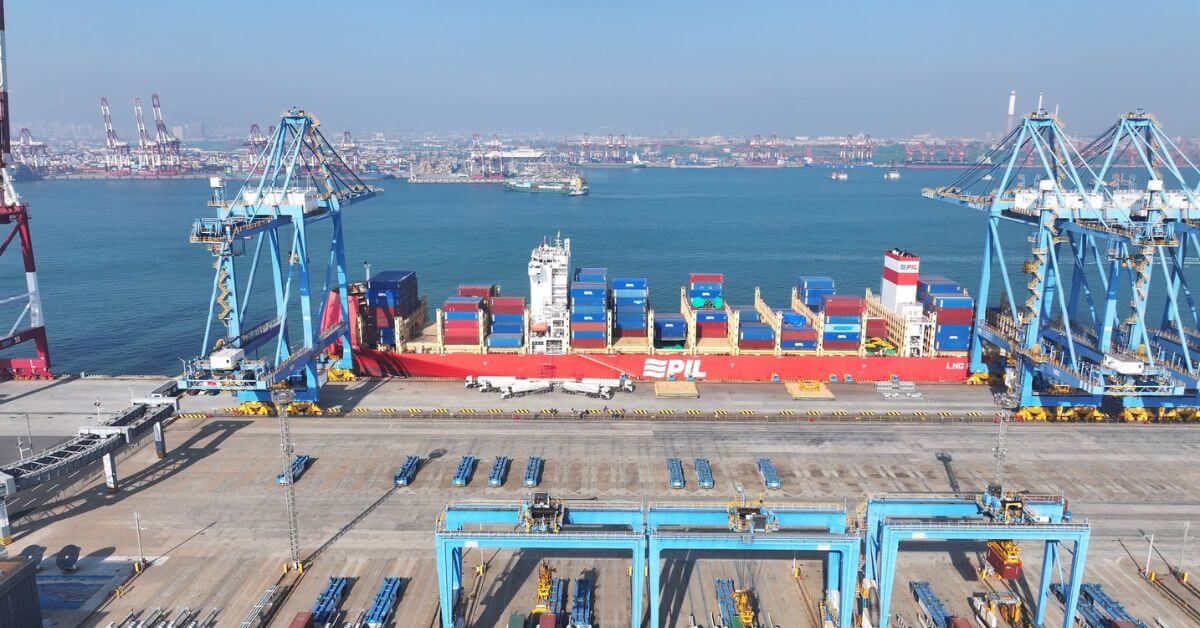
The decarbonisation of international shipping is not a distant ambition; it is happening now, in measurable and validated steps. Pacific International Lines' first-ever bunkering of ISCC-certified liquefied bio-methane (LBM) for the *Kota Odyssey* at Qingdao Port is a concrete demonstration that green fuel pathways can be deployed at scale today, cutting well-to-wake emissions by over 70 percent against conventional fuel oil. This milestone matters because it proves that existing LNG dual-fuel vessels can accept renewable drop-in fuels without any machinery modifications, creating an immediate lever for operators to reduce their carbon footprint while the supply of zero-emission fuels matures.
The operation, conducted with Qingdao Port Group, positions the Chinese port as a credible contender in the green bunkering landscape, following similar moves by Hong Kong and Piraeus forge measurable green shipping corridor earlier this year. Where Hong Kong's corridor agreement focuses on route-level collaboration and infrastructure planning, Qingdao has delivered a physical transaction, truck-to-ship bunkering of a certified renewable gas. That distinction is important for readers tracking the gap between corridor announcements and operational reality. PIL's chief marine officer, Abhishek Chawla, emphasised the flexibility built into the company's fleet renewal programme, noting that the 28 LNG dual-fuel newbuilds ordered since 2022 allow the carrier to gradually introduce cleaner fuels like LBM as supply grows. This is not a speculative pledge; it is an engineering strategy that aligns vessel design with fuel availability, a model other lines could replicate.
For the research and policy community, the 70 percent well-to-wake reduction figure deserves scrutiny. The LBM used here comes from organic feedstocks, and the carbon savings are calculated against both heavy fuel oil and fossil LNG. That kind of empirical, peer-reviewed accounting is exactly what the industry needs to move past vague sustainability claims. Yet the undisclosed volume and commercial terms of the deal leave an open question: how scalable is this supply chain? Qingdao Port's Yijie Zhang described the maiden biomethane bunkering as a major milestone for China's green shipping transition, and the port's ambition to become a regional hub is credible. But replicating this operation weekly, across multiple berths, will require a build-out of production, liquefaction, and trucking capacity that does not yet exist. The Ethanol capacity offers a validated pathway for methanol-ready ship fleets study reminds us that alternative fuel strategies must be grounded in feedstock realities. LBM from organic waste is not unlimited, and competition for those feedstocks with other sectors will set a ceiling on its maritime adoption.
The specific detail to watch is how PIL integrates LBM into its regular operations on the SWS service connecting Asia with West Africa. That route's port infrastructure and fuel availability will test whether the Qingdao bunkering was a one-off demonstration or the start of a repeatable logistics chain. If the carrier can secure consistent LBM supply for even one string of its network, it will provide a real-world template for other dual-fuel operators and give charterers a validated option for Scope 3 reductions. The *Kota Odyssey* is not a testbed; it is a working ship on a commercial route, and that is precisely what makes this milestone measurable.