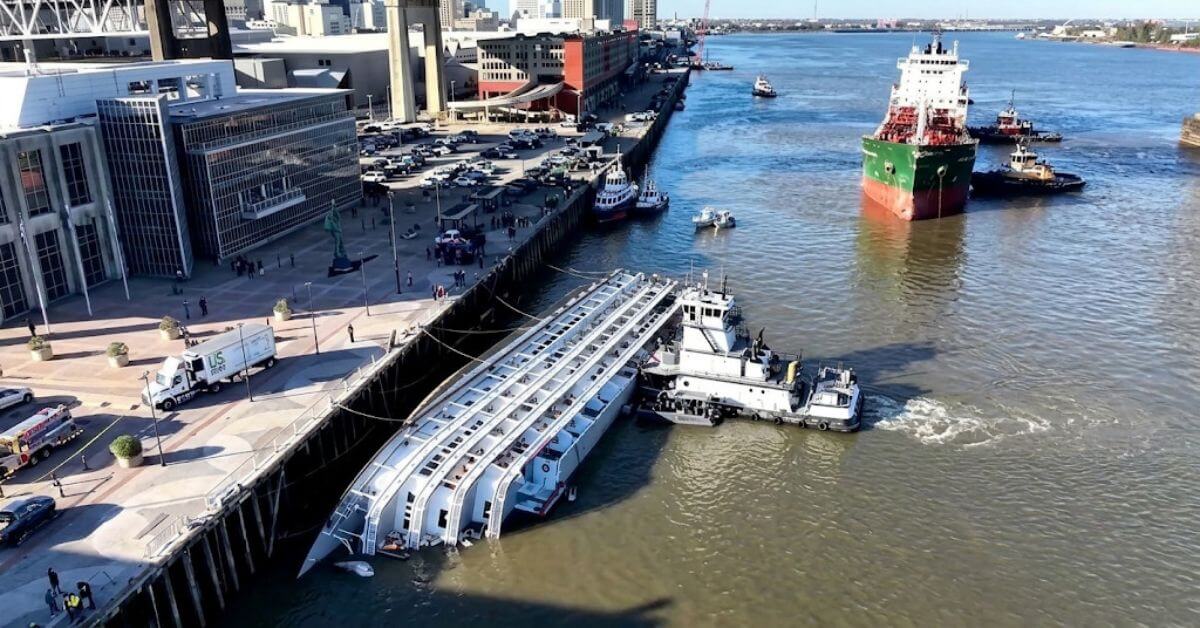
Understanding drives protection. That principle is tested when a preventable maritime accident leaves passengers injured and the legal system scrambling to assign accountability. The collision between the tanker *Atlantic Asphalt* and the docked cruise ship *American Heritage* in New Orleans on November 13 is not merely a lawsuit; it is a data point in a larger pattern of operational failures that demand empirical scrutiny. An elderly couple from Pennsylvania has now filed the second state lawsuit over the crash, alleging serious physical injuries sustained during both the impact and the chaotic rescue that followed. Their case joins a growing docket: two New Orleans police officers have already sued in the same court, and four crew members have filed a federal claim against the tanker's owner Nave Shipping SA and manager Thome Ship Management. The Port of New Orleans has separately sued for more than $1 million in dock damage, and a federal judge has authorized the arrest of the *Atlantic Asphalt* as security. These are not isolated grievances. They are calibrated signals of a system under stress.
The preliminary NTSB finding, that the tanker's rudder remained stuck to starboard for roughly two minutes before the collision, raises immediate, measurable questions about maintenance protocols and crew response. The vessel veered toward the east bank and struck a stationary cruise ship carrying 140 passengers and 50 crew. The *American Heritage* capsized 22 minutes later. The couple's attorney stated that the husband and wife barely escaped falling into the cold river water. This is not a weather event or an act of nature. It is a mechanical failure with human consequences, and it echoes a troubling pattern we have tracked closely. Earlier this year, a Houston ship pilot became the first in U.S. history to face a seaman's manslaughter charge over a fatal collision, a case that set a legal precedent we examined in Seaman's Manslaughter Charge Sets Legal Precedent in Houston Ship Collision. That case and the *Atlantic Asphalt* incident share a common thread: the gap between what voyage data recorders can tell us and what oversight systems actually prevent. Meanwhile, the crew members who filed their own federal lawsuit over this same collision are seeking accountability through the same legal channels we covered in Lawsuit Filed Against Tanker Operators Over Mississippi River Collision. Each filing adds a layer of empirical evidence to a narrative that demands integrated action.
Our take is straightforward: litigation is a lagging indicator. It documents failure after the fact. What the maritime industry needs is a leading indicator, a real-time, peer-reviewed system of operational intelligence that flags mechanical anomalies before they become collisions. The NTSB's preliminary finding is a valuable piece of ocean intelligence, but it arrived after 140 passengers and 50 crew were evacuated from a capsizing vessel. The wife in this case had helped a fellow passenger during a medical emergency earlier in the cruise, only to be seriously injured herself when the tanker hit. That detail is not sentimental. It is a reminder that human resilience is not a substitute for engineered safety. The Port of New Orleans' separate claim for more than $1 million in terminal damage underscores the economic ripple effects of a single rudder failure.
The specific consequence to watch is the legal trajectory of the federal arrest warrant for the *Atlantic Asphalt*. If a court holds the vessel as security while these multiple lawsuits proceed, it will create a tangible financial pressure on the owner and manager to produce the tanker's maintenance logs and crew-training records. Those documents, if made public, could provide the longitudinal data the industry needs to calibrate better standards. The question is not whether this couple deserves compensation, they clearly do. The question is whether the industry will treat their injuries as a measurable indicator of a systemic risk, or as an isolated event to be settled and forgotten. The answer will be written in the data that emerges from these cases.