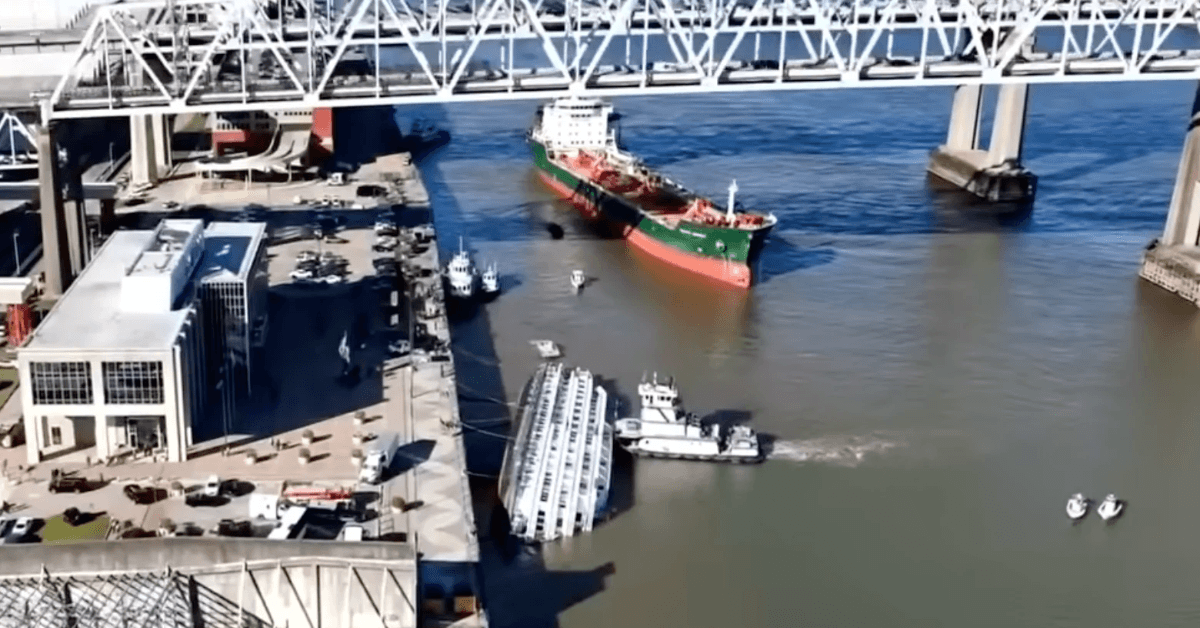
A federal lawsuit seeking more than $1 million in damages is a clear signal that the Port of New Orleans holds the operator of the tanker *Atlantic Asphalt* accountable for a collision that could have been far worse. This is not merely a financial dispute; it is a test of maritime accountability on a working river where the margin for error is razor-thin. For our readers, researchers, policymakers, and maritime professionals, the practical takeaway is this: the incident exposes critical vulnerabilities in vessel navigation and emergency response that demand systematic, data-driven scrutiny.
The collision on November 13, 2026, occurred when the 160-metre tanker, reportedly laden with asphalt, lost steering and struck the docked riverboat *American Heritage*, capsizing it. That all 197 passengers and crew survived is a testament to swift evacuation, but 32 hospitalizations and an estimated $1 million in terminal damage are not acceptable outcomes for a preventable event. The Port's complaint alleges negligence and gross negligence by the tanker's owner, Nave Shipping SA, and manager, Thome Ship Management Pte Ltd. The emergency seizure of the vessel, and the request for its sale to cover claims, underscores the severity of the alleged failures. This story echoes a broader pattern we have examined in our reporting on maritime security and infrastructure resilience. The Security Incident in Singapore Strait Highlights Maritime Vulnerability reminds us that critical waterways remain points of risk, while the Mississippi River collision grounds American Heritage, 32 hospitalized after tanker strike provides the foundational facts of this event. These incidents, though different in nature, converge on the same question: how do we validate that vessels operating in constrained channels have the operational integrity and contingency planning required to prevent catastrophe?
What makes this case particularly significant is the ownership structure. Nave Shipping SA, registered in Liberia, is reportedly a subsidiary of China State Shipbuilding Corporation, a Chinese state-owned conglomerate. This international chain of accountability, from the Marshall Islands flag to a Liberian registry to Chinese state ownership, complicates liability and regulatory oversight. Meanwhile, the *Atlantic Asphalt* was built in 2017, a relatively modern vessel, raising questions about whether its steering failure was a mechanical defect, a maintenance lapse, or a human error. The National Transportation Safety Board is collecting evidence and interviewing crew, but our readers should watch for the empirical data that emerges: the vessel's maintenance logs, its real-time steering system diagnostics, and the crew's training records. These are the measurable inputs that will determine whether this was an anomaly or a systemic risk.
The immediate consequence is tangible: moving the capsized *American Heritage* could take weeks, as 16,000 gallons of fuel must first be removed safely. That timeline means the Thalia Street Terminal will remain partially inoperable, and business interruption claims will mount. But the open question, one that demands longitudinal study, is whether this incident will drive the adoption of integrated data ecosystems for vessel tracking and emergency response along the Mississippi River. The Port of New Orleans has made its position clear: it bears no responsibility. The court will decide liability, but the maritime community should decide on better safeguards. We will be watching for the NTSB's final report, specifically whether it recommends mandatory real-time steering monitoring for tankers navigating congested river sections. That single detail could reshape operational standards on one of America's busiest waterways.