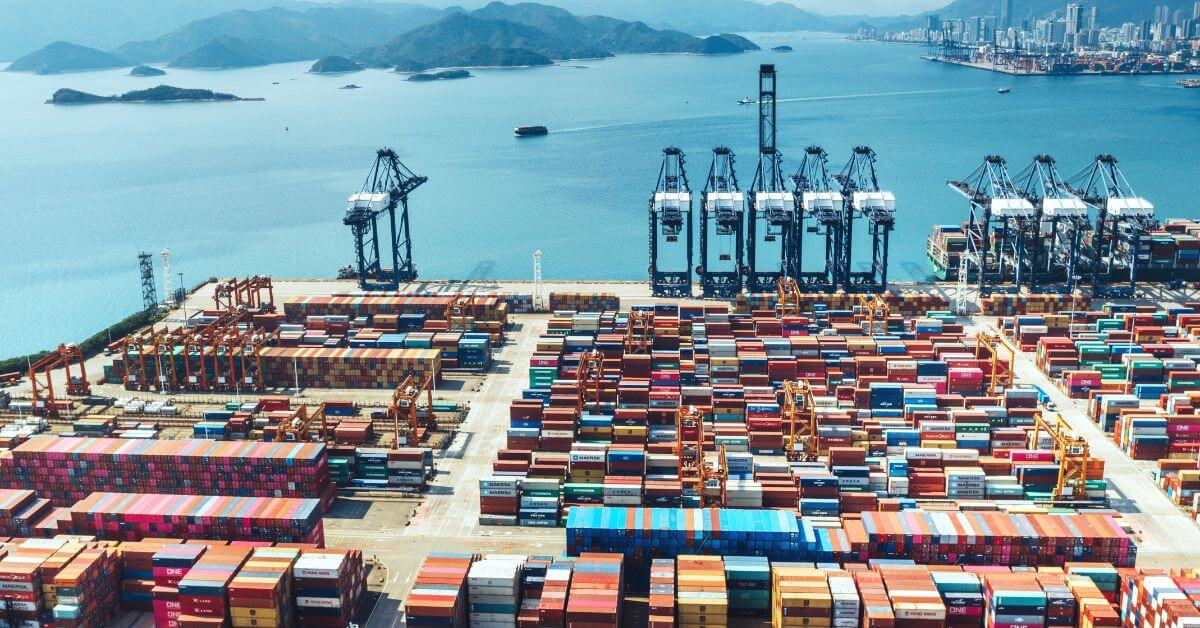
The record 7.279 million twenty-foot equivalent units that moved through Chinese ports in the seven days to September 20 is not just a number on a shipping manifest. It is a calibrated signal, measured in real time, of how trade policy uncertainty reshapes physical supply chains before diplomatic talks even begin. The surge in export activity ahead of the Xi-Trump summit tells us that commercial actors are not waiting for political clarity. They are moving inventory now, integrating the risk of new tariffs into operational decisions rather than strategic forecasts. This is ocean intelligence at work: the empirical evidence of behavior responding to a known policy cliff.
We would tell a reader who asks what this means for them to watch the direction of these flows, not just their volume. The same week that Chinese exports max out port capacity, we see parallel moves in other corridors. Ship-to-ship transfers in the Gulf of Oman have hit their maximum, as Gulf of Oman STS Transfers Max Out Amid Rising Saudi Oil Exports shows, while Integrated Subsea Infrastructure Shifts to Enhance Indian Ocean Connectivity indicates that data routes are reweaving around geopolitical friction. And Russia Calibrates Export Revenue for Northern Sea Route Icebreaker Fleet shows another state calculating how to monetize its own chokepoints. Taken together, these are not isolated data points. They are integrated data ecosystem events, each one a measurable adjustment to a world that is fragmenting along political lines while remaining physically connected through the ocean.
Our honest take is that this port record is less about Chinese economic strength and more about the cost of uncertainty. When businesses front-load exports, they are borrowing future demand to hedge against present risk. That is a rational response, but it is not a sign of sustainable growth. It is a logistical arbitrage against an unpredictable policy environment. The practical consequence for researchers and policymakers is that quarterly trade numbers will be distorted by this effect. Reading them as straightforward economic indicators would be a mistake. They are, instead, climate indicators of a different kind: signals of how much stress the global trading system can absorb before a correction.
The specific thing to watch in the coming weeks is whether the post-summit outcome validates or reverses this front-loading. If the tariff threat is defused, expect a sharp drop in the next reporting cycle. If not, the record will hold, but with thinner margins and higher costs baked into every route. We would advise anyone tracking these trends to correlate the port data with the STS transfer volumes and the subsea cable shifts. The ocean is the connective tissue, and it is telling us that the system is recalibrating, not collapsing. The question is not whether these flows will continue, but at what price, and under whose rules. That is the number to watch.