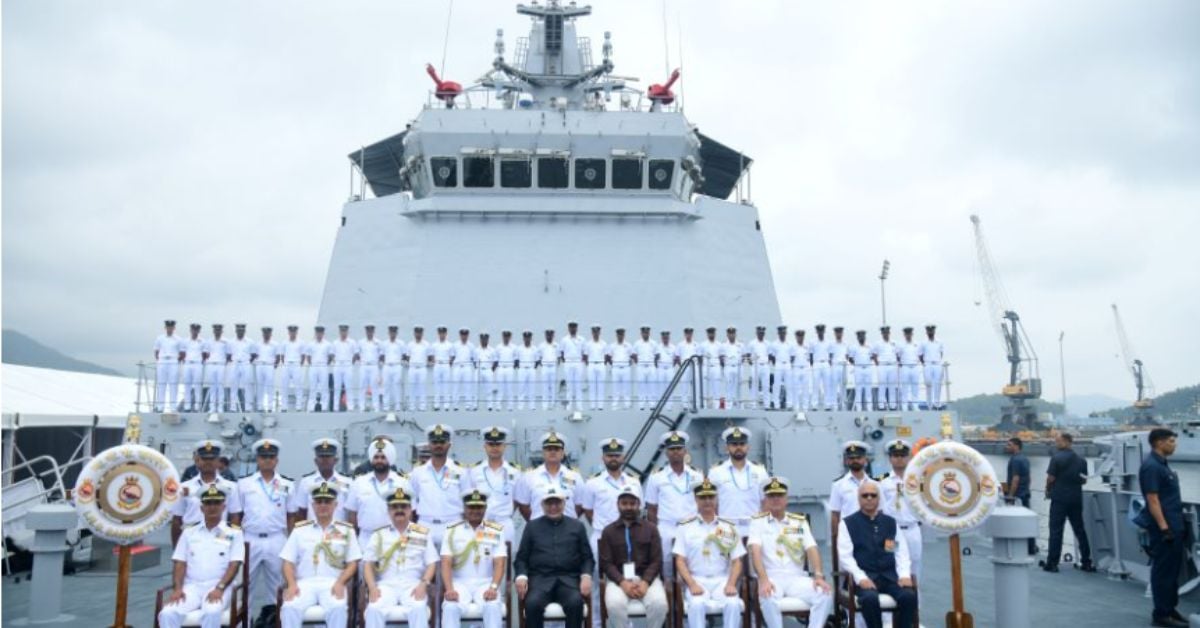
The commissioning of INS Samarthak marks a genuine milestone for India's naval ambitions, and not simply because another hull has entered service. What matters here is that a private shipyard, Larsen and Toubro, delivered a warship with over 75% indigenous content under the Make in India initiative, proving that the country's industrial base can now produce complex, multi-role vessels outside of government-owned yards. For our readers, researchers, policymakers, and defense analysts, this is a measurable signal that India's defense ecosystem is maturing. It is worth comparing this achievement with parallel efforts globally: Canada's largest polar icebreaker begins construction to expand Arctic ocean intelligence shows another nation pushing sovereign shipbuilding capacity, while Fincantieri commits nearly €100 million to robotic shipyard intelligence demonstrates how European yards are integrating automation to stay competitive. India's approach, leveraging private sector engineering talent rather than solely state-run infrastructure, offers a different, but equally valid, path to modern naval power.
The vessel's design philosophy is what makes this commissioning more than a routine event. INS Samarthak is explicitly built to support unmanned systems, test new naval technologies, and operate in contested environments. Its dynamic positioning system allows precise launch and recovery of targets at sea, a capability that directly supports the integration of naval drones into fleet operations. This is not a ship built for a single mission; it is a platform intended to evolve as threats and technologies change. Admiral Krishna Swaminathan's comment that lessons from this project must shorten approval periods for future vessels is the practical insight our readers should watch. If India can reduce the bureaucratic lag between design and delivery, private shipyards could become a reliable engine for rapid fleet modernization, an outcome that would give the Navy a genuine operational edge.
The technical specifications reinforce the vessel's purpose. With a displacement of 3,750 tonnes, a length of 107 metres, and a range of 4,500 nautical miles, INS Samarthak is not a capital ship but a versatile workhorse. Its armament, an OTO Melara 76 mm gun, 30 mm cannons, rocket launchers, torpedoes, and a flight deck for a HAL Dhruv helicopter, covers surface, sub-surface, and air threats. The crew complement of just 16 people suggests a high degree of automation and systems integration, which aligns with global trends in warship design. Compare this to the LNG-Ready Makua Christened, Advancing Measurable Fleet Modernisation, which focuses on commercial efficiency and environmental compliance. INS Samarthak prioritizes adaptability and indigenous content, reflecting a different set of strategic imperatives driven by national security and self-reliance.
The specific detail to track is how the Indian Navy uses this vessel as a testing platform for naval drones. If INS Samarthak accelerates the operational deployment of unmanned systems within the fleet, it will validate the entire private-sector shipbuilding model. If not, the vessel remains a capable but conventional asset. For our audience, the open question is whether the lessons learned here will translate into shorter delivery times for the next class of warships. That is the metric that will determine if this commissioning is a one-off success or the beginning of a structural shift in India's defense industrial base.