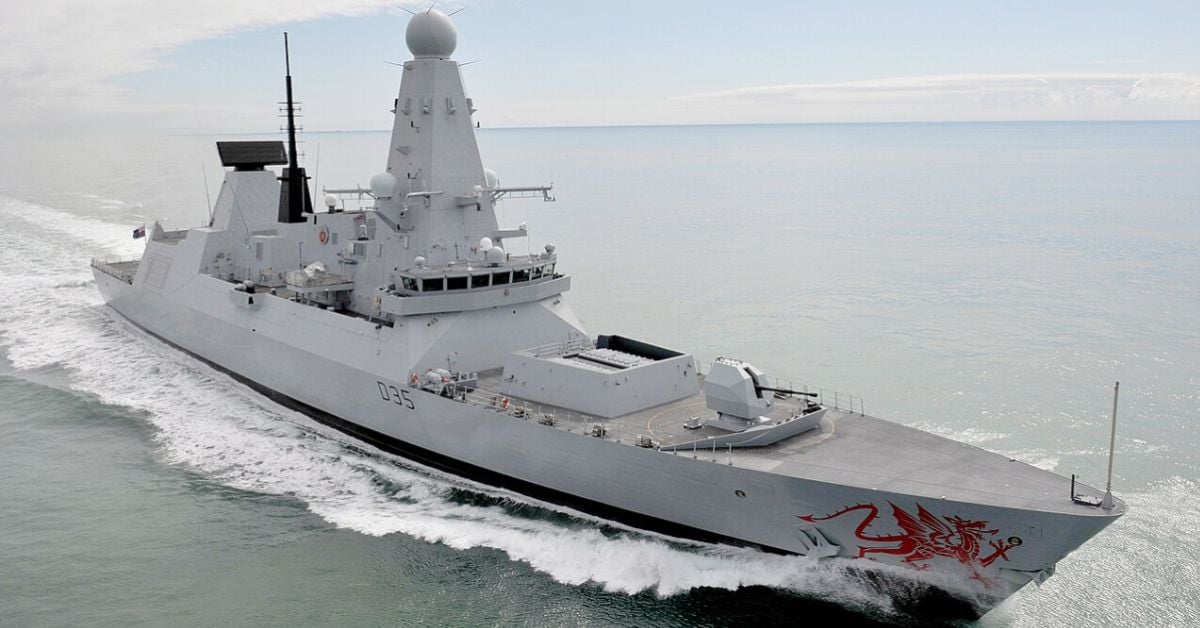
The Royal Navy's presence near the Strait of Hormuz has quietly thinned to a single vessel, and that is a strategic signal worth reading carefully. HMS Dragon has returned to Portsmouth after a seven-month deployment that included escorting German minehunters through the Suez Canal and protecting British assets on Cyprus, but no replacement destroyer has been announced. With only six destroyers in the fleet and three currently undergoing overhaul, the U.K. has effectively accepted a reduced posture in one of the world's most contested maritime chokepoints.
This is not a failure of the crew, who operated in some of the riskiest waters while safeguarding British interests, as Admiral Gwyn Jenkins rightly acknowledged. It is a structural constraint. The Royal Navy is choosing where to concentrate its limited hulls, and the Gulf is currently bearing the cost. The practical consequence is measurable: RFA Lyme Bay, a mine countermeasures mothership, now stands alone near the Strait of Hormuz. That vessel is vital for clearing mines, but it is not a combatant capable of deterring the kind of attacks we have already documented, including drone and fire attacks targeting three tankers near the Strait of Hormuz and strikes that left two Indian seafarers missing after commercial vessels were hit. The gap between the threat and the response is widening.
The broader picture is equally telling. France sent a Carrier Strike Group led by FS Charles De Gaulle in May, then pulled it back after the U.S.-Iran ceasefire, leaving two frigates and two minehunters in the region. The U.K. has not matched that follow-through. The ceasefire has not held in any meaningful way; ships are still being attacked, operating costs for shippers are climbing, energy supplies are tightening, and inflation is rising across multiple economies. This is not an abstract geopolitical debate. It is a direct economic pressure on global supply chains, and it connects to the kind of operational validation we see elsewhere, such as the Arctic transit validated as PanStar Acro completes maiden commercial voyage, where new routes are being tested precisely because traditional passages are becoming more dangerous and expensive.
Our take is plain: the U.K. is underinvesting in a region where its interests are actively threatened. The mission to the Strait of Hormuz was announced with clear intent in April, when Prime Minister Starmer and President Macron agreed to deploy warships to safeguard commercial vessels and conduct mine clearance once a truce was reached. The truce arrived, but the sustained naval commitment did not. HMS Dragon's return is not a routine rotation; it is a de facto withdrawal. The open question is whether another destroyer will be sent, and there is no public indication that one will be. The specific detail to watch is the status of the three destroyers under overhaul. If those repairs do not accelerate, the Royal Navy's capacity to respond to the next attack near Hormuz will be measured in months, not weeks. That is the timeline that matters for shippers, insurers, and every economy dependent on the energy and commodities moving through that strait.