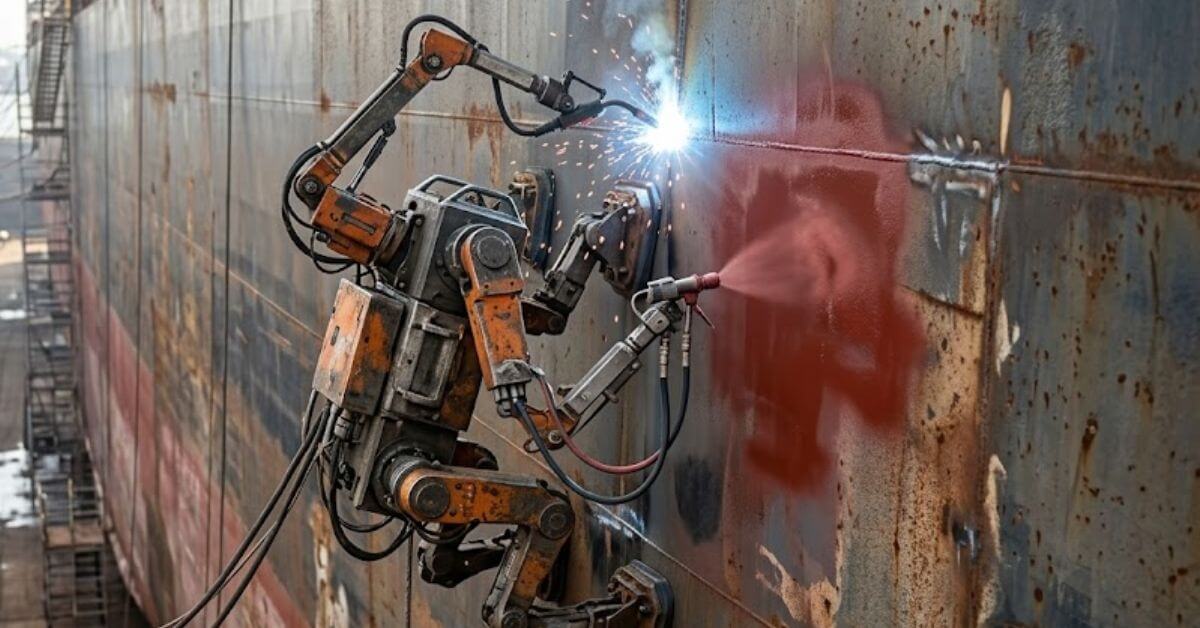
Kawasaki Heavy Industries' four-legged welding robot is not a novelty act. It is a direct, measurable response to a documented problem: Japan's shipbuilding workforce is shrinking, and the knowledge held by veteran welders is retiring with them. The prototype, which uses electromagnets to climb vertical and curved hulls and physical AI to assess weld seams, targets the kind of repetitive, physically demanding work that young workers are increasingly unwilling to take on. That is not automation for its own sake; it is the difference between building ships and losing the ability to build them at all.
The practical implications extend far beyond one factory floor. Kawasaki plans to test the robot at its Sakaide Works in 2027, with operational use targeted for 2028, and the company has paired the project with NVIDIA to connect vessel design to production through digital twins and simulation. This is the same logic driving the £6 billion naval infrastructure advances sovereign submarine fleet support in the UK and the new container ship design eliminates manual lashing to boost capacity and safety from HD Hyundai: the maritime sector is not just adding new hardware, it is re-engineering how vessels are built and operated around labor scarcity. The $6.6 billion Maryland shipyard, the largest U.S. maritime investment since WWII, will face the same recruitment pressures. A robot that can weld in a tight corner on a curved hull is not a replacement for human judgment; it is a way to keep human judgment in the industry longer.
What matters here is the transfer of expertise. Kawasaki president Yasuhiko Hashimoto explicitly stated that the company intends to use veteran workers' experience to build the physical AI systems that control these machines. That is the correct approach: the robot does not invent new welding techniques, it learns from the people who already know them. The cameras and sensors that inspect seams and calculate the required weld volume are only as good as the data they are trained on. The real asset is not the hardware, it is the codified knowledge of a shrinking workforce. This is empirical, calibrated automation, not a black box.
The open question is whether this model scales beyond shipbuilding. Kawasaki has said it wants to extend physical AI to vessel operations, maintenance, and servicing, and Hitachi is pursuing similar machines for manufacturing and logistics. That trajectory is worth watching, but the immediate test is simpler: can the prototype survive the salt, vibration, and heat of a working shipyard? The 2027 demonstration will answer that. If it succeeds, the takeaway is clear: the next generation of shipyard workers will not be replaced by robots, they will be supervised by them, and the bottleneck will shift from skilled welders to skilled robot operators. That is a workforce transition every major maritime nation should be planning for now, not after the robots arrive.