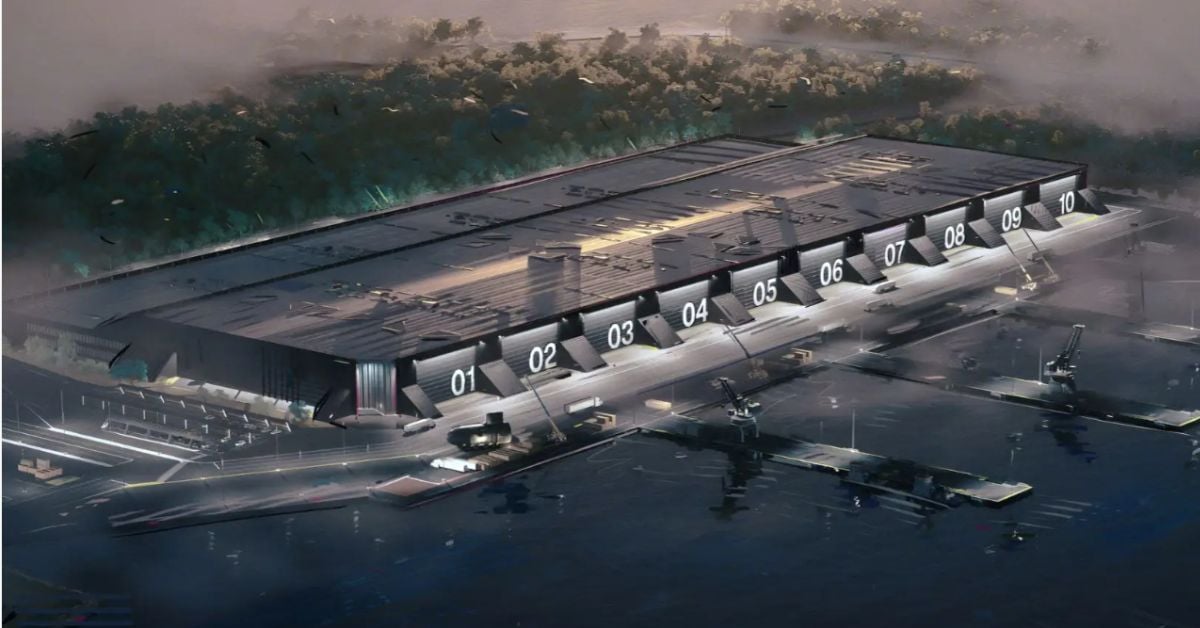
This $6.6 billion investment in a Maryland shipyard is not merely a historic infrastructure project; it is a calibrated response to a bottleneck that has silently constrained naval readiness for years. The announcement of Arsenal 2 at Sparrows Point represents the largest U.S. maritime investment since World War II, and it signals a practical shift in how we approach the industrial base behind national security. For our readers tracking the strain on naval assets, this development connects directly to recent indicators of operational pressure, such as the Longest carrier deployment in decades signals shifting maritime demands and the sustained production timelines reflected in the Aircraft Carrier John F. Kennedy Reaches 99% Completeness Ahead of 2027 Handover. The shipyard is an empirical answer to a measurable problem.
What makes this project distinct is its integration of physical scale with digital precision. Anduril's ArsenalOS platform will link material handling, fabrication, inspection, and assembly into a single real-time dashboard. This is not speculative tech; it is the application of an integrated data ecosystem to a domain that has historically relied on fragmented coordination. The facility will produce components for Virginia-class submarines and next-generation autonomous vessels, then ship those parts to General Dynamics Electric Boat and HII Newport News for final assembly. The logic is straightforward: by distributing the fabrication load, the Navy can accelerate delivery schedules without overburdening its two primary yards. The 1,200-foot graving dock and two million square feet of space translate directly into faster production cycles for fast-attack submarines, vessels that have faced documented delays.
The economic data is measurable: over 3,200 direct jobs, an additional 11,500 indirect positions, and $312 million in wages. But the strategic takeaway for our audience is narrower and more concrete. This yard is designed to reduce the single-point-of-failure risk that has haunted submarine construction for a decade. When one yard falls behind, the entire fleet feels the ripple effect. Arsenal 2 creates parallel capacity, and that redundancy is itself a form of resilience. It is also worth noting that Sparrows Point was once a steelmaking and shipbuilding hub; this project restores industrial capability on a site with validated infrastructure, not a greenfield gamble.
The question that remains open is whether the software layer, ArsenalOS, can perform at the scale of forty football fields without introducing its own integration risks. Real-time coordination across hundreds of welders, pipelayers, electricians, and inspectors is a complex systems problem. If Anduril's platform delivers on its promise, this model could be replicated elsewhere. If it stumbles, the delays will be measured in months, not weeks. That is the detail to watch: not the ribbon-cutting, but the first full production cycle.