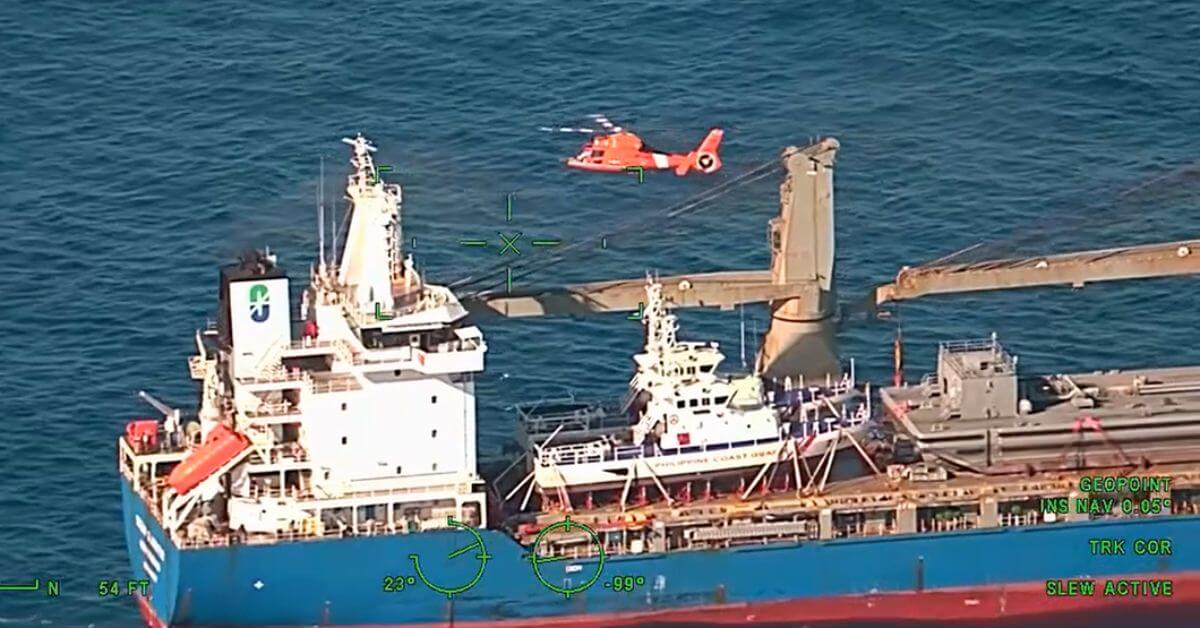
A Coast Guard helicopter crew lifted a 55-year-old seafarer from the deck of a cargo ship 86 miles off Hawaii last week, and the operation tells us more about the state of ocean stewardship than any single rescue can convey. This medevac was not a crisis of equipment or coordination, it was a textbook execution of the maritime safety net that exists because we have chosen to measure, track, and respond. The Joint Rescue Coordination Centre Honolulu maintained contact with the *Ocean Gladiator* for nearly 24 hours as the vessel steamed closer to the island, ensuring that when the MH-65 Dolphin launched, the window for extraction was precise. That kind of operational intelligence depends on the same integrated data ecosystems that allow us to validate Measured sea level rise validated across decades of ocean data and track the movement of Tracking 350 million tons of annual plastic waste to its ocean sink. The ocean does not offer second chances; we need real-time, calibrated awareness to act.
What makes this story significant is the cargo the *Ocean Gladiator* carried. The vessel was transporting two decommissioned 87-foot Coast Guard cutters, *Marlin* and *Bluefin*, repainted and destined for the Philippine Coast Guard, where they will become BRP *Pag-Asa* and BRP *Patag*. The Philippine service formally accepted those vessels in Baltimore in August. This is not a routine transfer of hardware. It is a measurable, peer-reviewed kind of alliance: two nations exchanging proven maritime assets to extend patrol coverage, response capability, and ocean intelligence across a region where contested waters and medical emergencies alike demand reliable presence. The same week the US Coast Guard evacuated a mariner from a ship carrying those cutters, the Philippine Coast Guard was intercepting a vessel during its own medevac in the South China Sea, as reported in Escalation at Sea: Vessel Intercepted During Medevac in Contested Waters. The parallel is not coincidental. When nations invest in interoperable, validated response systems, the return is measured in lives saved and sovereignty sustained.
The practical takeaway for our readers is this: the rescue of one crew member 86 miles offshore is a direct consequence of long-term investment in ocean infrastructure, satellite links, AIS tracking, helicopter readiness, and multinational agreements that allow a US cutter to become a Philippine patrol vessel. These are not abstract policy wins. They are the reason a 55-year-old man on a 545-foot freighter received a flight surgeon's consultation from a duty desk in Honolulu and was lifted to care within hours. The Coast Guard has not released details of his condition, but the system worked because the data flowed and the assets were in place.
Watch what happens when the *Ocean Gladiator* reaches Manila. The cutters it carries will begin their own operational lives under a new flag, performing medevacs, conducting patrols, and feeding data into a shared picture of ocean health. That is the concrete return on a calibrated, collaborative approach, and it is the standard by which every future rescue, and every future transfer, will be measured.