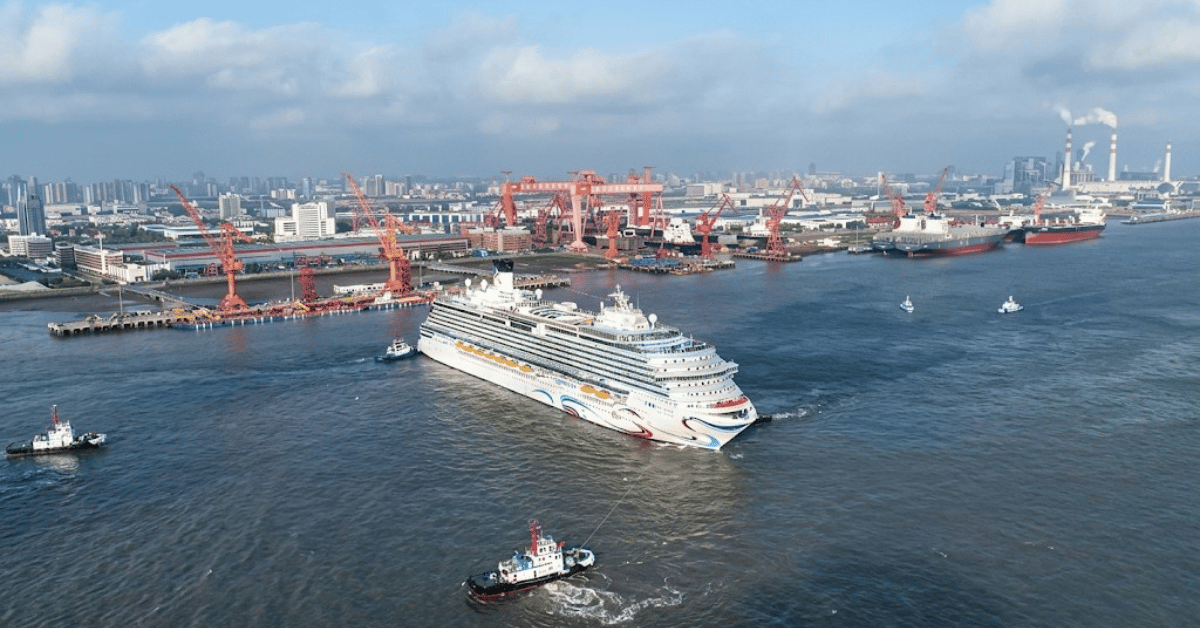
The rapid delivery of China's second home-built large cruise ship, Adora Flora City, is a measurable step forward in maritime industrial capacity, but it also raises a set of empirical questions about ocean transit's growing footprint. The vessel was handed over on November 6 in Shanghai, eight months ahead of schedule, with construction efficiency improved by 20 percent compared to its predecessor. That is a validated gain in production capability, and it matters for anyone tracking the intersection of commercial shipping, tourism infrastructure, and ocean use. Yet as we watch this vessel prepare to sail from Guangzhou on November 22, calling at Hong Kong and Hue, Vietnam, we should also consider what it means to add a 141,900-ton, 5,232-passenger ship to regional waters at a time when maritime corridors are already under strain. This is not about alarmism. It is about calibration.
Consider the contrast with other recent maritime developments we have covered. The Strait of Hormuz access secured for four nations under validated passage terms is a narrow, negotiated corridor, geopolitical precision in a choke point. Meanwhile, the Residential cruise terminates voyage, stranding over 200 paid passengers in Cambodia is a reminder that the business of ocean transit can fail abruptly, leaving people and assets in limbo. Adora Flora City occupies a different lane: it is a state-backed, series-production vessel, built by Shanghai Waigaoqiao Shipbuilding for the joint venture between CSSC and Carnival Corporation. The shipbuilder's chairman has confirmed that conceptual design for a third large cruise ship is already underway. That signals a shift from single-ship breakthrough to an integrated, repeatable production model. For researchers and policymakers who track industrial maritime output, the 80 percent domestic content in interior outfitting materials is a concrete indicator of supply chain integration.
The practical takeaway is this: the program's acceleration, eight months shaved off the build time, means more vessels entering service sooner, each carrying thousands of passengers across routes that were previously less traveled by ships of this scale. Adora Flora City will make Hong Kong its home port in 2027, with nearly 20 sailings planned that season, including a special overnight New Year's Eve cruise departing December 30. That is a specific, near-term increase in vessel traffic through one of the world's busiest ports. Whether that concentration of ocean transit aligns with climate indicators or port emission targets is a question that deserves empirical, longitudinal study. The data exists to track it. The question is whether it will be collected and peer-reviewed with the same rigor applied to the ship's sea trials. The vessel completed a 12-day sea trial in the East China Sea in May this year. The next trial may be one of capacity, not just engineering.