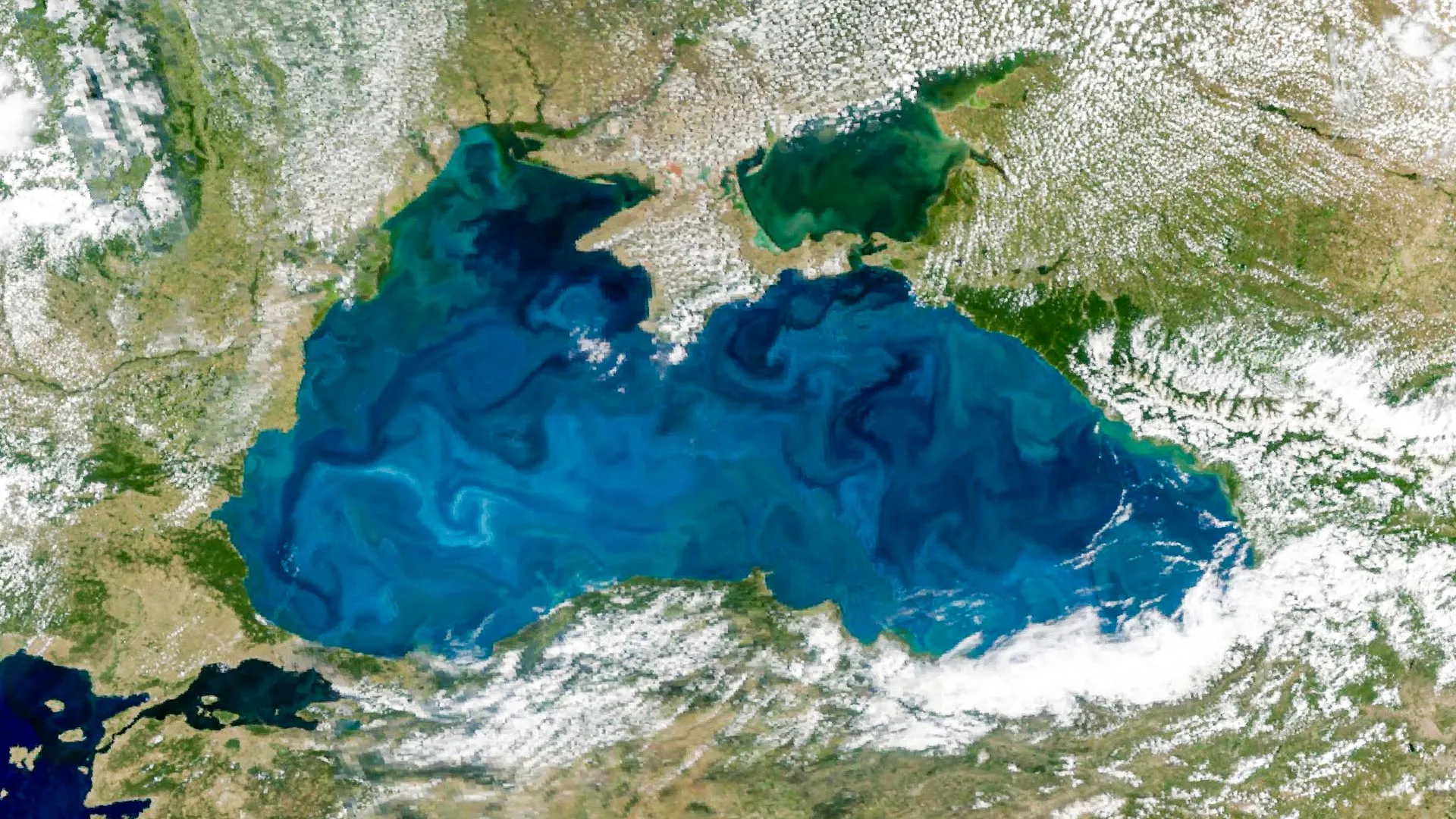
From orbit to ocean floor, the Black Sea's annual turquoise bloom is more than a fleeting spectacle. NASA's PACE satellite captured the phenomenon, where countless coccolithophores, microscopic organisms with reflective shells, brighten the water enough to be seen from space. An astronaut aboard the International Space Station also documented the bloom threading through the Bosphorus, exposing the region's swirling currents. This is not a curiosity; it is a measurable event with implications we are only beginning to integrate into calibrated ocean intelligence, now within reach through integrated data discovery.
For researchers, this imagery is a reminder that satellite data is no longer abstract. The same orbital perspective that tracks a bloom's spread can inform decisions about shipping lanes, fisheries, and coastal resilience. That is why we pair this visual evidence with the practical realities of the region. As Ukraine Supports India’s Initiative for Black Sea Shipping Routes, the waters are not only a biological stage but a geopolitical one. The bloom's currents do not respect borders, yet the policies that govern these waters are shaped by human negotiation. Understanding the ocean's behavior, validated by peer-reviewed satellite observation, becomes a tool for dialogue, not just discovery.
Our take is straightforward: this is what ocean intelligence looks like in practice. The PACE data is empirical, calibrated, and repeatable. It gives us a longitudinal view of seasonal cycles that used to be the province of shipboard sampling alone. For policymakers, the takeaway is not to marvel at the color but to ask what the bloom signals about nutrient loads, warming surface temperatures, and shifting food webs. For the public, it is an invitation to see the ocean as a system we can observe, measure, and ultimately steward. This is not alarmist messaging; it is the quiet authority of data.
What we would tell a reader who asks about this image is simple: watch the patterns, not just the pictures. The Bosphorus plume is a visible thread connecting the Black Sea's ecology to the broader Mediterranean system. As discussions about safe navigation continue, including recent confirmed military action targeting ports and vessels, the same waters carry both ecological vitality and strategic weight. The concrete point to watch is whether future blooms shift in timing or intensity, because that would be a climate indicator we can see from space. That is the kind of signal that should guide not just curiosity, but cooperation.