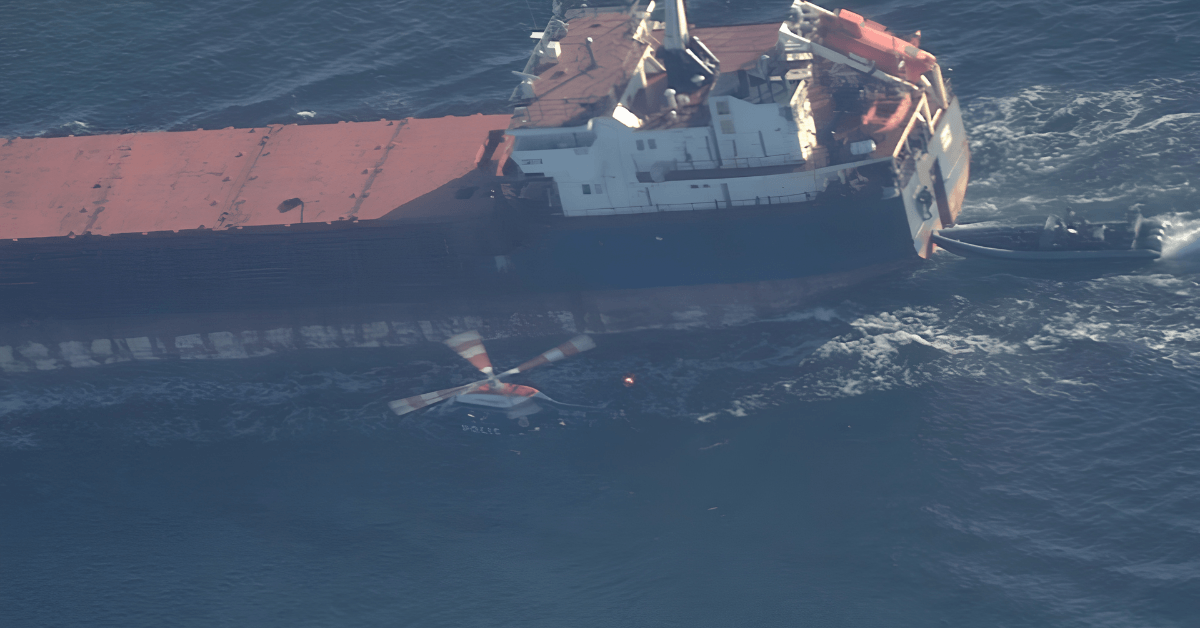
National security and ocean intelligence are converging in the Baltic Sea in ways that demand our attention. The recent Swedish special forces operation near Gotland, boarding a dry cargo vessel linked to Russia, checking crew documents, then letting it proceed, is not a standalone event; it is a calibrated data point in a pattern of hybrid activity that Europe is only beginning to measure systematically. For our readers, this signals that the maritime domain is no longer just a conduit for trade or climate data, it is a frontline for geopolitical accountability, and the tools we use to monitor it must evolve accordingly.
The facts from this operation are deliberately sparse, and that itself is instructive. Swedish police confirmed the boarding and document check but withheld the crew's nationalities, the vessel's name, and any charges. TV4 reported the crew were Russian nationals and that the ship's operator has a presence in Kaliningrad, where it recruits personnel. The vessel belongs to a company previously suspected of links to Russian intelligence. Compare this to the recent detention of the Arctic LNG 2 vessel in Norway, which was inspected on October 13 after seeking shelter in Andfjorden, another case where weather and operational vulnerability intersected with state security. In both instances, the vessels were not immediately seized or charged. They were documented, inspected, and released. This is not hesitation; it is evidence gathering. The Swedish approach mirrors the calibrated, empirical method we advocate for in ocean stewardship: collect the data, validate the patterns, and act when the evidence is peer-reviewed and actionable.
Meanwhile, the shadow fleet's reach extends beyond the Baltic. The vessels *Sea Owl I* and *Jin Hui* remain moored in Sweden, linked to Russia's "shadow fleet." The *Caffa*, detained in March 2026 for allegedly sailing under a false flag and transporting grain from Ukraine's occupied territories, was later ordered by the Swedish Supreme Court to be handed over to Kyiv. These are not isolated boardings, they are longitudinal indicators of a system that exploits the ocean's openness to move personnel, cargo, and influence. And as 99% of global data flows through targeted undersea cables, the same ocean that carries grain and gas also carries the digital backbone of our security. The connection is not metaphorical: a cable cut in the Baltic can disrupt intelligence-sharing as surely as a boarded ship can expose a spy network.
What this means in practical terms is that European authorities are moving from reactive detentions to preemptive data collection. The Politico report that EU ministers are preparing strict restrictions on Russian entry following hybrid threats is a policy shift that mirrors the operational trend: measure first, restrict second. For researchers and policymakers who track climate indicators or shipping patterns, the lesson is clear. The same integrated data ecosystems that track ocean temperature anomalies can, and should, be calibrated to monitor vessel identity, flag changes, and route deviations. The Russian Ambassador's claim that five Russian-crewed vessels have been detained since late 2025 is a political statement, but the underlying data is empirical. Each boarding, each inspection, each released vessel adds to a measurable pattern.
The specific detail to watch is the *Caffa* handover to Kyiv. If that precedent holds, it transforms a national security operation into an international legal instrument. That is not a shift in tone, it is a shift in consequence.