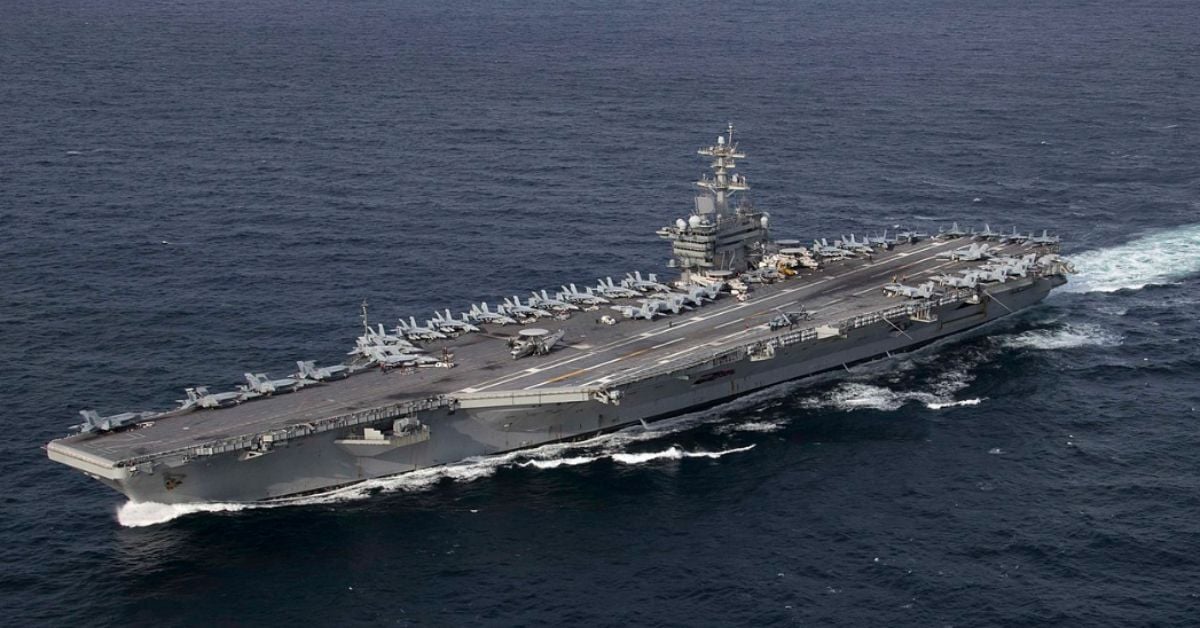
The USS Abraham Lincoln's scheduled port visit to Thailand after a prolonged Middle East deployment is more than a logistical footnote. It is a quiet reminder that naval power is, at its core, a tool of presence and persistence, not just combat readiness. For those of us tracking maritime dynamics, the carrier's movement matters less for its destination than for what it signals about the operational tempo the U.S. Navy is sustaining across two hemispheres. This is not a story about a ship; it is a story about how naval forces are being cycled, stretched, and repositioned in an era where every transit carries strategic weight.
The timing is worth pausing on. As the carrier heads toward Southeast Asia, the U.S. Navy is simultaneously pushing Navy Accelerates Autonomous Systems Integration for Enhanced Maritime Operations to reduce the crew burden on exactly these kinds of deployments. That is the practical lens here. Autonomous systems are not a futuristic aside; they are the answer to a question this deployment raises: how do you maintain forward presence when shipyards are backlogged and crews are fatigued? The Lincoln's journey is a reminder that the Navy is betting on integration, not replacement, to keep carriers like this one available when and where they are needed. Meanwhile, the Gulf of Oman STS Transfers Max Out Amid Rising Saudi Oil Exports shows that the maritime chokepoints this carrier just left remain commercially hot, even as the military focus shifts east. The carrier's departure does not mean the region is quiet; it means the Navy is willing to accept a different risk calculus there.
What we would tell a reader who asks us about this is straightforward: do not read the Thailand stop as a sign of disengagement. Read it as a logistics decision with strategic consequences. The carrier is not retreating; it is redistributing. But that redistribution carries an open question: if China's new nuclear carrier, as reported in China’s New Nuclear Carrier Signals Extended Naval Operations Capability, extends endurance and reach, the U.S. Navy's ability to match that persistence with conventional carriers becomes the central variable. The Lincoln's deployment is a measurable data point in that comparison. It is not a victory lap; it is a stress test.
The concrete detail to watch is the carrier's next assigned tasking after Thailand. If it returns to the U.S. for a minimal maintenance period, that tells you the Navy believes its current force posture is sufficient. If it turns around quickly with only a light maintenance cycle, that tells you the service is feeling the pressure of global demand. Our take is simple: the Abraham Lincoln's journey is not a headline about a ship. It is a signal about capacity, and the difference between a Navy that can sustain presence and one that is merely rotating assets will be measured in the weeks after this port call ends. That is the metric to track.