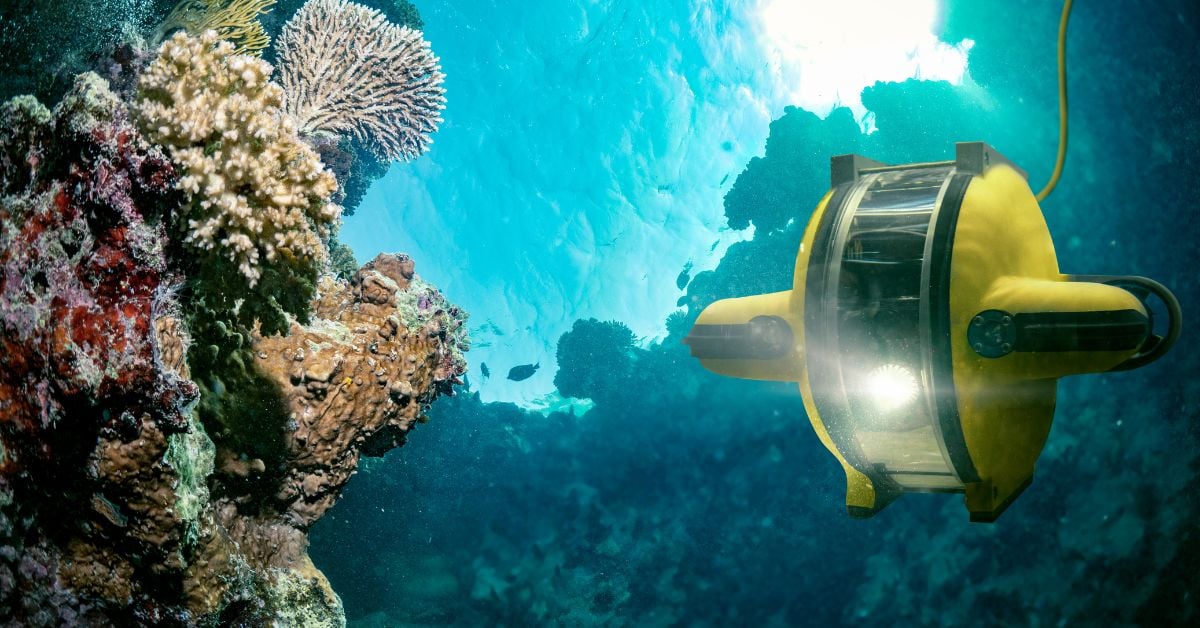
China's deployment of an autonomous robot capable of reaching 4,500 meters in the South China Sea represents a measurable leap in ocean intelligence, and that carries implications well beyond pure science. The vehicle, built by the Harbin Institute of Technology's Weihai Branch, is equipped with seven hydraulic arms designed to handle over 30 operational scenarios, from high-pressure sealing to autonomous navigation. It will conduct pipeline inspections, seabed surveys, mineral resource exploration, and geological mapping. These are empirically valuable tasks, and the calibrated data they yield will strengthen our integrated data ecosystem for ocean observation. Yet the same technology that enables sampling of basalt from the seafloor also enables reconnaissance and mine identification in contested waters. The line between scientific exploration and maritime security is not a bright one; it is drawn in water.
This dual-use reality places the robot in a context we cannot ignore. Last year, China's ROV Haiqin reached 4,410 meters in these same waters; this year, the drill ship *Mengxiang* extracted basalt from 5,000 meters below the South China Sea Basin. Meanwhile, a parallel effort is underway to build a geological dataset spanning China's eastern waters in search of copper, manganese, nickel, and rare elements, resources that underpin everything from energy storage to defense systems. Some analysts point to potential military applications, including terrain understanding for contingencies involving Taiwan or the Philippines. For readers tracking ocean intelligence, this is not speculative alarmism; it is the logical extension of a nation investing heavily in both scientific and strategic assets. Compare this to recent developments in naval ocean intelligence, such as the keel laying for a second U212NFS submarine, which advances similar capabilities through a different platform. The submarine and the robot share a common goal: extending reach into environments where human presence is impractical or impossible.
What matters for researchers, policymakers, and ocean advocates is the specificity of the data now accessible. A robot that can navigate autonomously at 4,500 meters, seal high-pressure systems, and communicate over long distances is not an incremental upgrade; it is a new tool for empirical measurement in a region where climate indicators, geological formations, and resource deposits intersect. When the USS *Frank E. Petersen Jr.* returned from a 300-day deployment in the Pacific with calibrated data, it demonstrated the value of sustained, long-duration collection. The Chinese robot brings that same principle to the vertical dimension: persistent observation from the surface to the seafloor. If the data is made open and peer-reviewed, it will accelerate global understanding of ocean dynamics. If it is not, the gap between scientific authority and strategic advantage will narrow further.
The specific detail to watch is integration. China is now operating surface drill ships, deep-sea robots, and a ROV capable of exceeding 4,400 meters, all within the same basin. The question is whether this fleet forms a coherent, real-time network feeding into a shared dataset, or remains a set of independent projects. An integrated data ecosystem would produce validated, longitudinal records that benefit climate science and resource management worldwide. A fragmented one serves narrower purposes. We will know which path is being taken by how the data is shared, not by how the robot is described. That is the difference between ocean intelligence and ocean presence.