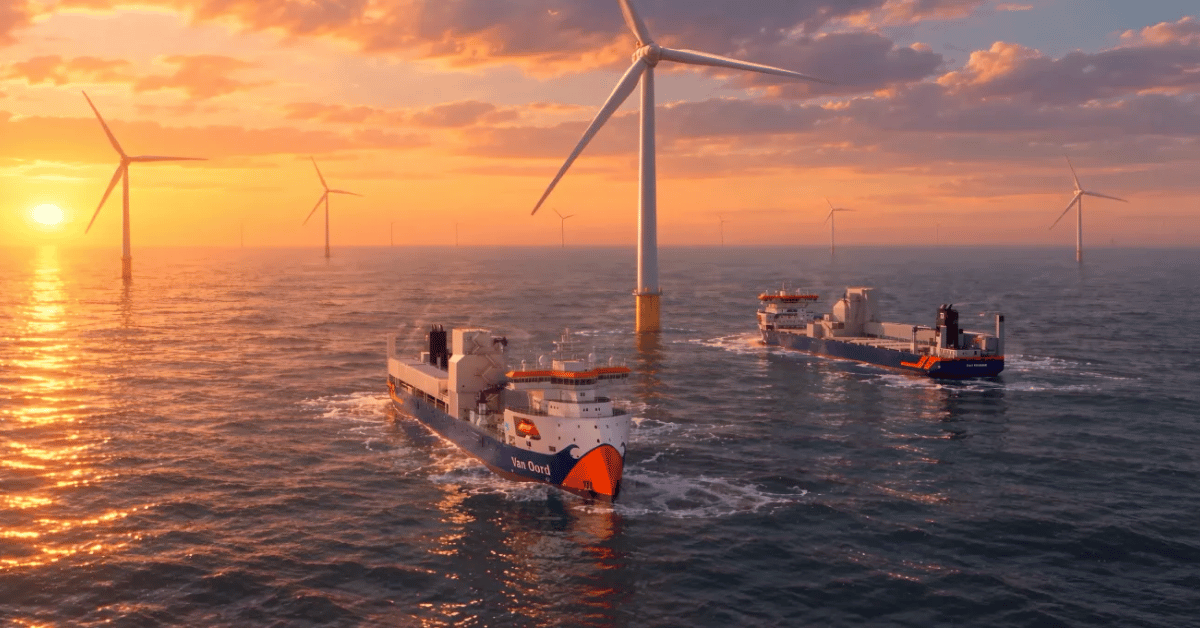
Van Oord's decision to name its next two 31,000-tonne flexible fallpipe vessels Vindnes and Vestnes, with deliveries scheduled for 2028 and 2029, is more than a fleet update. It is a calibrated statement about where subsea rock installation is headed. These are not incremental replacements; they are purpose-built tools for a workload that is becoming deeper, more exposed, and more logistically demanding. The fact that Van Oord is investing in this capacity now, rather than waiting for demand to peak, tells us something important about how they read the next decade of marine infrastructure.
What stands out to us is the engineering intent behind the 35,000-tonne displacement figure. That is not a number chosen by accident. Heavier vessels mean greater holding capacity for rock, which translates directly into fewer transits between quarry and offshore site. For projects in remote or weather-sensitive regions, that efficiency is not a luxury; it is what makes a schedule viable. We would put this in the same category as the Centennial TNT Leak Highlights Risks from Historic Submarine Wrecks story we covered recently, where the challenge is not just doing the work, but doing it safely in environments that carry hidden hazards. A fallpipe vessel dropping rock with precision from a moving position is operating under similar constraints of unpredictability, though with different variables.
For operators and project developers, the practical takeaway is straightforward: the window for securing high-capacity fallpipe assets is closing. If you are planning a cable route, a pipeline stabilization campaign, or scour protection for a wind farm foundation, you should be looking at 2028 and 2029 delivery slots as your realistic planning horizon. We would also link this to the broader push for Advancing Sustainable Shipping: Ethanol-Fuelled Tanker Project Gains Momentum, because both stories point to the same underlying trend: the marine sector is not waiting for regulation to force its hand on newbuild design. It is ordering assets that anticipate tighter environmental and operational standards.
Our honest read is that Van Oord is positioning itself for a market where the easy projects are gone. The next wave of offshore wind and oil and gas work is in deeper water, farther from shore, and often in conditions that would have halted operations a decade ago. These vessels are the response to that reality. The open question we would flag is how the industry will handle the crew training and operational knowledge transfer required to run these ships effectively. Hardware is only half the equation. We would tell any reader watching this space to track not just the launch dates, but the crewing announcements and the first charter confirmations. The vessel that matters is the one that proves it can work a full season without weather-related delays. That is the metric that will define whether Vindnes and Vestnes are successes or just expensive hulls.