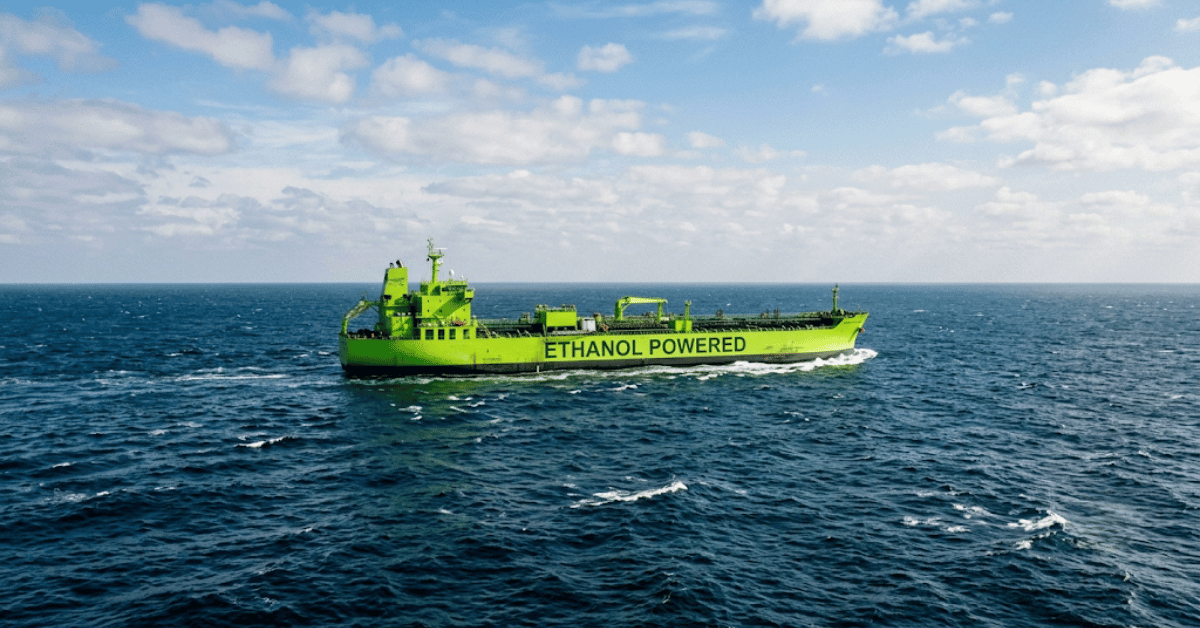
The maritime industry has a long record of treating alternative fuels as a theoretical exercise, so the news that K Shipbuilding and Lloyd's Register are advancing a 50,000 dwt ethanol-fuelled MR tanker toward approval in principle is a concrete signal, not a slogan. This is not a boutique concept vessel or a slide deck promise. It is a working design for a medium-range tanker, the workhorse of the refined products fleet, and it is being put through the rigour of classification review. That matters because the sector has been waiting for scalable, near-term decarbonisation options that do not require a complete reinvention of shipbuilding or crewing. Ethanol fits that brief, and this project treats it seriously.
The move also sits alongside other practical steps in the energy transition. Van Oord's new fallpipe vessels, Vindnes and Vestnes, and Lloyd's Register's analysis of larger LNG carriers, Optimal LNG Carrier Design, both point in the same direction: incremental, engineered progress over rhetorical leaps. None of these projects pretends that one fuel will solve everything. Instead, they reflect a mature understanding that the path to lower emissions runs through multiple corridors, each validated on its own terms. Ethanol offers particular advantages in tanker operations, where cargo segregation and tank coatings are already well understood, and where the fuel's lower carbon intensity can be measured against established baselines. That is not a silver bullet; it is an integrated data point in a broader energy system.
Our take is straightforward: this project earns attention because it is asking the right questions before the steel is cut. Feasibility assessment and approval in principle are not guarantees of commercial success, but they are the necessary filters that separate viable designs from hopeful ones. For operators and charterers, the practical implication is that ethanol-fuelled tonnage could arrive sooner than many expect, and it could do so without the operational complexity that has slowed adoption of other alternative fuels. The recent progress on LNG deliveries, such as the negotiations clearing the Strait of Hormuz, reminds us that fuel supply chains are as decisive as engine technology. Ethanol's existing global distribution network gives it a running start, and that is a detail worth watching.
The open question is whether the industry will treat ethanol as a transition fuel or a destination. We would advise our readers to watch the approval in principle process closely, because that will set the performance benchmarks for tank coatings, safety systems, and fuel consumption that others will follow. If this design clears that bar, it will give charterers a credible, lower-carbon option without waiting for green ammonia or methanol to scale. That is not a distant promise; it is a measurable step toward ocean intelligence in practice. The specific detail to track is the timeline for classification approval and whether a shipowner partner steps forward to order. That will tell us if this is a study or a direction of travel.