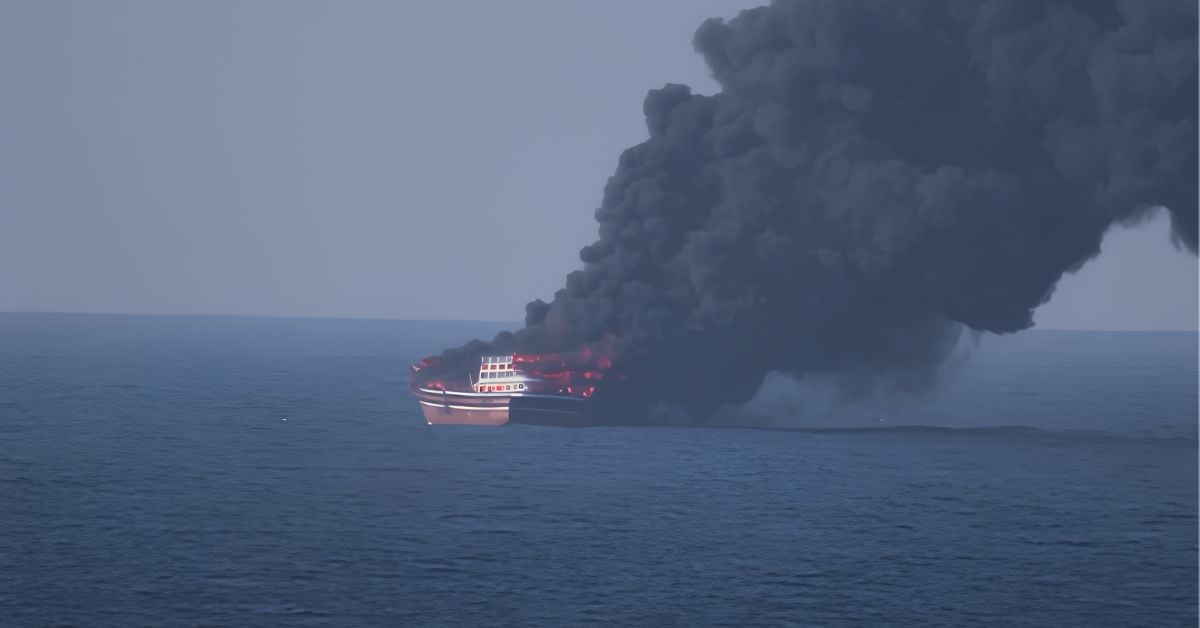
The Strait of Hormuz is no longer a maritime corridor, it is a live-fire data gap, and the consequences for global shipping are becoming empirically measurable. The U.S. destruction of an Iranian-affiliated surveillance dhow in the Gulf of Oman on October 6 may read as a single tactical event, but it is a calibrated signal in a pattern that demands closer scrutiny from anyone who relies on ocean intelligence for route planning, insurance underwriting, or geopolitical risk assessment. This is not an isolated incident; it is a validated data point in a worsening trend that includes the sinking of a Singapore-flagged container ship in the same waterway and the escalating posture challenges documented in our recent coverage of the Strait of Hormuz Posture Raises Stakes for Maritime Data Verification.
CENTCOM's statement is direct: over the past seven months, Iran's Islamic Revolutionary Guard Corps has "indiscriminately targeted thousands of civilian mariners" in addition to U.S. Navy warships. The dhow destroyed on October 6 was conducting surveillance and targeting U.S. ships. Crew members were removed before destruction, and repatriation efforts are ongoing. This is not alarmist language, it is a measured, empirical account of repeated hostile action in a chokepoint that carries roughly 20 percent of the world's oil transit. Compare this to the Iranian Navy's own announcement on the same day, deploying a new formation east of the Strait of Hormuz for "continuous, real-time surveillance of maritime traffic and activities Tehran considers hostile." Both sides are now operating integrated surveillance ecosystems in the same narrow body of water, and the margin for miscalculation is shrinking fast.
What this means for our readers is practical, not theoretical. If you track maritime risk, the pattern is now longitudinal: Iranian forces have challenged the Counter-Drone Electronic Warfare Now Protects Guided-Missile Submarine USS Ohio and other U.S. assets, while simultaneously demanding that commercial vessels keep transponders on and coordinate passage with Iranian armed forces. The U.S. naval blockade, resumed in July, adds another layer of enforcement, as seen when a U.S. fighter jet disabled the Panama-flagged M/V Ocean Molica with a precision-guided munition after it ignored warnings while departing an Iranian port. No crew injuries were reported, but the precedent is clear: vessels transiting this region now operate under two competing authorities, each armed and each willing to use force. The open question is whether the commercial shipping industry has the real-time data verification tools to navigate this safely.
The Iranian Rear Admiral's threat to sink U.S. aircraft carriers if they approach the strait is rhetorical, but the dhow destruction and the container ship sinking are not. The takeaway is specific: any vessel transiting the Gulf of Oman or the Strait of Hormuz should expect its tracking data to be contested, its compliance with both U.S. and Iranian directives to be impossible, and its insurance exposure to rise. The integrated data ecosystem we advocate for, peer-reviewed, calibrated, real-time, is not an abstract goal. It is the only mechanism that can give commercial operators a validated picture of where the next interdiction will occur.