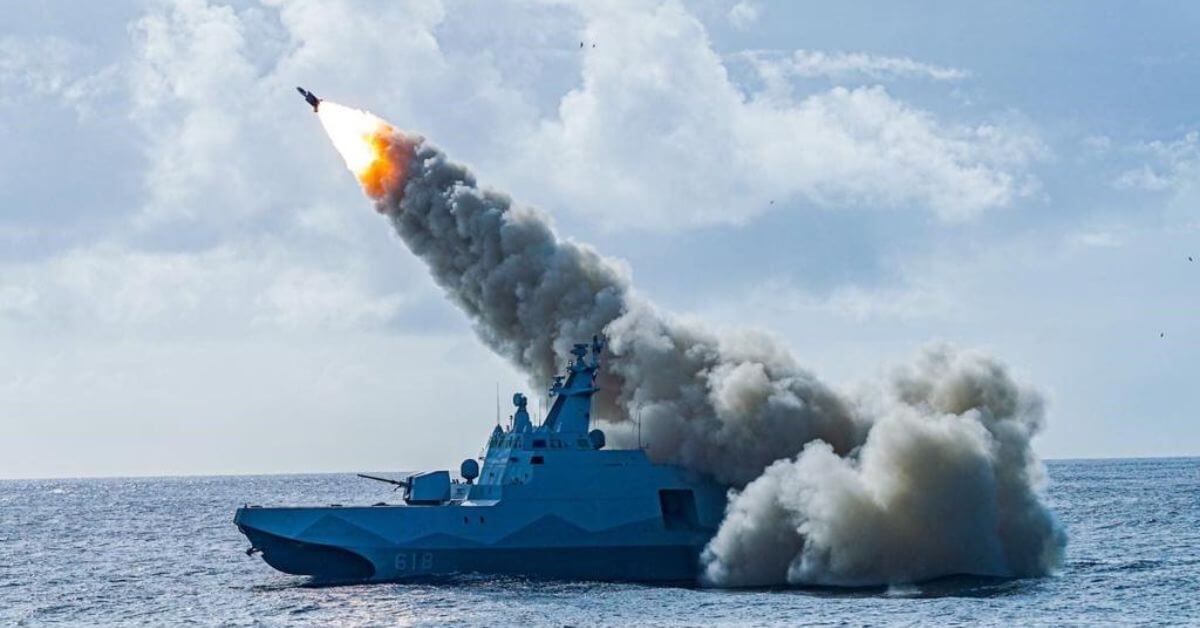
Taiwan sank a decommissioned navy frigate with anti-ship missiles on September 18 during a three-day military exercise in Pingtung.
The exercise brought together Taiwan’s army, navy, air force and coast guard. The former frigate Lan Yang was used as the target at Jiupeng Base.
The drill tested how Taiwan’s different military services and weapons could work together in an attack on a ship.
Taiwan used land-based and ship-launched Hsiung Feng II and III missiles, extended-range HF-3 missiles, Harpoons, Mavericks, HIMARS rockets, Tien Kung III interceptors and land-based Sky Sword II missiles.
Attack drones were also used in the exercise alongside the other weapons for the first time. These included the ALTIUS 600M, Switchblade and Taiwan-made systems.
The exercise was based on a US RIMPAC-style sinking drill. Using a full-sized frigate allowed Taiwan’s forces to fire their weapons at a real ship hull and test how different units worked together.
Video released by Taiwan’s Presidential Office showed several weapons hitting Lan Yang. Large explosions, fire and smoke could be seen coming from the ship.
President Lai Ching-te watched the final morning of the exercise. Taiwan’s coast guard also took part.
The coast guard’s Anping-class patrol ship Qijin fired a Hsiung Feng III, or HF-3, anti-ship missile at Lan Yang. Local media reported that the missile hit the former frigate from more than 100 km (62 miles) away.
Qijin also fired a Hsiung Feng II, an older subsonic anti-ship missile.
At least three of the coast guard’s 12 Anping-class ships have now fired Hsiung Feng missiles, based on the information provided.
The Anping-class ships are based on Taiwan’s Tuo Chiang-class corvette. They can carry up to 16 HF-2 and HF-3 anti-ship missiles when mobilised for wartime use.
John Bradford, executive director of the Yokosuka Council on Asia-Pacific Studies and a former US Navy officer, said the exercise showed closer cooperation between Taiwan’s coast guard and navy.
Coast guards normally focus on law enforcement, patrols and maritime safety rather than long-range military strikes. Taiwan’s use of a coast guard ship to fire a supersonic anti-ship missile is unusual.
During the late Cold War, the US Coast Guard fitted some Hamilton-class vessels with Harpoon anti-ship missiles. The Mellon patrol vessel fired one in January 1990. The capability was later removed.
Taiwan’s Coast Guard Administration is a civilian agency during peacetime. Its role changes during a conflict under Taiwan’s defence laws.
The National Defence Act allows the government to bring the Coast Guard into the military order of battle during wartime.
A special defence procurement law passed in 2021 also provided money for weapons and related support systems for coast guard ships. The programme was intended to help convert the ships from peacetime to wartime roles.
China has taken a different approach with its coast guard.
The China Coast Guard was moved to the People’s Armed Police in July 2018 and placed within a structure under the Central Military Commission.
China’s Coast Guard Law came into force in 2021. It allows the Coast Guard to carry out defence operations under orders from the commission.
The agency’s director, Zhang Jianming, is a former navy officer.
The PLA Navy has also transferred ships to the coast guard. This included 22 Type 056 corvettes from 2021. Their missile and torpedo launchers were removed.
Chinese coastguard forces have also taken part in exercises around Taiwan, including Joint Sword in 2024 and Strait Thunder-2025A.
References: SCMP, Defence Security Asia