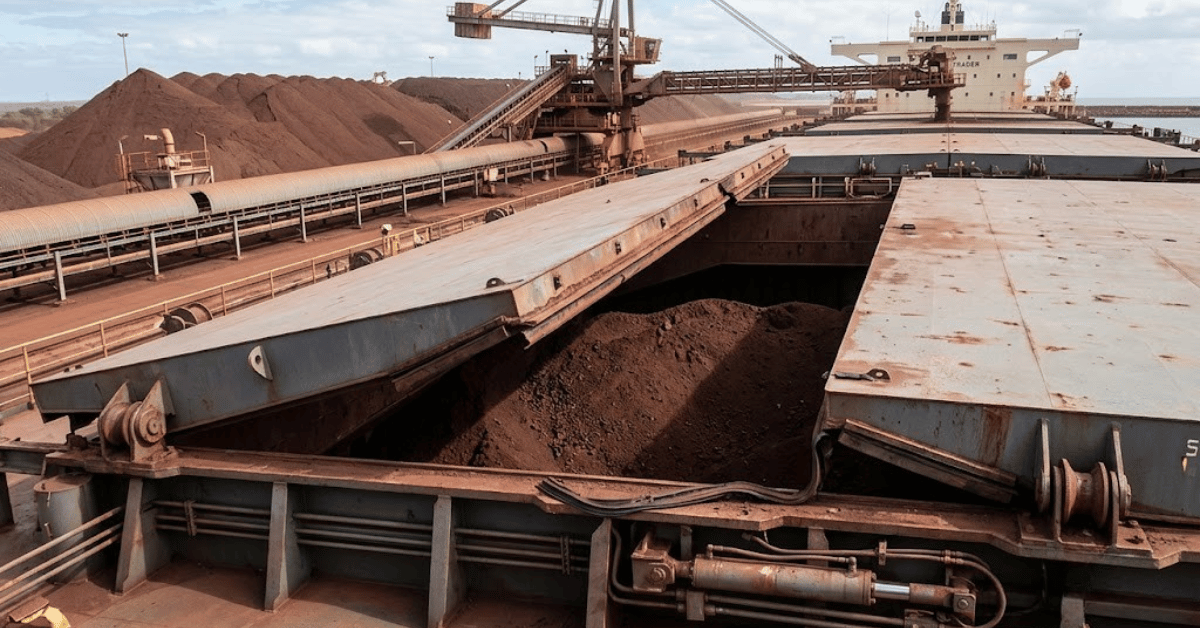
The uneven loading of iron ore that twisted a Panamax bulk carrier's hull into a parallelogram is a textbook case of how a seemingly minor imbalance in heavy cargo can produce outsized structural consequences, and it deserves far more attention than it typically receives. What happened is straightforward: three forward hatch covers would not close because the vessel had twisted, turning the hatch coamings into non-rectangular shapes that the rigid steel panels could not follow. The corrective action, re-opening the aft holds, trimming the cargo with bulldozers, and measuring diagonals until the torsion resolved, worked, but it should never have been necessary. This incident sits alongside other operational failures that stem from overlooked fundamentals, such as Cargo spill in the Strait of Hormuz scatters consumer goods across shipping lane and When Communication Fails: Ambiguous VHF Exchange Prevents TSS Collision, both of which illustrate how routine procedures, proper stowage, clear radio protocol, are the real barriers against cascading problems.
The practical lesson is not about exotic naval architecture but about the gap between what loading manuals cover and what crews actually need to know. Manuals typically specify maximum trim and heel conditions, but they rarely include a caution about coaming deflection during loading, especially on vessels with broad hatch squares like this combination bulk/container carrier. The broader the hatch opening, the less torsional stiffness the hull has, and the more sensitive it becomes to asymmetric distribution of dense cargo such as iron ore. In this case, the cargo in the forward three holds was slightly to port of centerline while the after three holds was slightly to starboard, a difference small enough to escape notice during routine loading but large enough to prevent hatch closure. The crew had to re-open three holds and re-level the cargo before they could proceed, a delay that could have been avoided with continuous monitoring of transverse distribution.
What stands out is the operational implication for anyone planning a loading or discharge sequence: always assume you might need to close hatch covers at short notice. Rain squalls, sudden port restrictions, or emergency departures do not wait for a re-trim. The standard practice of leveling each hold as it is filled is good seamanship, but it is not enough if the overall longitudinal and transverse balance across all holds is not verified during the process. Diagonal measurements of hatch coamings, as taken here, are a simple empirical check that requires no instrumentation beyond a tape measure. The fact that the crew used freeboard readings and diagonal measurements to confirm the twist shows that the diagnostic tools are available; the failure was in not applying them preventively.
The open question this incident raises is whether loading software and ballast calculators currently in use on similar vessels account for torsional deflection as a real-time variable. Most systems model static stability and hull girder stresses, but the deflection that prevented hatch closure here was a geometric distortion within the elastic range of the hull, not a stress failure, but a functional one. If a vessel can twist enough to jam its hatches without exceeding structural limits, then the safe operating envelope is narrower than the stress-based envelope implies. That is a specific detail worth watching: as bulk carriers continue to be built with wider hatches for container compatibility, the margin for error in cargo distribution shrinks. A note in the loading manual about coaming deflection is useful, but an empirical check during loading is essential.