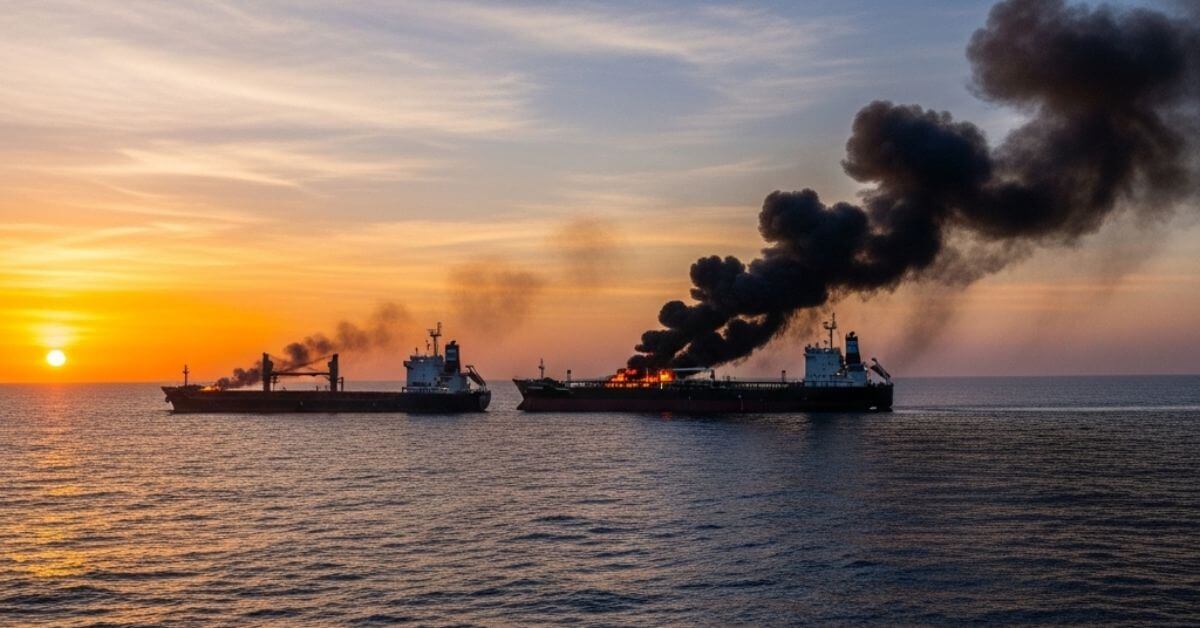
The Strait of Hormuz is no longer a chokepoint in theory, it is a chokepoint in practice, and the cost of that reality is climbing faster than the headlines suggest. Last week's reports of two oil tankers striking naval mines in the strait, combined with Houthi missiles damaging Riyadh's tallest skyscraper, pushed Brent crude to $92.22 a barrel, a modest 24-cent gain. But the real story is not the price tick; it is the accumulating risk that the market is only beginning to price in. The insurance cost for a single crossing now stands at $64 million, according to Acting US Navy Secretary Hung Cao, a figure that transforms every voyage through the strait into a binary bet on whether the vessel will emerge intact. That is not a supply disruption, it is a structural friction that will persist regardless of the next OPEC+ meeting.
The paradox is that crude flows through the strait have recovered to near pre-conflict levels, yet the market remains under a surplus that has Brent on track for a 3.5% weekly loss and West Texas Intermediate for a 6% decline. This tension, between physical volume and financial risk, is the critical dynamic our readers should track. Iranian attacks are holding back Middle Eastern exports at a moment when Chinese demand is rising, as UBS analysts noted, leaving less oil at sea. Meanwhile, Saudi Arabia has ramped its September crude exports to 5.38 million barrels a day, the highest since February 2026. The kingdom is shipping more oil, but it is doing so through a corridor where an unverified mine strike can ignite two tankers in a single day. The US maritime advisory flags ship-to-ship transfers as blockade evasion risk adds another layer: any vessel that takes on Iranian-loaded cargo via ship-to-ship transfer now faces treatment as a blockade evader, further narrowing the legal pathways for crude movement.
The naval posture in the region has also shifted. With the USS George Washington departed and only two carriers remaining, the Carrier Presence Shifts as Middle East Naval Posture Reduces to Two Vessels means the buffer that once allowed insurers to calculate risk with some confidence is thinning. The IEA's tally, 2.8 billion barrels of oil and 60 billion cubic metres of gas wiped out by the conflict, is a cumulative measure of opportunity lost, not a projection of future supply. The OPEC+ group meets on November 29 to set production policy for 2027, but their decisions will be made against a backdrop where the primary constraint is no longer output capacity but transit security.
The concrete point to watch is the insurance premium curve. If the cost of insuring a single strait crossing continues to rise, the effective price of Gulf crude will decouple from the Brent benchmark, creating a two-tier market where only buyers with the highest risk tolerance, or the deepest state backing, can access the cheapest barrels. That is not a short-term spike; it is a structural reconfiguration of global oil logistics.