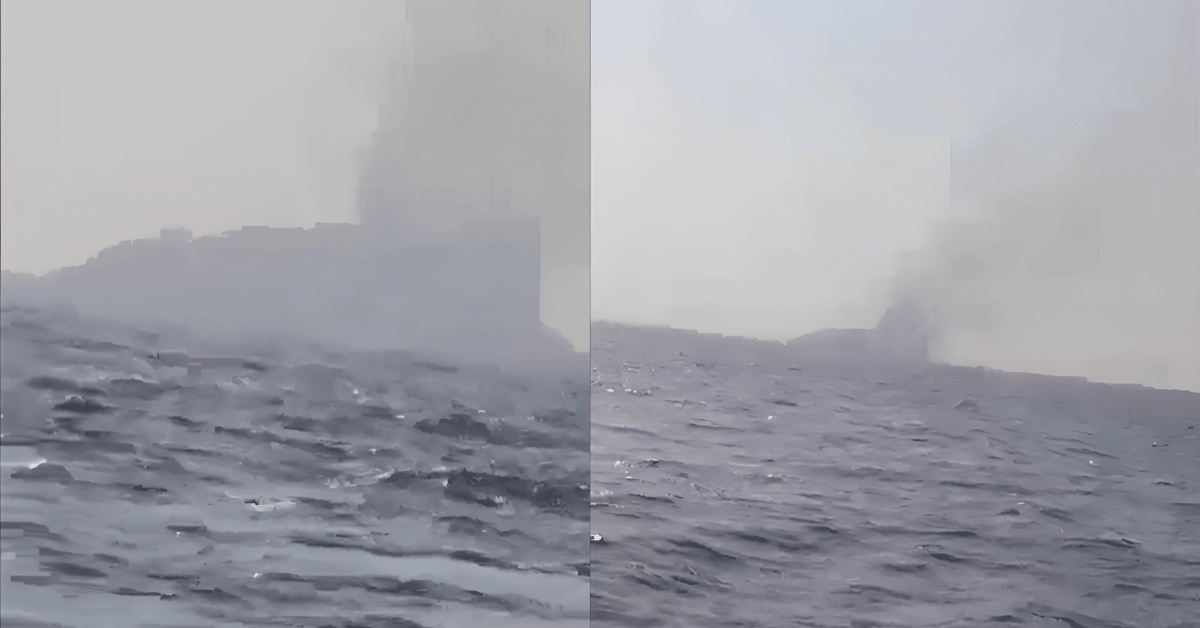
The Strait of Hormuz is no longer a theoretical flashpoint; it is an active, calibrated crisis, and the confirmed strike on Oman's Didamar Island demands a measured but clear-eyed response from the global community. Iran's claim that it destroyed navigational aid systems on the small Omani island, coupled with Oman's confirmation of a loud explosion, represents a direct attack on the infrastructure that keeps one-fifth of the world's oil supply moving. This is not a skirmish to be watched from a distance; it is a warning that the rules governing maritime transit are being rewritten by force, and the consequences will be measured in barrels, not headlines.
What makes this incident particularly destabilizing is its precision. The target was not a warship or a port but the shore radar and radio equipment on Didamar, the very systems that coordinate vessel traffic through the southern corridor. Satellite imagery from November 8 shows scorch marks near that equipment, and while the cause is unconfirmed, the operational logic is clear: disable the eyes and ears of the shipping lane, and you control who passes. This fits a pattern we have tracked closely. In our recent coverage of Iraq and US Align on Gulf Oil Route Near Omani Waters, we noted that Baghdad had reached understandings with Washington to export oil through this same southern route. That alignment now faces a hardened reality: the route itself is under physical threat. Likewise, we previously reported on Unconfirmed reports of tanker fires in the Strait of Hormuz merit calibrated observation, where Iran claimed two oil tankers hit mines on an "unauthorised" path. The Didamar strike confirms that the IRGC Navy is willing to escalate from mines to direct strikes on fixed infrastructure. The difference between unconfirmed reports and confirmed explosions is the difference between tension and crisis.
Our opinion is straightforward: the international community cannot treat this as a bilateral dispute between Iran and Oman. The Strait of Hormuz is a chokepoint for global energy security, and attacks on navigational aids are attacks on the shared infrastructure of maritime commerce. The United States struck Iran's Qeshm Island on November 2, described by one US official as limited, and President Trump has since stated that the war with Iran is "effectively over." But the Didamar strike suggests the IRGC Navy does not consider the conflict concluded. The presence of three US nuclear carriers potentially converging in the region, as we examined in Three US Nuclear Carriers Could Converge in the Middle East by Late 2026, creates a backdrop of naval power that has not deterred this escalation. The question now is whether the US and its allies will treat the destruction of a lighthouse, established in 1914, a symbol of open passage, as a red line or as another incident to be absorbed.
The specific detail to watch is the condition of the navigational aid systems. Iran claims they were destroyed; satellite imagery shows scorch marks but does not confirm total loss. If the radar and radio equipment are inoperable, every tanker, bulk carrier, and warship transiting the southern corridor is navigating blind. That is not a diplomatic abstraction, it is a concrete risk of collision, grounding, or misidentification that could trigger a much larger incident. The Strait of Hormuz does not need another explosion to become unstable; it needs only a single ship to lose its way.