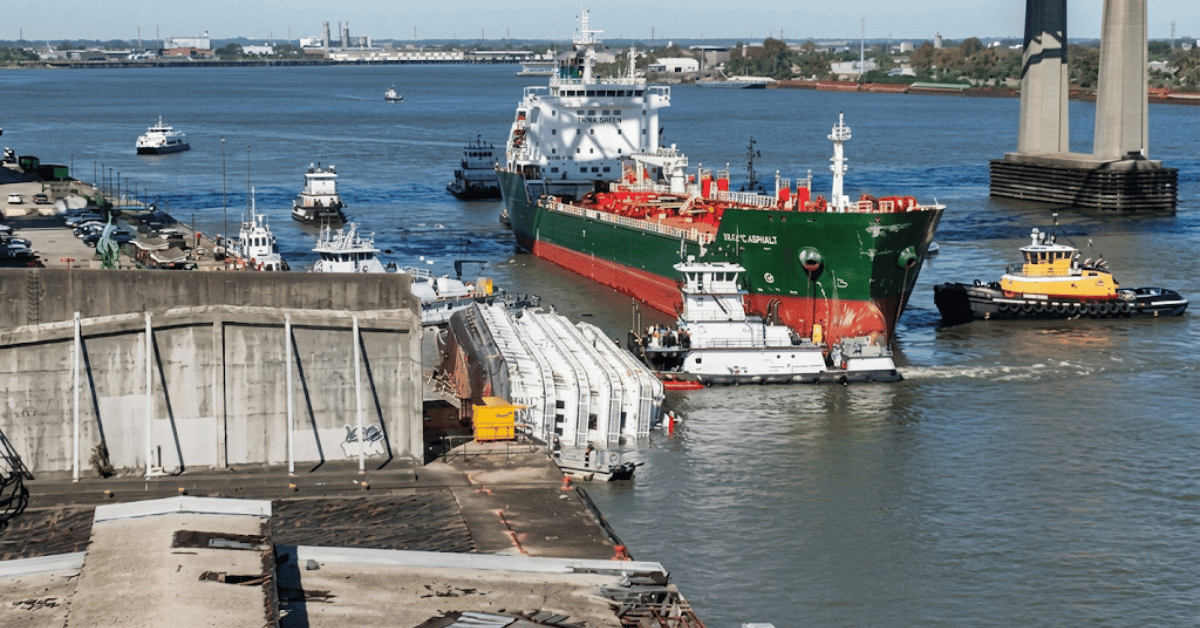
The NTSB's preliminary finding that a steering failure caused the tanker *Atlantic Asphalt* to veer into the docked *American Heritage* is a stark reminder that maritime safety hinges on systems we too often take for granted. Two minutes, that is the window between a stuck rudder and a capsized riverboat carrying 140 passengers. For our readers who track ocean intelligence and infrastructure risk, this is not a one-off accident; it is a data point in a pattern of preventable failures that demand integrated, real-time monitoring.
The timeline is damning. At 12:26 p.m., the rudder locked to starboard near the Crescent City Connection Bridge. By 12:28 p.m., the 520-foot tanker struck the *American Heritage* at the Thalia Street Wharf. The vessel's voyage data recorder captured the sounds of whistle blasts, radio warnings, and anchor-drop orders, a textbook emergency response that still could not overcome a mechanical failure whose root cause remains unknown. As we reported in Captain Stewart stayed on the bridge as ship capsized, last to leave despite injury, the riverboat's captain held his post even as his vessel rolled over. That bravery does not erase the question: why did the steering system fail, and why was there no redundant control ready? The NTSB investigator's admission that the cause "could be many different things" is not reassuring, it is an indictment of how little empirical data we have on the mechanical health of vessels transiting one of America's busiest waterways.
This collision did not happen in isolation. The Port of New Orleans has already filed a federal lawsuit seeking more than $1 million in damages, as detailed in Port of New Orleans Pursues Federal Liability Action After Mississippi River Collision. That legal action targets the tanker's owner and manager, but liability alone will not retrofit aging steering gear across the fleet. What would have made a difference is a calibrated, real-time monitoring system, the kind of integrated data ecosystem that tracks rudder angle, hydraulic pressure, and response lag before a failure becomes a catastrophe. The *Atlantic Asphalt* had a VDR, but it is a recorder, not a predictor. We need sensors that alert crews and shore-based operators to anomalies in seconds, not post-incident analysis that takes days.
The human outcome was merciful: all passengers and crew survived, with 32 hospitalized and six still in care as of November 15. But survival is not the goal, prevention is. The NTSB expects a preliminary report within 30 days and has asked the public for photos or video. That crowdsourced data may help, but the real takeaway is structural. Every vessel operating in confined channels like the Mississippi River should have its steering system's performance validated against longitudinal benchmarks. Without that, we are trusting two minutes of reaction time to save lives. That is not ocean intelligence; that is gambling. The specific detail to watch in the NTSB's final report is the exact failure mode of the rudder control, hydraulic, electrical, or mechanical, because that answer will determine whether a simple retrofit or a full redesign is needed.