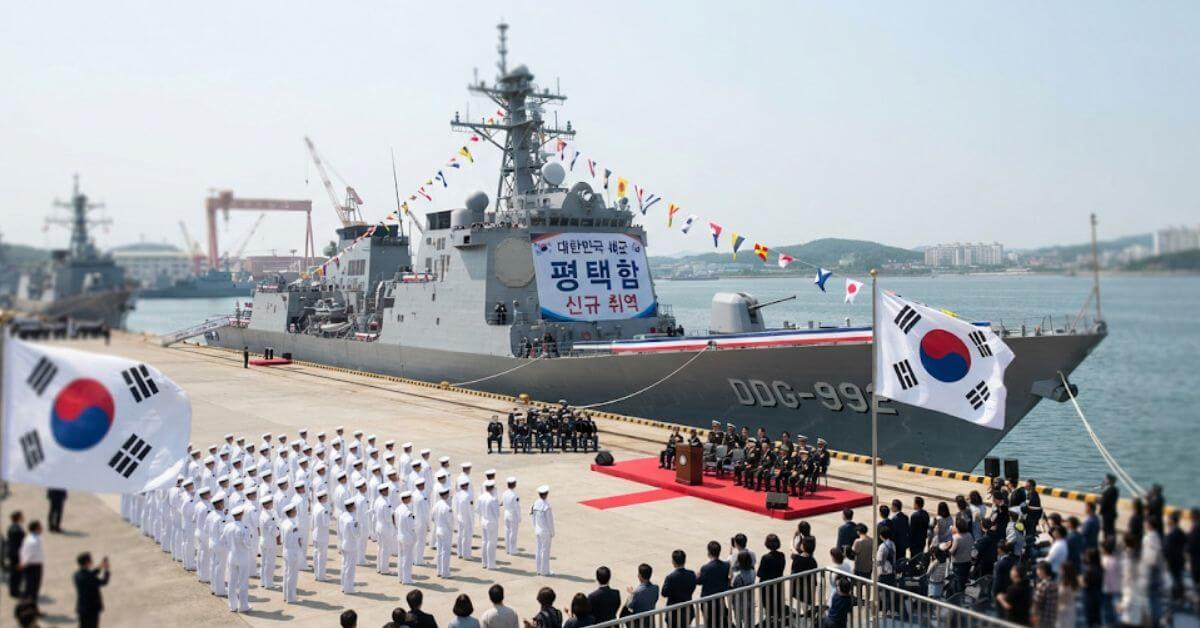
The integration of a homegrown phased array radar into South Korea's new frigate Pyeongtaek marks a calibrated step toward maritime self-reliance, and it signals something broader for how nations will gather ocean intelligence in contested waters. This is not merely a shipbuilding milestone; it is a declaration that indigenous sensor ecosystems are becoming as strategically valuable as the hulls they ride on.
South Korea's 3,600-tonne stealth frigate, launched at Hanwha Ocean's Geoje shipyard, carries a locally developed Multifunctional Phased Array Radar with four fixed panels capable of scanning air and sea simultaneously. That radar, embedded inside a radar-evading mast alongside infrared sensors, gives the vessel persistent, real-time awareness of its environment while keeping its own signature low. For researchers and defense analysts tracking the evolution of maritime surveillance, this represents a validated shift: the line between naval defense and ocean data collection is thinning. When a frigate can track multiple airborne threats while also feeding calibrated environmental data into a wider network, it becomes a node in an integrated data ecosystem. Compare this to the Rotating decoy launcher brings calibrated electromagnetic defense to Royal Navy fleet, which focuses on electronic countermeasures; the Pyeongtaek instead prioritizes persistent, multi-domain sensing as a first-line capability. Meanwhile, the 600-ton unmanned warship signals a new era in ocean intelligence launched by HD Hyundai earlier this year suggests that South Korea is pursuing both crewed and uncrewed platforms to layer its maritime picture. The Pyeongtaek, as a crewed command platform, likely serves as the data fusion center for such distributed assets.
Defense Minister Kang Shin-chul framed the launch as part of a journey from having no warships of its own to looking ahead at nuclear-powered submarines and manned-unmanned command ships. That forward-looking language is grounded in empirical results: the frigate's hybrid propulsion system and twin Korean-made sonars, one hull-mounted, one towed, give it the ability to operate quietly while tracking submarines over long distances. For nations watching South Korea's defense export ambitions, the senior procurement official's comment that this frigate reflects domestic shipbuilding capability and could win future export deals is the practical takeaway. The Pyeongtaek is not just a warship; it is a certified reference design for a modern, sensor-heavy patrol frigate that other navies may seek to acquire.
What remains to be observed is how the Pyeongtaek's radar data will be shared, or not, with allied networks. The frigate is slated to join the 2nd Fleet in December 2027 after sea trials and will stand guard over the Yellow Sea. Whether its indigenous sensors feed into a broader ocean intelligence framework or remain siloed within national command structures will define the frigate's real contribution to global maritime awareness. That is the detail to watch.