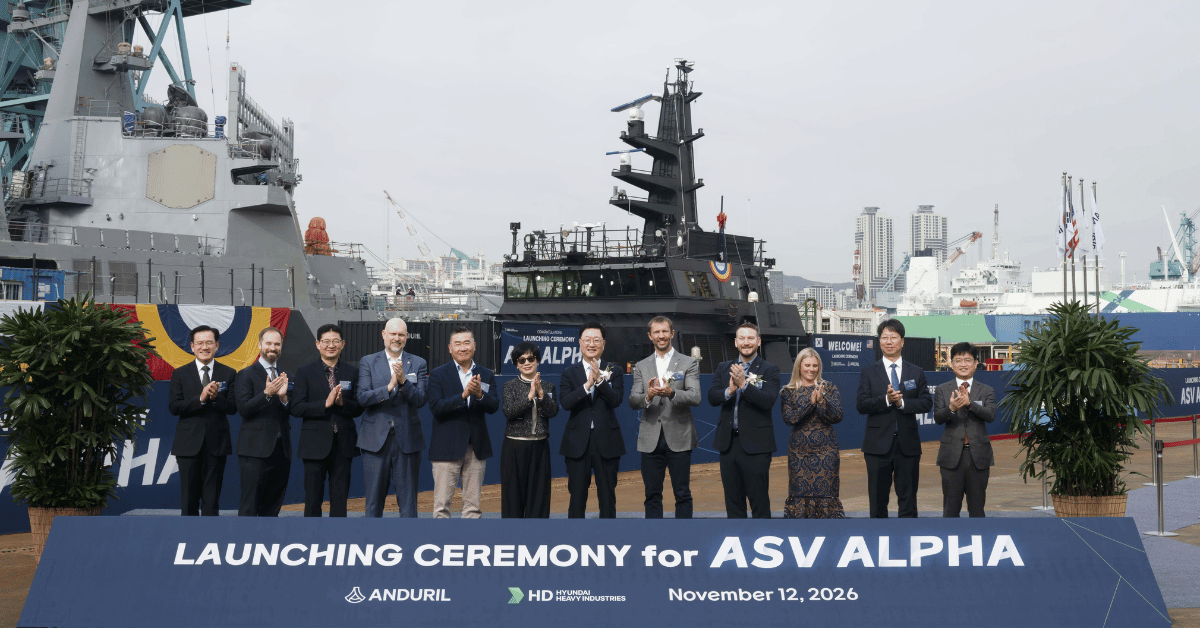
The launch of a 600-ton unmanned warship is not merely a shipbuilding milestone; it is a calibrated step toward a future where ocean intelligence is gathered continuously, persistently, and without a crew at risk. HD Hyundai and Anduril Industries have put the ASV Alpha in the water, and we should pay close attention to what this vessel represents: a validated, integrated platform designed for long-duration reconnaissance and surveillance, built in under 12 months through private investment rather than a government contract. This matters because it signals a shift in how maritime nations can acquire and deploy autonomous systems, faster, more modularly, and with fewer bureaucratic anchors. The timing aligns with other developments we have covered, including the Unmanned surface vessels join Philippine fleet for integrated ocean monitoring and the Assessing Allied Shipbuilding Capacity Through Measured Joint Evaluation of HD Hyundai's Ulsan shipyard by U.S. Navy and Marine Corps officials just days before the launch.
What makes the ASV Alpha distinct is its dual autonomy architecture. The VA ONE platform handles navigation, engine control, and damage response, while Anduril's Lattice manages mission planning, sensor fusion, and command of multiple unmanned systems. This separation of core vessel control from mission execution is a practical design choice. It allows the warship to operate as a persistent sensor node, capable of carrying any equipment that fits a standard 40-foot module, without requiring a human to manage every subsystem. For researchers, oceanographers, and defense analysts, this means the same hull could be configured for climate indicator monitoring one month and maritime domain awareness the next. The partners have already demonstrated a smaller 368-ton unmanned boat in California, showing autonomous navigation and response to engine failure. The ASV Alpha is a direct scaling of that capability.
We should also note the industrial logic here. The prototype was paid for through joint investment, not a government order. That is an unusual and deliberate move. It suggests HD Hyundai and Anduril are betting that demonstrated performance at sea will be more persuasive than any proposal document. The vessel is set to complete sea trials off Ulsan and then head to the U.S. for further testing in early 2027. Meanwhile, HD Hyundai has formed a joint venture with Kiewit, with a new U.S. shipyard planned for 2027. This is not a one-off experiment; it is the beginning of an integrated production pipeline designed to deliver autonomous surface vessels at scale. The open question is whether the U.S. Navy's acquisition system can match that speed. The Nuclear Carrier Roosevelt Ties Strategic Port Call to Global Maritime Data reminds us that traditional naval power still dominates headlines, but the ASV Alpha represents a different kind of presence, one that is quieter, cheaper, and built to stay on station for weeks without resupply.
The concrete point to watch is how quickly the U.S. Navy moves to integrate this capability into its existing fleet architecture. The ASV Alpha is a prototype, but it is a prototype built in less than 12 months by a commercial partnership that has already demonstrated a smaller vessel in U.S. waters. If the sea trials validate its endurance and sensor integration, the conversation will shift from whether autonomous warships are viable to how many the Navy needs and how fast the new U.S. shipyard can build them. That is the empirical question that will define the next phase of ocean intelligence.