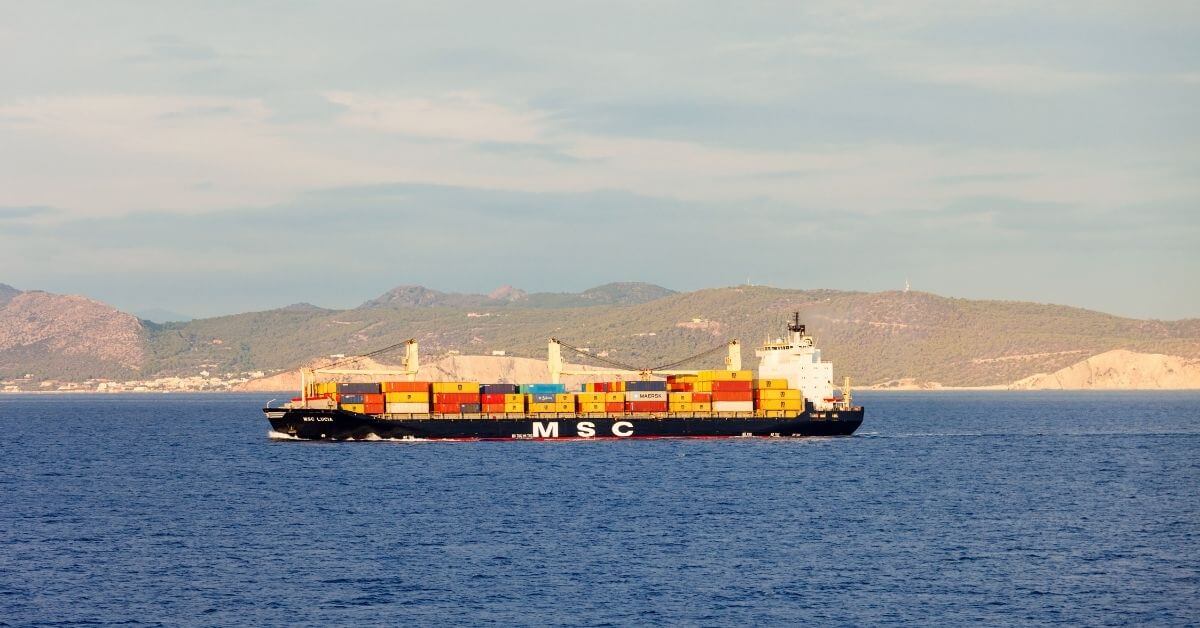
The decision by MSC, the world's largest container shipping firm, to pause bookings at the Russian port of Novorossiysk after an attack on one of its vessels is a measured response to a volatile reality. The MSC Ulsan III, a Panama-flagged ship with a capacity of roughly 2,700 TEUs, is not just a statistic; it is a physical asset moving through a corridor where risk is no longer theoretical. This move signals something practical: the calculus of maritime routing has shifted from convenience to consequence. For our readers who track supply chains, this is not an abstract headline. It is a direct signal that operational continuity in the Black Sea now demands a higher threshold of threat assessment, one that ports and carriers can no longer afford to ignore.
This incident does not exist in isolation. It follows a pattern of maritime vulnerabilities that have been playing out across different waters. The recent Cargo Ship Fire Prompts Evacuation Near Mykonos; Incident Under Investigation reminds us that the perils facing commercial vessels are not limited to geopolitical flashpoints. Similarly, the Bulk Carrier Freed After Prolonged Grounding Near Gladstone, Australia underscores how a single navigational error or mechanical failure can strand a ship for days, disrupting schedules and rerouting cargo. What connects these events is not the cause, but the consequence: every delay, every reroute, every pause in bookings ripples outward, affecting insurance premiums, cargo availability, and port congestion. When a major player like MSC pulls back from a specific port, it is not making a political statement; it is making a logistics decision based on empirical risk.
Our take is straightforward: this is the new normal, and it demands that stakeholders recalibrate their expectations. The era of predictable sea lanes and stable port rotations is over, at least in regions where conflict and accidents overlap. For importers and exporters who rely on Black Sea routes, this pause is a warning sign to diversify options now, not later. The related incident involving Integrated Subsea Infrastructure Shifts to Enhance Indian Ocean Connectivity shows that global trade is already redrawing its maps, with data and goods moving along new corridors. That shift is not incidental; it is a structural response to the very same volatility that now touches Novorossiysk. The question is not whether the Black Sea will stabilize, but how long it will take for carriers to reassess the true cost of calling there.
What we would tell a reader who asks us about this is simple: watch the insurance clauses and the charter rates. A pause in bookings is a leading indicator, not a final verdict. The real test will come in the coming weeks, when we see whether other carriers follow suit or whether the MSC Ulsan III incident is treated as an outlier. The concrete detail to monitor is the duration of the suspension. If it extends beyond a few weeks, it will signal that the risk assessment has fundamentally changed, not just for Novorossiysk, but for every port in the region. That is the number to watch, because it will tell us whether this is a temporary adjustment or a permanent redirection of maritime traffic.