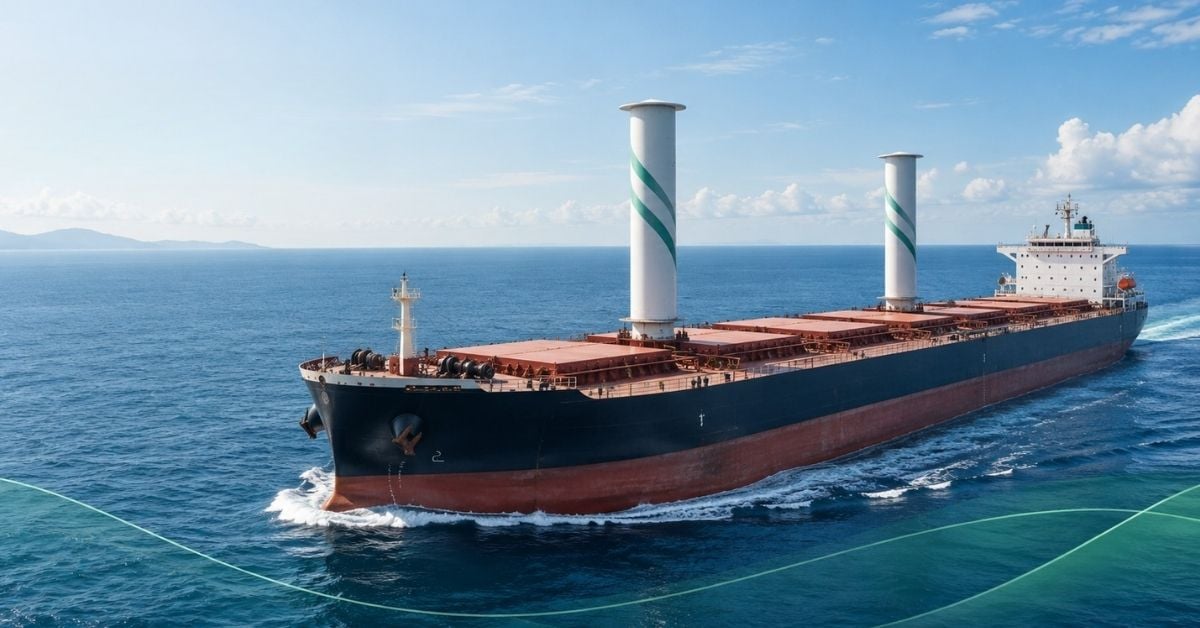
The commercial shipping fleet is not waiting for a newbuild revolution; it is already in the water, and most of it will still be sailing past 2035. Retrofitting is the only viable path to decarbonisation at scale, yet the industry remains stuck on a financing model designed for billion-dollar newbuilds, not million-dollar efficiency upgrades. This mismatch is not a technology problem, it is a structural failure of maritime finance, and it demands a more creative, integrated approach than the market has delivered so far.
Consider the arithmetic. The Getting to Zero Coalition estimates that efficiency measures alone can cut fleet emissions by 25 to 30 percent, and payback periods for retrofits can fall to one or two years for owners with cash on hand. That is an unusually attractive return. Yet uptake remains slow, not because the technology is unproven, but because a 12-year-old bulker already carries a mortgage, and banks see a USD 3 million retrofit loan as too small to justify the same credit committee time as a USD 30 million one. This is where our previous reporting on Recycling declines 13% as high freight rates keep aging vessels in service becomes directly relevant: older vessels are staying in the fleet longer, making the retrofit financing gap more urgent, not less. Meanwhile, the acoustic monitoring work documented in Listening to the Deep: 46 Hours of Acoustic Data from an Offshore Platform reminds us that operational changes and retrofits must be measured against real-world environmental baselines, not just fuel curves.
The practical path forward is not one solution but a portfolio of them, and the most promising innovation is the unsecured lease model pioneered by the Fund for Energy Efficiency Technologies. By funding equipment and installation up front, linking repayment to verified fuel savings, and severing the link to the vessel mortgage, FEET shifts risk to where it belongs: on the technology's performance. That template matters far more than its current USD 35 million capitalisation. For owners who cannot access balance-sheet funding, the options are clear but require deliberate timing: fold retrofit costs into a refinancing cycle, seek guarantee-backed debt from export credit agencies, or negotiate retrofitting clauses into longer charters that convert efficiency gains into a contracted cash flow. The Aligning Blue Finance Governance for China-ASEAN Ocean Climate Action piece underscores that regional coordination on finance governance is still nascent; the MDF in India and the EIB's Green Shipping Guarantee show that public capital can de-risk private investment, but only if owners and financiers start the conversation twelve months before drydock, not during it.
The single most concrete takeaway for any owner operating a vessel built before 2015 is this: time your retrofit request to your refinancing calendar, not your drydock calendar, and demand that your bank fold the capex into the existing facility. The bank gets an improved CII rating for its Poseidon Principles disclosure, and you get a payback period that rivals any other capital investment in the fleet. The fleet is aging, the clock is running, and the financing templates exist. What is missing is the deliberate coordination to use them.