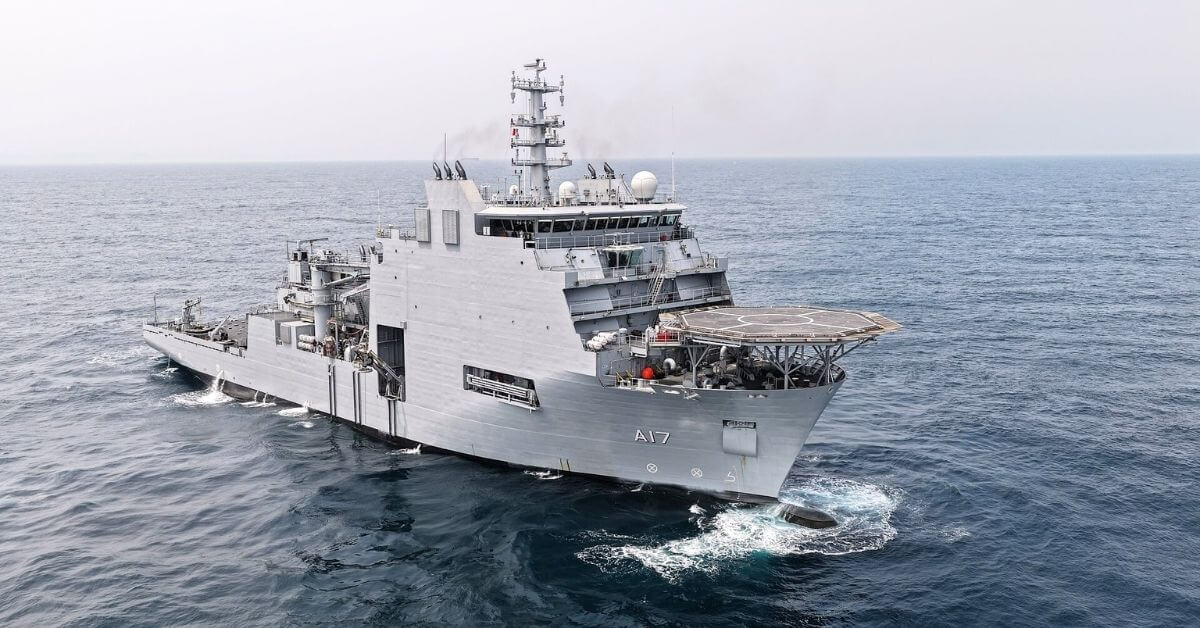
The Indian Navy's commissioning of INS Nipun, its second Nistar-class Diving Support Vessel, is not a headline that will dominate global news cycles. But for those who track maritime power, it is a quiet signal of something more consequential than a single hull entering service. This is a vessel designed for the underwater domain, a space where operational readiness depends less on visible firepower and more on the unglamorous, precise work of salvage, rescue, and submarine support. In an era of contested seabeds and expanding sub-surface fleets across the Indo-Pacific, that capability is not ancillary. It is foundational.
The timing aligns with a broader trajectory the Indian Navy has already articulated. As we noted in India Projects Expanded Naval Fleet to Navigate Evolving Maritime Landscape, New Delhi is planning for around 230 ships by 2040-2045, a force structure built for a more crowded and competitive ocean. INS Nipun fits that blueprint, but it also does something the headline numbers do not: it adds operational depth rather than simple mass. A diving support vessel is not a destroyer. It cannot intimidate a rival fleet. What it can do is extend the safe operating envelope for submarines, enable rapid response to underwater emergencies, and ensure that the human element of sub-surface operations is backed by credible infrastructure. That is the difference between having a navy and fielding a maritime force with genuine endurance.
This is where the story connects to a wider principle we have long championed: data and domain awareness are not abstract concepts. They are the difference between a successful operation and a costly failure. Consider the recent Ocean Data Enables Swift Rescue of Injured Seafarer Near Andamans, where real-time ocean intelligence directly enabled a time-critical rescue. INS Nipun, with its dedicated role in diving support and underwater maintenance, represents the same logic applied to a more deliberate, long-term mission. It is not about reacting to a crisis; it is about building the capacity to prevent one, or at least to manage it before it escalates. For our readers, whether they are policymakers, researchers, or industry stakeholders, the takeaway is practical: the Navy is not just buying ships, it is investing in the less visible, more complex systems that make those ships useful.
The domestic angle is equally important. The commissioning of an indigenously built vessel, alongside the Navy's recent RFI for six new Landing Craft Utility Mk V vessels from Indian industry, signals a deliberate pivot toward self-reliance. That is not a feel-good slogan; it is a strategic calculation. Supply chains for advanced marine systems are vulnerable, and a navy that depends on foreign platforms for its most sensitive capabilities is a navy with a ceiling on its independence. INS Nipun is a reminder that the submarine-industrial base, and its support ecosystem, must be grown at home if it is to be trusted in a crisis.
What we would tell a reader who asks about this story is simple: do not mistake the quiet role of this vessel for a lack of strategic weight. The underwater domain is where the next generation of maritime competition will be decided, and it is a domain that rewards patience, precision, and preparation. The specific detail to watch is not just how many ships join the fleet, but how quickly the Navy can generate operational confidence in their support vessels. If INS Nipun shortens the cycle between a submarine's repair and its return to patrol, it will have done more for deterrence than many a more visible platform. That is the metric that matters.