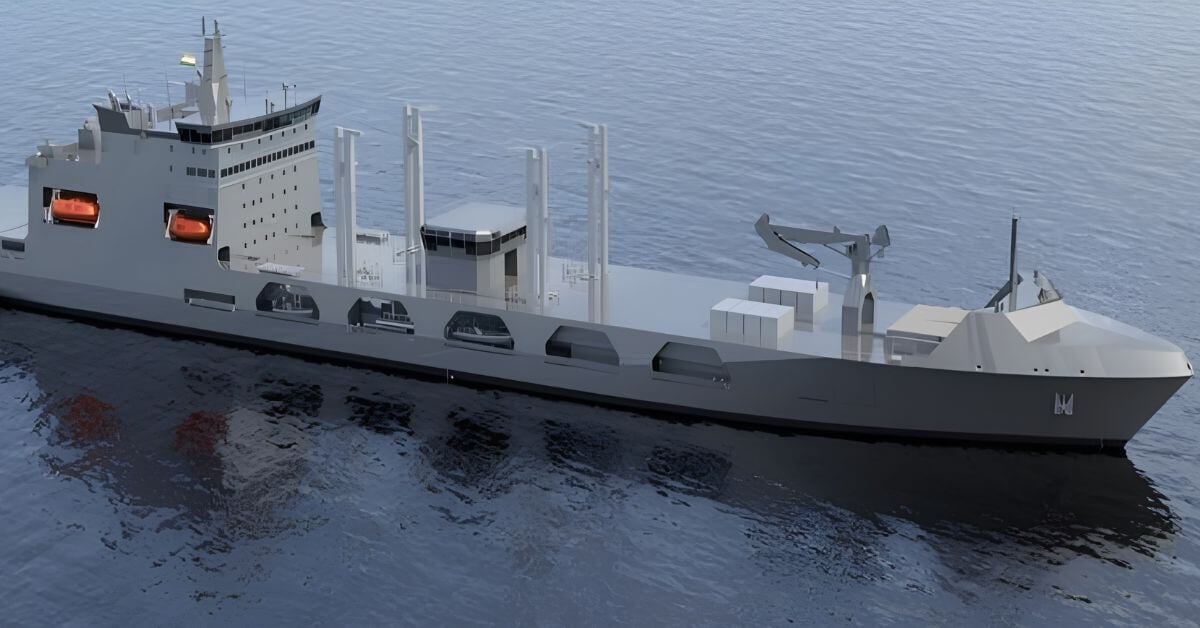
India's launch of the fleet support ship *Surya* is a clear signal that the Indian Navy is building for endurance, not just presence. This 43,500-tonne vessel, built indigenously at Hindustan Shipyard Limited, represents a practical answer to a strategic question: how do you keep a naval force operational far from home for weeks at a time? The answer, as Defence Minister Rajnath Singh noted, is sustained logistics. *Surya* can carry 20,000 tonnes of fuel, 2,500 tonnes of aviation turbine fuel, and enough water and ammunition to keep a carrier battle group at sea for 60-day missions. That is not just a capability upgrade; it is a shift in operational philosophy. For comparison, the mothership concept Beijing is developing for underwater drones, as we have covered in A mothership for underwater drones signals a new era in ocean intelligence, also points to a global trend: navies are extending reach through logistics platforms rather than simply adding more hulls.
This is not about a single ship. The five-vessel Fleet Support Ship programme, built under a Rs 19,000-crore contract with 82% indigenous content, is a deliberate investment in *range*. By enabling simultaneous replenishment of multiple warships, alongside, via stern, or by helicopter, *Surya* allows the Navy to sustain operations across the Indian Ocean Region without returning to harbour. That matters practically for the kind of missions the Navy already runs. Earlier this year, we reported on a Coordinated response enables medical evacuation in Andaman Sea transit, where a merchant vessel required rapid assistance far from shore. A support ship like *Surya* could serve as a floating logistics hub for such operations, reducing response times for both naval and humanitarian missions.
The takeaway here is concrete: *Surya* and its sister ships will allow the Indian Navy to double the time its warships can stay on station without rotating back to port. That directly increases the Navy's ability to monitor chokepoints, respond to distress calls, and project power without the diplomatic friction of forward basing. The ship's secondary role in Humanitarian Aid and Disaster Relief operations also gives it a dual-use utility that aligns with broader regional stability goals. But one question remains open: how will the Navy integrate these vessels with its existing fleet tankers, INS Shakti, INS Jyoti, INS Deepak, and INS Aditya, without creating a logistics chain that is more complex than the operations it supports? The answer will determine whether this programme delivers on its promise of extended reach or simply adds capacity without coherence.