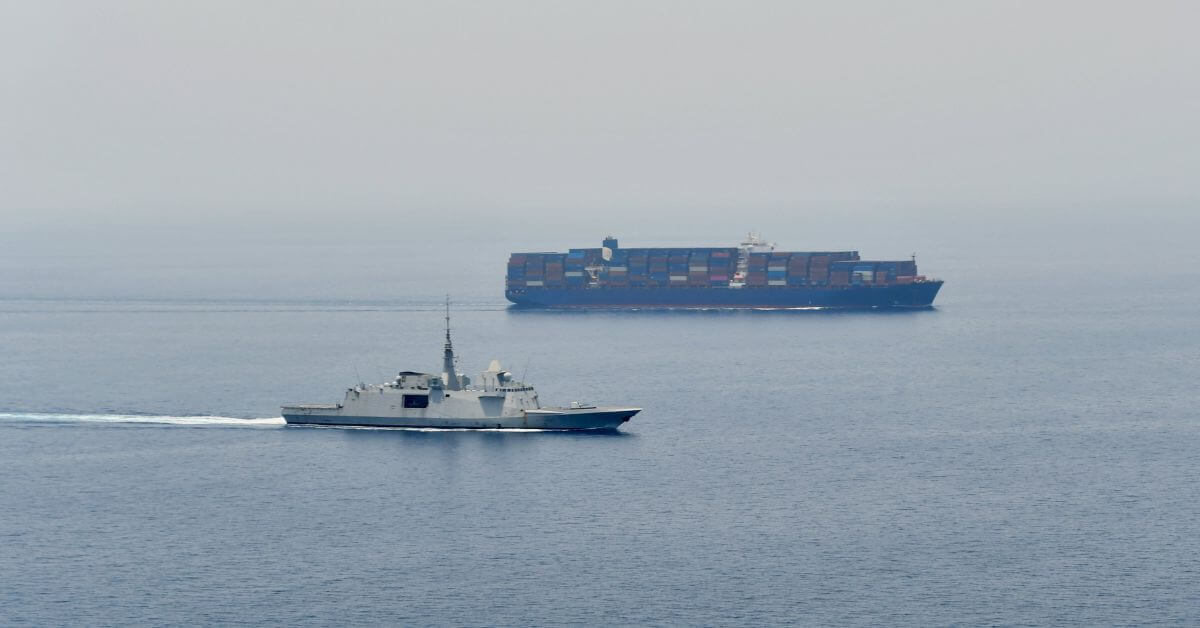
The European Union's stated need for more than ten warships to secure Red Sea shipping is not a dramatic overreaction; it is a calibrated acknowledgment of the operational reality now facing one of the world's most vital maritime corridors. When EU foreign policy chief Kaja Kallas puts a number on the table, she is moving the conversation from abstract concern to concrete force requirements. This is the kind of precision that maritime stakeholders should welcome, because it signals that the bloc is finally treating the threat to commercial traffic with the seriousness it demands. The question is no longer whether to respond, but whether the response is sized correctly to the risk.
The pressure on the Red Sea does not exist in isolation. It is part of a broader recalibration of maritime security and commercial strategy that we have been tracking closely. Consider the strain on other key routes: Gulf of Oman STS Transfers Max Out Amid Rising Saudi Oil Exports shows a system working at capacity, where every disruption has ripple effects. Meanwhile, Russia Calibrates Export Revenue for Northern Sea Route Icebreaker Fleet demonstrates how states are investing heavily in alternative trade lanes, and Russian Maritime Activity Raises Concerns of Drone Operations in Mediterranean underscores the widening range of asymmetric threats facing commercial vessels. These are not separate stories; they are data points in a single, integrated picture of a global shipping network under sustained, multi-front pressure. Our take is that this is the new baseline, not a temporary spike in risk.
For our readers, the practical implication is clear: the era of relying on a handful of frigates or a single coalition task force to keep sea lanes open is over. A force of more than ten warships is not just about numbers; it is about endurance, coverage, and the ability to escort convoys through a high-threat zone while also conducting surveillance and interdiction. We would tell any shipping operator or insurer watching this that the math has changed. Underestimating the required naval footprint risks leaving commercial traffic exposed, and overestimating the stability of the region is a miscalculation with cascading consequences for global supply chains. The EU's calibration is a useful benchmark for what credible deterrence looks like in this environment.
The specific number matters less than the principle it establishes: security in the Red Sea must be empirically assessed, not optimistically assumed. We will be watching whether the EU follows through with the force generation, or whether this remains a statement of intent. The concrete point to monitor is the timeline for deployment. If the bloc cannot deliver on this calibrated number, the signal to both the shipping industry and the threat actors is that diplomatic calculation has not yet translated into maritime reality. For now, the takeaway is straightforward: expect naval presence to become a more prominent factor in shipping risk assessments, and plan accordingly, because the vessels are only part of the equation. The other part is the credible will to use them.