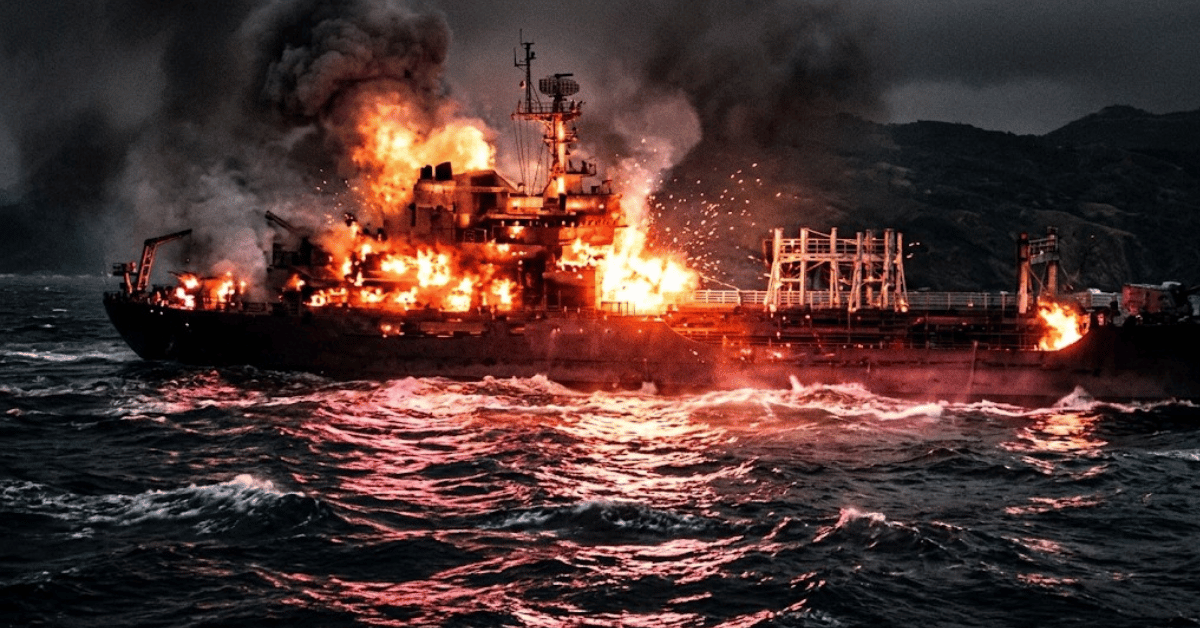
A chemical tanker was lost not to storm or collision but to a fire that began in a laundry room. This is not a freak accident; it is a predictable failure of risk management, and one that should command the attention of every operator and regulator in the maritime industry. The vessel's fire detection system did not activate, its firefighting capability was disabled by the very precautions taken to investigate the initial smoke, and the fire grew unchecked until the crew had no choice but to abandon ship. For our readers, whether researchers, policy analysts, or operational leaders, this incident offers a stark, empirical lesson in the gap between procedure and reality.
The sequence of events is well-documented. The officer on watch saw smoke from behind a light fitting and, as a precaution, stopped the generator and main engine. This is a standard response, but it removed the vessel's ability to run its fire pump. The emergency fire pump, located in the steering gear room, was inaccessible due to dense smoke. The fire alarm system never sounded. Smoke in the laundry room was only noticed because of a duct connection to the engine control room, a chance detection, not a designed one. By the time the crew could respond, the fire had already spread through the accommodation. This is not a case of equipment failure alone; it is a case of systems that were not integrated, not calibrated for the actual risks of the space. Compare this to the measured response described in our coverage of a Drifting Tanker With 11,000 Tonnes of Sunflower Oil Prompts Measured Response, where operational discipline prevented escalation. Here, the opposite occurred: a precaution removed capability, and a lack of detection removed time. The same industry that can manage a drifting tanker with precision can also lose a vessel to a laundry room.
The investigation points to an electrical fault in laundry machinery as the probable ignition source, but the real failure is in the assumptions made about that space. Laundry rooms are known fire hazards, heat, lint, combustible materials, yet this vessel had no dedicated smoke or heat detection in the laundry itself. The crew found the door hot to the touch before they even knew there was a fire. This is not a new problem. A historical policy surfaces, an enduring marker of maritime risk reminds us that risk documentation has long been a weak link in maritime safety. In this case, the policy may have existed on paper, but the practical integration of detection and firefighting capability was absent. The lesson is not that electrical faults happen, they do, but that the systems meant to catch them must be validated and calibrated for the spaces they protect. A functioning detection system is often the difference between early intervention and total loss. This vessel's system did not function, and the result was a total constructive loss.
What this means in practical terms is that every vessel operator should now audit their own laundry spaces with specific, measurable criteria. Is there a dedicated smoke or heat detector in the laundry room? Is it tested and linked to the main alarm system? Does the emergency fire pump have a secondary means of activation that does not depend on the main generator? These are not theoretical questions. They are the difference between a contained incident and a ship lost to explosions minutes after the crew abandons. The crew in this case survived, but the vessel was scrapped. The open question for the industry is whether this incident will prompt a fleet-wide review of detection coverage in auxiliary spaces, or whether it will be filed as an isolated event until the next laundry room fire.