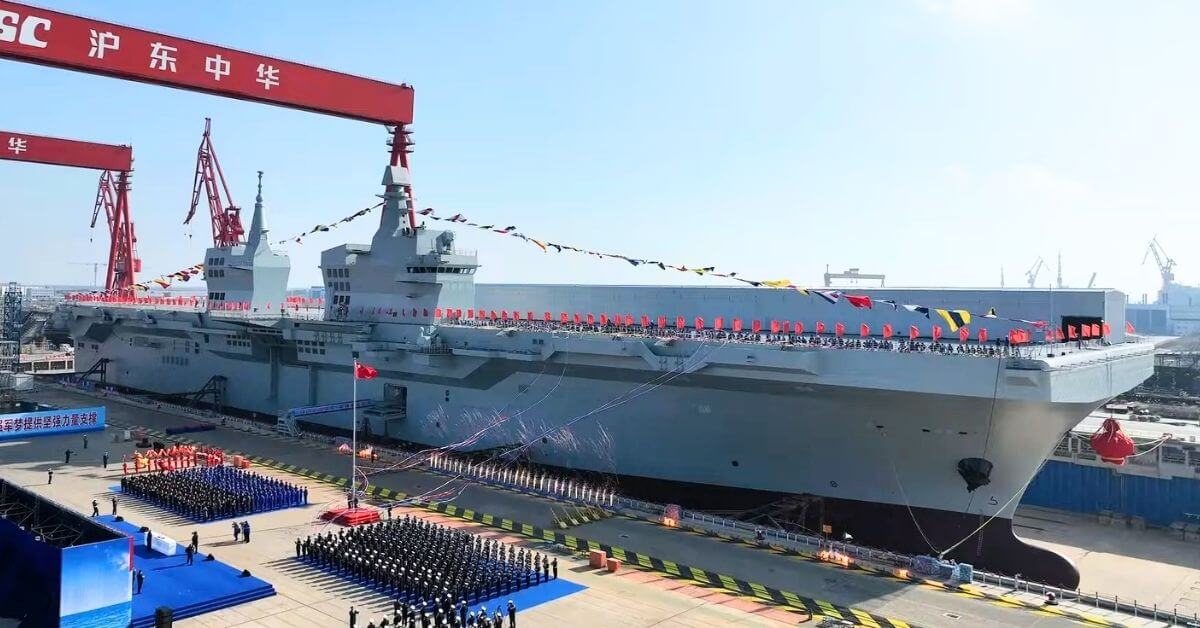
The Type 076's entry into final trials is not another incremental warship announcement; it is a confirmation that the electromagnetic launch systems long associated with next-generation carriers have been scaled and validated for a 40,000-ton drone platform. The ability to launch fixed-wing GJ-21 stealth drones from a vessel of this size changes the operational calculus in the Indo-Pacific. For those of us tracking maritime power, the takeaway is straightforward: the barrier to distributed, carrier-capable drone operations has just been lowered, and the strategic implications are measurable in range, persistence, and cost per strike.
This development does not exist in a vacuum, and readers should connect it to the broader trend of navies re-evaluating their capital ship programs. Just last month, Indonesia Launches First Aircraft Carrier, Signaling Naval Expansion demonstrated that even second-tier navies are acquiring legacy carrier hulls to project power. Meanwhile, the commercial sector is solving the fuel question that will power these fleets, as seen with the Ammonia Bunkering Milestone: Pioneering Sustainable Shipping Practices, which points toward a future where naval logistics are not tethered to traditional petroleum supply chains. The Type 076, however, is a different animal. It is not a repurposed flattop or a symbolic purchase; it is purpose-built to operate uncrewed combat aircraft from day one. That design choice signals that China is not simply matching the U.S. Navy's current carrier model but is leapfrogging ahead to a force structure where the pilot is the expendable part, and the sensor is the weapon.
What does this mean for our readers in practical terms? For defense analysts, the electromagnetic launch system is the critical variable to watch. A system that can reliably launch heavy fixed-wing drones from a smaller deck suggests that the engineering challenges around power generation and energy storage have been resolved to a degree that warrants fleet integration. For policymakers, the question shifts from whether China can field a drone carrier to how they intend to use it in a contested environment. The GJ-21's reappearance alongside the ship is not coincidental; it is a pairing designed to signal a coherent capability, not just a hull in the water. We should treat this as a data point in a longer time series, not a singular event.
Our honest take is that the West has been slow to grasp the operational depth of this shift. The related Navy Personnel Face Justice for Fentanyl Distribution Aboard Aircraft Carrier story reminds us that even the U.S. Navy's existing carrier force is struggling with human capital and discipline issues, which are unlikely to be solved by adding more crew to the deck. The Type 076's design implicitly reduces that human friction. The specific detail to watch is the launch cadence. If the electromagnetic system can sustain a sortie rate comparable to a conventional catapult, then the strategic geography of the Pacific changes overnight. That is the number to track in the coming months, because it will tell us whether this is a demonstrator or a doctrine.